
Facing Climate Crisis and Global Turmoil, Ministry of Agriculture and Commission IV Strengthen Food Security
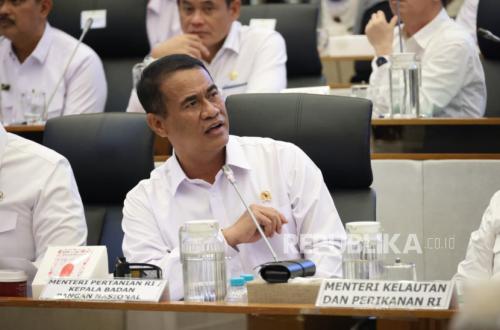
The Ministry of Agriculture, together with Commission IV of the DPR RI, is strengthening synergies to maintain national food security amid global dynamics, energy crises, and the impacts of climate change. These efforts aim to ensure the availability of food remains safe, stable, and sustainable for Indonesian society.
Minister of Agriculture Andi Amran Sulaiman stated that Indonesia has successfully demonstrated positive performance in the food sector through achieving self-sufficiency in a relatively short time. This is the result of the President’s directives, support from Commission IV of the DPR RI, and the hard work of farmers across Indonesia.
“Through the President’s directives, support from Commission IV, and the hard work of all farmers, Indonesia has successfully achieved food self-sufficiency in one year. Rice production has increased by 4.07 million tons according to BPS data, or 13.29%,” said the Minister of Agriculture at the Working Meeting of Commission IV of the DPR RI on Tuesday (7/4/2026).
He added that the National Rice Reserves (CBN) as of the morning of 7 April 2026 reached 4.6 million tons, the highest in history. With this achievement, the national rice stock is ensured to be safe to meet needs for the next 10-11 months, even with potential global supply chain disruptions due to conflicts in the Middle East and predictions of El Niño in the next six months.
In addition to rice, the availability of other strategic foods such as shallots, garlic, chillies, beef/buffalo/chicken meat, chicken eggs, and granulated sugar is also sufficient.
Strategic Steps Instructions to All Governors
In facing the impacts of climate change, particularly the potential for drought during this year’s dry season, the Ministry of Agriculture has instructed strategic steps to all governors since 9 March 2026.
These steps include mapping drought-prone areas based on an early warning system, optimising water management through rehabilitation of irrigation networks, construction of retention basins, and utilisation of pump irrigation and piping.
In addition, accelerating planting, using drought-resistant varieties, adjusting planting patterns, and strengthening coordination between local governments and stakeholders are also key focuses.
On the production side, the Ministry of Agriculture continues to promote priority programmes to support sustainable food self-sufficiency, including land clearing and optimisation, water and irrigation management, land conservation and rehabilitation, construction of farm roads, provision of superior seeds, agricultural tools and machines (alsintan), subsidised fertiliser, and strengthening extension services and farmer regeneration.
To support the implementation, the government has prepared alsintan on a massive scale. In the 2024-2025 period, 171,000 units of alsintan have been distributed, with a target of an additional 37,000 units in 2026. Meanwhile, the distribution of water infrastructure reached 94,000 units in the same period, with a target of an additional 21,000 units in 2026.
To anticipate rising food prices as an implication of rising fuel prices due to the global energy crisis, President Prabowo has instructed the optimisation of vegetable fuel (biofuel) sourced from palm oil, sugarcane, cassava, and corn.
“The Ministry of Agriculture has prepared an implementation plan for B-50. Insyaallah, this year Indonesia will not import 5.3 million tons of diesel. In the future, the government will also implement the construction of ethanol factories with raw materials from cassava, sugarcane, and corn,” said Amran.