
Extinguishing Peat Fires from the Ground Up
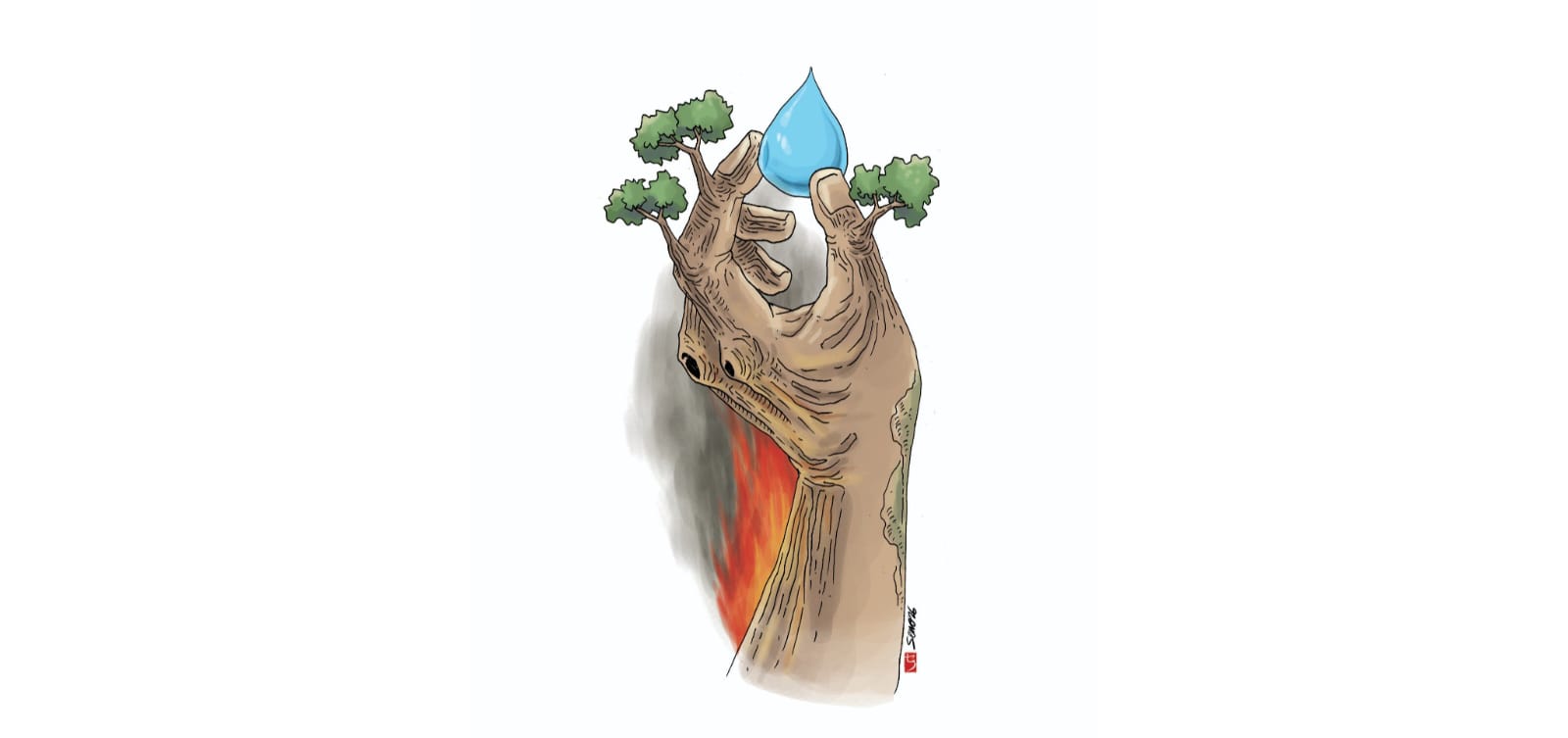
The rescue of Kalimantan’s peatlands will never succeed if we continue to be trapped in the delusion of romanticising local residents as seasonal ‘Superman’ emergency firefighters. The key lies in restoring the sovereignty of residents at the ground level to become daily water stewards who maintain the peat dome as a common resource through an equal tripartite collaboration with BRIN and local district governments.
Macro-theoretical reviews have clearly detected the root cause of forest and land fires (karhutla) at a structural level, namely the harsh clash between global supply chain globalisation and national spatial regulations; therefore, it is now time to radically shift our analytical compass. The question is no longer ‘why does this happen’, but rather ‘how can we concretely extinguish the fuse of that fire at the ground level?’.
We will not find true answers in the roar of expensive water-bombing helicopter propellers, or rigid, centralised command instructions at a time when smoke has already choked the breathing of children in West Kalimantan, spreading as far as Sarawak. A permanent solution to forest fires demands a radical transformation in environmental governance, repositioning the wet peat dome ecosystem as a common-pool resource that is worthy of collective management.
PEAT DOMES
Peatlands possess unique hydrological characteristics that cannot be partitioned by administrative boundaries or corporate concessions. The water characteristics in a peat dome are integrated; drainage through artificial canals by a single business permit holder in one concession will automatically drain groundwater across the entire dome expanse, including the managed areas of surrounding indigenous communities.
This is where Elinor Ostrom’s (1990) theory on governing the commons finds its tactical relevance. Ostrom proved that the failure to manage shared resources is often triggered by two erroneous extremes: unilateral surrender through massive corporate privatisation or state control that is too distant from ground realities. The peat dome is an ecological ‘commons’ that can only be saved if its hydrological management rights are returned to local collective institutions that merge physical ecological boundaries with the social institutions of the local community.
To operationalise Ostrom’s ideas in the field, peat restoration should be placed within a balanced tripartite collaboration structure consisting of a science bridge, legal facilitation, and local community sovereignty. The first pillar is the science-technology bridge led by the National Research and Innovation Agency (BRIN).
The role of this state research institution is not merely to present post-disaster spatial maps, but also to provide appropriate technology for peat rewetting. BRIN is tasked with designing smart canal blocking and productive peat reservoirs capable of maintaining water levels during the dry season without flooding residential areas. This applied research should be aligned with bioeconomy programmes based on wetlands (paludiculture), such as inland swamp fishery cultivation. Through this approach, President Prabowo Subianto’s tactical direction to integrate forest fire mitigation with rural food security and green economic downstreaming can be realised simultaneously.
The second pillar is legal legitimacy and decentralisation facilitation by district governments. District governments must act as a protective fortress for local initiatives to break the tyranny of rigid, sectoral central policies. The strategic role of district governments is realised through the issuance of local regulations (perda) for ground-based peat control.
These local regulations should not merely contain burning prohibitions, but also serve as firm legal instruments to audit overlapping industrial concession permits, prohibit the opening of new drainage canals by corporations, and ensure tenure certainty for social forestry for indigenous communities. Without a legal umbrella from district governments that sides with the community, citizens’ ecological protection initiatives will always be vulnerable to being displaced by large-scale capital expansion.
The third pillar, and the very heart of the defence for this commons governance model, is the sovereignty of local communities at the lowest level, specifically the Fire Care Communities (MPA) and the Dayak indigenous peoples. Referring to Ostrom’s design principles, effective resource management rules must be overseen by actors who interact directly with nature every day.
MPA members should no longer be treated pejoratively as emergency firefighters (‘seasonal Supermen’) who are only called when the fire is already raging. Their role should be reconstructed into daily water stewards. They are the ones who design customary agreements to regulate water distribution, monitor the moisture levels of the peat dome soil, maintain the function of village canal blocks, and enforce customary social sanctions against those who disrupt the shared water balance.
STRUCTURAL SOLUTIONS
Through this tripartite synergy (BRIN providing science, district governments providing the legal umbrella, and MPA leading daily maintenance), we are moving beyond the classic dichotomy that separates human culture from nature. This synergy also proves that protecting the peat ecosystem does not have to stifle the economic pulse of the people.
By utilising canal block reservoirs resulting from BRIN’s research for local swamp fishery cultivation, communities gain real economic incentives to keep their land wet and hydrated throughout the year. Wet peatland means sustainable fish harvests, whereas burnt peat means the permanent destruction of their economic future and living space.
Ultimately, the true structural solution to forest fires does not lie in the sophistication of aerial firefighting technology or the deployment of thousands of fully armed personnel amidst the haze.