
Exports to Australia Reach Rp7 Trillion, Domestic Fertiliser Prices Drop 20%
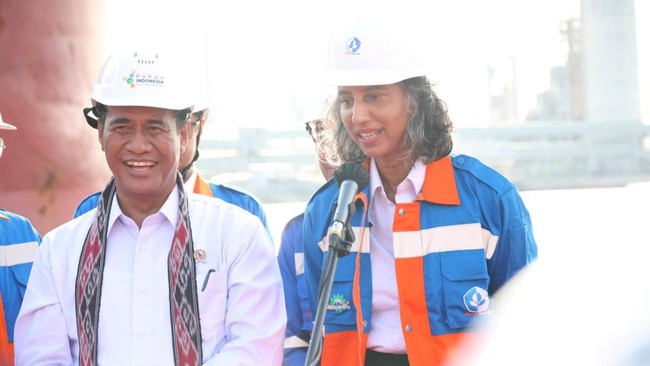
Minister of Agriculture, Andi Amran Sulaiman, stated that Indonesia has recorded a new milestone in the transformation of the national fertiliser industry through the export of urea fertiliser to Australia, valued at around Rp7 trillion. At the same time, the government has successfully reduced the price of subsidised fertiliser by 20% and increased the volume of fertiliser for national farmers, marking the strengthening of the fertiliser sector from upstream to downstream.
Amran explained that the inaugural export released on Wednesday (13/5) amounted to 47,250 tonnes of urea fertiliser worth around Rp600 billion. This export represents the initial phase of a cooperation commitment of 250,000 tonnes and will continue to be increased to 500,000 tonnes with a total value of around Rp7 trillion.
“Our plan is to export 250,000 tonnes to Australia and then increase it to 500,000 tonnes,” he said, quoted on Thursday (14/5/2026).
At the same time, Amran said that the government has also recorded progress in the domestic fertiliser sector through President Prabowo Subianto’s policy, which reduces the price of subsidised fertiliser by 20% without additional burden on the state budget. This policy is also accompanied by an addition of 700,000 tonnes of subsidised fertiliser to expand farmers’ access.
“Amid the heating global geopolitics, Indonesia, alhamdulillah, has reduced fertiliser prices by 20%. Subsidised fertiliser for Indonesian farmers. Then the volume of fertiliser increases. This is the happiness of 160 million Indonesian farmers and 115 million rice farmers,” said Amran.
He stated that this success demonstrates the increasing competitiveness of the national fertiliser industry and opens up new market opportunities in various countries.
“Once again, on behalf of the government, we thank Pupuk Indonesia for their hard work and achievements,” said Amran.
According to him, several other countries are also beginning to show interest in Indonesian fertiliser.
“In addition, the Indian Ambassador has directly contacted me requesting 500,000 tonnes, and several other countries are interested, namely the Philippines, Brazil, Bangladesh, and some other countries. Earlier, we received reports of countries interested in urea fertiliser from Indonesia. This is what we are grateful for and proud of,” he revealed.
Deputy Ambassador of Australia to Indonesia, Gita Kamath, expressed appreciation for the cooperation that has been established between Indonesia and Australia.
“On behalf of the Australian Government, I would like to express our deepest thanks to Minister Amran. Australia values its relationship with Indonesia. This cooperation reflects the strong friendship and partnership between Australia and Indonesia, not only with PT Pupuk Indonesia,” said Gita.
She added that this cooperation also has direct benefits for strengthening food security in both countries.
“Australia is also proud to support food security and value addition in Indonesia. This fertiliser will help Australian farmers produce commodities like wheat used in Indonesia to make various food products. This is a real example of Indonesia-Australia cooperation that produces mutual benefits,” she said.
This success, continued Amran, is inseparable from various strategic policies of President Prabowo Subianto in overhauling the national fertiliser governance from upstream to downstream.
At the beginning of the administration, Prabowo took a major step by restoring the allocation of subsidised fertiliser from the previous around 4.55 million tonnes to 9.55 million tonnes to support accelerating national food self-sufficiency. This policy expands the reach of beneficiaries to around 160 million people directly involved in the agricultural sector.
The government also carried out total deregulation of 145 regulations across ministries and institutions to accelerate fertiliser distribution. The distribution system was simplified through a direct pattern from the Ministry of Agriculture-PIHC-Farmer Groups/Cooperative-Farmers so that fertiliser reaches farmers faster.
In addition, the government reformed the national fertiliser subsidy mechanism by eliminating various inefficient components such as raw material profits, bank interest burdens, and multiple VAT. This reform is projected to save up to Rp14 trillion while lowering the national fertiliser production costs.
Besides governance improvements, the government is pushing for a massive revitalisation of the national fertiliser industry through seven strategic projects with a total investment of Rp72.84 trillion. This revitalisation involves PT Pupuk Indonesia (Persero), PT Pupuk Sriwidjaja Palembang, PT Pupuk Kalimantan Timur, PT Petrokimia Gresik, and PT Pupuk Kujang.
Modernisation is carried out by replacing old energy-intensive factories with new, more efficient facilities. The new fertiliser production cost efficiency is recorded at 26% lower compared to the old factories.
Through subsidy scheme reforms and industry revitalisation, the government projects savings in fertiliser subsidies of up to Rp112 trillion by 2035 while curbing potential waste of Rp14.4 trillion per year.
Amran emphasised that all fertiliser sector improvements are directed towards strengthening food self-sufficiency, improving farmer welfare, reducing imports, and building national fertiliser industry independence.
“Fertiliser is not just about production and distribution. Fertiliser is a strategic instrument towards national food sovereignty,” he stressed.
Source: jawawa.id (https://jawawa.id/newsitem/exports-to-australia-reach-rp7-trillion-domestic-fertiliser-prices-drop-20-1778781538)
Originally published by CNBC Indonesia (https://www.cnbcindonesia.com/news/20260514191209-4-735000/ekspor-ke-australia-tembus-rp-7-t-harga-pupuk-dalam-negeri-turun-20), translated from Indonesian