
Exports of Nickel Downstream Products Rise to US$39.2 Billion
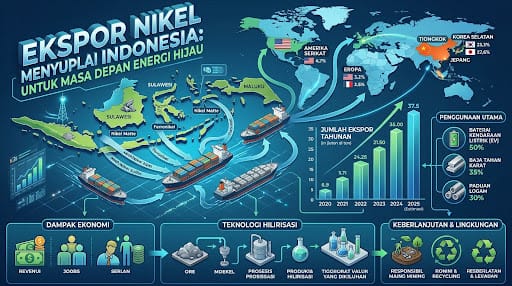
NIKEL.CO.ID, JAKARTA — The annual value of Indonesia’s exports of downstream nickel products has increased almost fivefold in six years. Figures presented by the Ministry of Investment and Downstreaming/BKPM show that exports rose from US$8.1 billion in 2019 to US$39.2 billion in 2025.
Rizwan Aryadi Ramdan, Director of Mineral and Coal Downstream Industries at the ministry, said the increase reflected the development of Indonesia’s nickel-processing industry, particularly in the stainless-steel value chain and electric-vehicle battery ecosystem.
“Indonesia’s nickel downstreaming policy has delivered significant results. Export value has risen more than fourfold, from US$8.1 billion in 2019 to US$39.2 billion last year,” Rizwan said.
He was speaking at the 5th Nickel Producers, Processors and Buyers Conference, organised by Petromindo at the Shangri-La Hotel in Jakarta on Wednesday, 4 November 2026.
Rizwan said export growth was inseparable from the expansion of the nickel industry’s value chain. The industry is no longer confined to extraction and the processing of raw materials, but is beginning to move towards higher-value-added production.
“This growth reflects the expansion of the stainless-steel value chain and the rapid development of the electric-vehicle battery ecosystem,” he said.
Rizwan explained that, for decades, many developing countries with mineral resources had participated in global value chains only at the extraction stage. Minerals were exported, while most value creation took place in other countries.
Indonesia is seeking to change that pattern through its downstreaming policy, promoting industrial development from resource processing through to the manufacture of value-added products.
He stressed that the next phase of nickel downstreaming would be determined not only by the scale of investment, but also by its quality, the depth of industrial integration and the ability to generate sustainable value for global markets.
“The next stage of Indonesia’s nickel downstreaming journey will be determined not only by the size of investment, but also by its quality,” he said.
For the next phase of development, the government is encouraging the industry to expand into electric-vehicle battery production, battery energy storage systems (BESS) and other high-value-added manufacturing.
Rizwan said Indonesia had launched an integrated electric-vehicle and battery ecosystem in West Java. The government has also begun a 100-gigawatt-peak solar power initiative, which is expected to create a market for battery energy storage systems.
These developments are intended to strengthen industrial integration, promote the use of technology, improve productivity and enhance the competitiveness of Indonesian downstream products in international markets.
Indonesia is also developing an integrated electric-vehicle ecosystem spanning nickel mining and refining, battery materials and cells, electric vehicles, charging infrastructure and recycling.
“The government also recognises that building processing facilities is not the ultimate goal of downstream industry. Our long-term ambition is to develop an industrial ecosystem that can compete internationally and produce higher-value-added products,” Rizwan said.
He added that the government had drawn up a national downstreaming roadmap covering 28 strategic commodities. The roadmap has investment potential of US$618 billion through to 2040, with minerals and coal accounting for about 81 per cent of the total.
Overall, the roadmap is projected to support export growth and create more than three million jobs by 2040.
Rizwan said the government wanted to ensure that downstreaming generated long-term economic benefits not only for investors, but also for communities around industrial areas.
For this reason, deeper industrial value chains need to go hand in hand with responsible investment, skills development, research and innovation, and the growth of domestic suppliers.
“Throughout these activities, we encourage companies to invest not only in physical facilities, but also in human resources, research and innovation capabilities, and the development of domestic suppliers,” he said. By developing an increasingly integrated value chain, the government hopes Indonesia’s nickel industry can expand markets for downstream products while strengthening its position in global supply chains.
Source: jawawa.id (https://jawawa.id/newsitem/exports-of-nickel-downstream-products-rise-to-us-39-2-billion-1793872227)
Originally published by nikel.co.id (https://nikel.co.id/2026/11/05/ekspor-produk-hilirisasi-nikel-naik-meningkat-jadi-us392-miliar/), translated from Indonesian