
Exploring the World-Class Ecotourism of Tanjung Puting
On this morning, hundreds of people crowded the Kumai Pier in Pangkalan Bun, Central Kalimantan, which serves as the starting point for exploring Tanjung Puting National Park. These visitors include local residents, domestic tourists, and many international tourists from various countries.
They are divided into several tour groups managed by agencies through both open-trip and private-trip packages. Domestic tourists generally opt for one-day open-trip packages due to time considerations and more economical costs compared to private trips.
After attending briefings regarding procedures and regulations for visiting Tanjung Puting National Park, tourists are transported via motorboats or water buses sailing along the Sekonyer River towards the orangutan conservation centre. There are approximately 170 motorboats (klotok) serving tourism in Tanjung Puting National Park.
Some boats are designed more like floating hotels, featuring complete facilities such as beds, lounging areas, sofas, and dedicated dining rooms. This type of vessel is commonly used by tourists for overnight packages within the Tanjung Puting National Park area for several days.
The water buses or tourist boats sail slowly in formation along the Sekonyer River, which features the characteristic reddish-black water of peat swamp areas. The left and right banks of the river are filled with typical swamp vegetation such as Nipah, Swamp Pandan, and mangroves with very dense canopies.
This river journey, spanning approximately 35 kilometres, takes about 4 hours and passes several orangutan conservation posts, including Tanjung Harapan, Pondok Tanggui, and Camp Leakey, which is the oldest conservation camp in the Tanjung Puting area. The Sekonyer Village, inhabited by indigenous communities living on the outskirts of the national park, is also passed, alongside several resorts along the riverbanks.
“Visits to Tanjung Puting National Park are always busy throughout the year, involving both domestic and international tourists. According to data, the number of tourists is expected to reach 30,000 throughout 2025. This demonstrates that Tanjung Puting, with its flagship orangutan conservation tourism, is a world-class destination,” said Roy, a travel agent from Red Monkey, affiliated with Borneo Top Holiday.
Orangutan Conservation
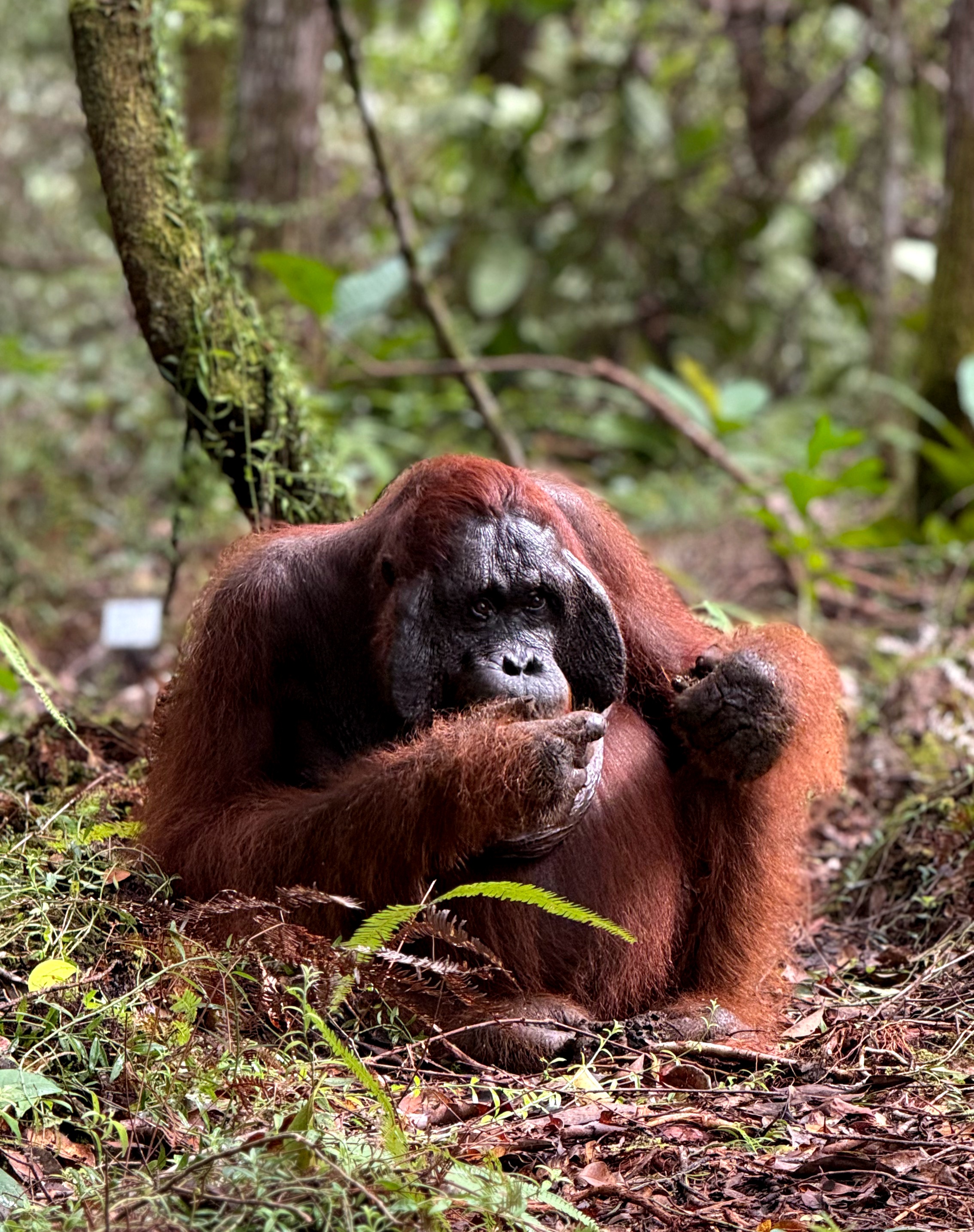
Tanjung Puting National Park is the first conservation area in Indonesia established to protect the Orangutan species (Pongo pygmaeus wurmbii). The park covers an area of 415,040 hectares, consisting of the Tanjung Puting Wildlife Sanctuary (300,040 ha), Production Forest (90,000 ha, formerly PT Hesubazah), and surrounding waters (approximately 25,000 hectares).
In addition to orangutans, Tanjung Puting National Park is home to key species such as the Proboscis monkey (Nasalis larvatus) and the Hawksbill sea turtle (Eretmochelys imbricata). The park represents the most important wetland area in Central Kalimantan, functioning as a water reservoir and maintaining the hydrological, biological, and ecological processes of the peat ecosystem and its biodiversity. Tanjung Puting National Park was also designated as a UNESCO Biosphere Reserve in 1977.
Although its habitat remains well-preserved and populations are quite high, reaching thousands of individuals, orangutans cannot be encountered every day at the conservation camps or feeding sites. “At certain times, orangutans do not come to the feeding locations and choose to forage in the forest during the forest fruit season,” explained Ami, a tour guide at Tanjung Puting National Park.
However, tourists can easily encounter troops of monkeys or proboscis monkeys swinging through the mangrove trees along the Sekonyer River. At night, the banks of the Sekonyer River are crowded with tourist boats, mostly carrying foreign tourists, which choose to anchor and spend the night enjoying the exotic atmosphere of the mangrove forest before continuing their adventure in the national park the following day.
Hasni, a tourist from Makassar who travelled specifically to Tanjung Puting via sea routes, hopes that the government and the community can continue to preserve the orangutan habitat and the biodiversity that serves as the tourism icon of Kalimantan.