
Exploring the Great Wall of China, One of the Seven Wonders of the World
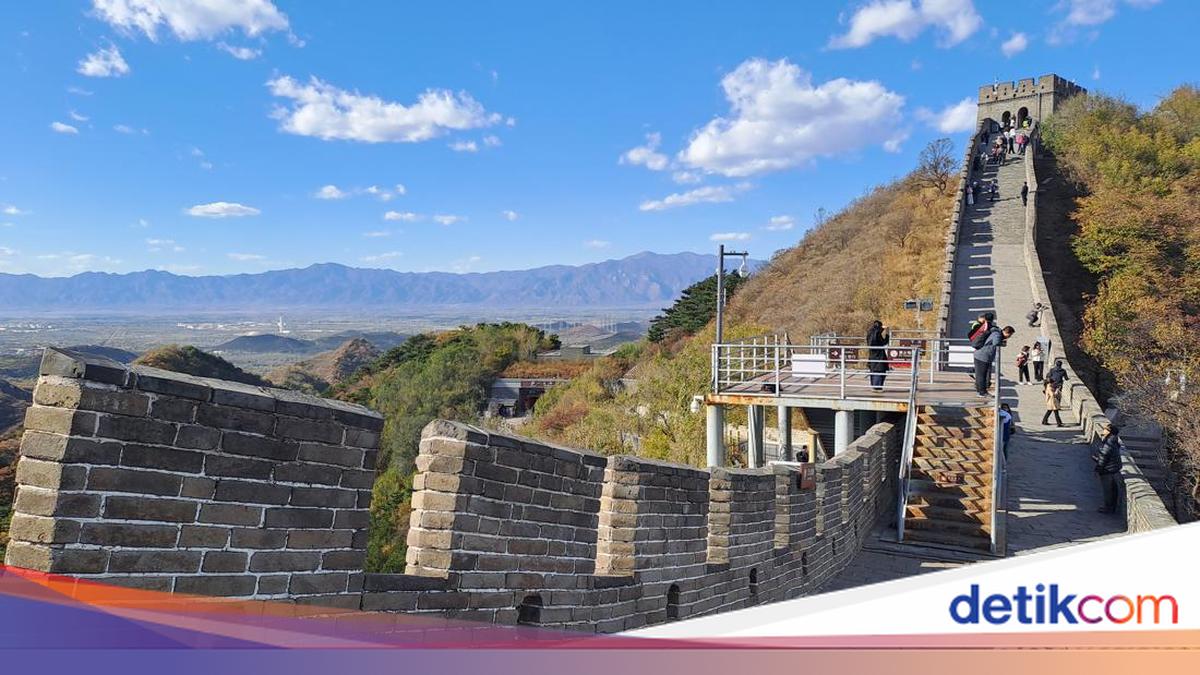
A visit to China would hardly be complete without exploring the Great Wall. One of the Seven Wonders of the World, it stretches from Shanhaiguan in the east to Jiayuguan in the west.
Detikcom visited the Great Wall of China on Tuesday (13 October 2026). The journey from central Beijing to Badaling, in Yanqing District, took about one hour and 10 minutes. The site is around 70 kilometres north-west of the city centre.
The route from central Beijing to Badaling offers views of the mountains, and passes through a number of tunnels.
At the entrance to Badaling, visitors can buy tickets for 40 yuan, or about Rp 90,000. International visitors need to have their passports ready when purchasing tickets.
Visitors can then climb the stairs or take an escalator towards the funicular station. After a roughly five-minute ride along the mountainside, they arrive at the first set of steps on the Badaling section of the wall.
The weather at the site this afternoon was partly cloudy and cool, tending towards cold, with a temperature of 16 degrees Celsius. As the Great Wall is in a mountainous area, the wind was quite strong.
The site was not particularly crowded. Visitors included tour groups and families.
Steps run along the mountain slopes, with several towers standing along the route.
Tourists could be seen taking photographs to capture the moment, while others simply walked along the Great Wall.
About the Great Wall of China
The Great Wall was designated a UNESCO World Heritage Site in 1987. According to the official Beijing municipal government website, construction took place in stages from the third century BC to the 17th century AD.
The wall stretches from Shanhaiguan in Hebei Province in the east to Jiayuguan in Gansu Province in the west. Its total length is more than 21,000 kilometres.
The most popular section is Badaling, north-west of Beijing, along a pass in the Jundu Mountains. The Badaling route branches out in several directions, which is why it is called Badaling — a name that literally means ‘reaching in all directions’.
The Badaling section lies on the northern ridge of Guangou Pass. Two mountain peaks face one another across the pass, making it a highly strategic position. Given its military importance, Badaling has served both as a battlefield and as a defensive stronghold.
During the Ming dynasty, the wall was rebuilt and developed into a more complex military defence system, rather than serving merely as a boundary wall. Its route crossed several areas, including Ningxia, Shaanxi, Shanxi and Hebei, and featured numerous defensive gates and shorter walls at strategic points.
From the Qing dynasty onwards, the Badaling section began to fall into disrepair. The defensive towers west of the city gate suffered severe damage. After the central government decided to carry out restoration work, Badaling has been repaired several times to preserve its historical and cultural heritage.
Other popular sections of the Great Wall visited by tourists include Mutianyu, Simatai, Jinshanling and Jiankou.