
Exploring the city's pulse through cubist symbols
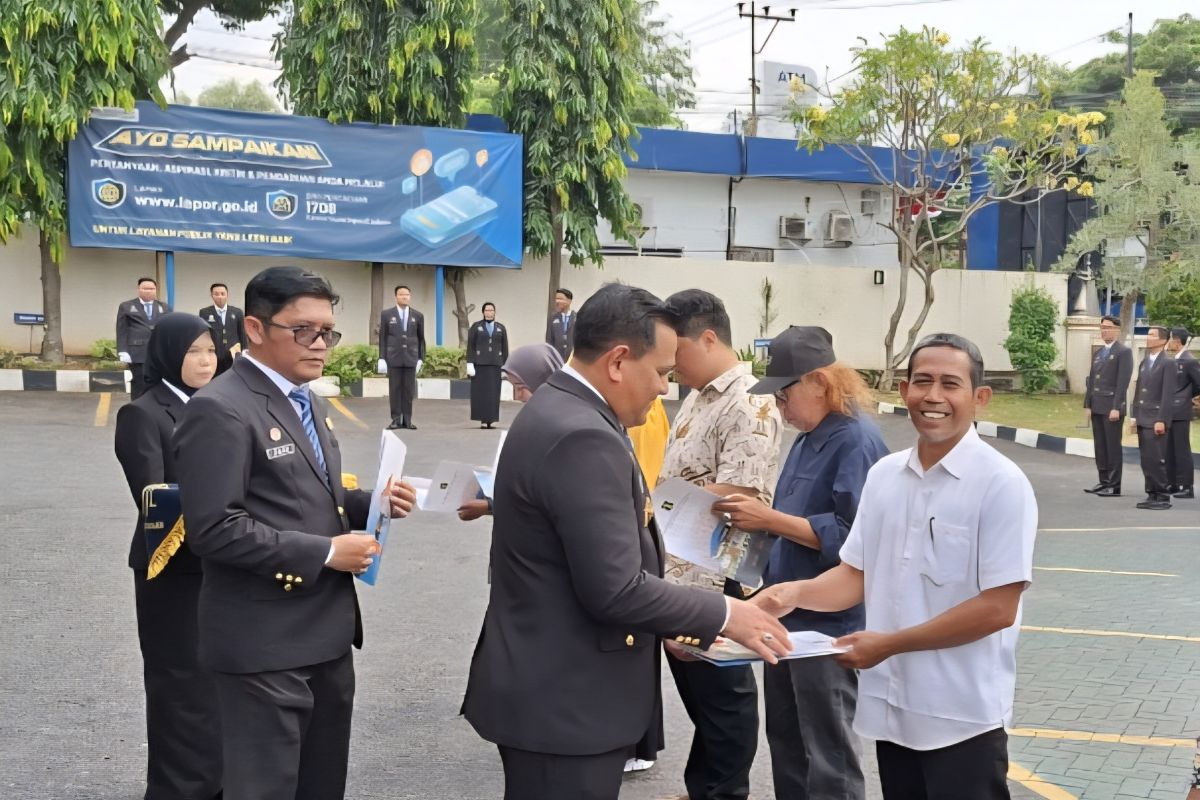
That morning, beaming smiles radiated from the faces of academics, creative economy practitioners, artists, cultural communities and members of the public who produce work in the visual arts, performing arts and literature.
They gathered not merely to socialise, but to receive official proof of their intellectual and creative output: a Copyright Registration Certificate from the Directorate General of Intellectual Property (DJKI) of the Indonesian Ministry of Law. The certificates were handed over directly by the Head of the Lampung Regional Office of the Ministry of Law, Taufiqurrahman, during the commemoration of Hari Pengayoman.
One of the recipients was Damsi Tarmizi, a Bandarlampung artist who has devoted 30 years to urban art, the practice of creating visual artworks in public urban spaces such as walls, streets and buildings.
Urban art grows and breathes from the pulse of city life, which is in constant, dynamic motion. Amid the roar of daily routine, public space becomes an open field of expression that brings visual art into direct contact with community life.
Through a blend of strokes, colours, forms, lines and the manipulation of symbols, urban art becomes a versatile visual language. It records a range of atmospheres, accumulated experiences and the distinctive character of urban areas that often escape attention.
For Damsi, the presence of urban art provides an inclusive space for bringing aesthetic ideas closer to the wider public.
Works are no longer confined exclusively behind gallery walls or in formal exhibition spaces, but instead appear on street corners, in urban passageways and across the various public spaces that form an inseparable part of residents’ daily activity.
Each work carries a story about the environment, identity, changing times and the social life unfolding around it.
The artistic process, which runs in step with the development of civilisation, becomes a moment to record that journey through creative work, departing from an imagination shaped by human experience and its surroundings.
The essence of life, which cannot be separated from three elements — God the Almighty Creator, the real world, and the living beings He created — becomes the source of imagination that is then realised in the work.
Source: jawawa.id (https://jawawa.id/newsitem/exploring-the-citys-pulse-through-cubist-symbols-1787269860)
Originally published by Antara (Indonesian) (https://www.antaranews.com/berita/5704400/menyelami-denyut-kota-lewat-simbol-kubisme), translated from Indonesian