
Exploring Remote Sulawesi: A Village Without Hunger and a Dream of Becoming Messi
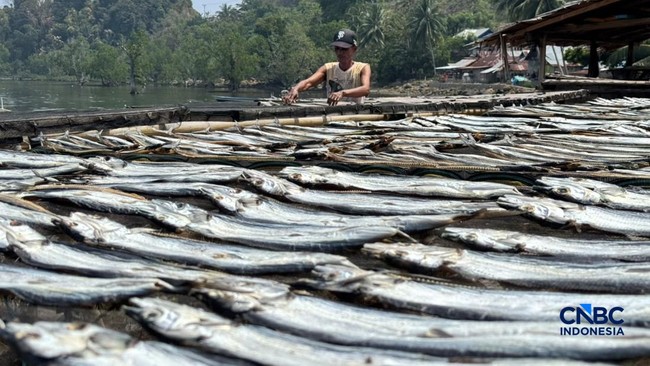
Jakarta, CNBC Indonesia — On the northern coast of Sulawesi, near the border between Central Sulawesi and Gorontalo provinces, lies a small village blessed with an abundance of ‘treasure’. Local residents say nobody goes hungry there.
Desa Harmoni is one of the fishing villages in Buol Regency, Central Sulawesi, and most of its residents work as fishers.
The village borders the Celebes Sea to the north and is backed by a range of hills to the south. Its upper reaches are fed by abundant natural springs, which also supply clean water to residents of neighbouring Desa Lunguto.
There is little information about Desa Harmoni online. Yet the village, with a population of 1,334, supplies much of the roa fish that is well known as far away as Java.
Although fishing is an ancestral tradition passed down through generations, many residents also farm. Fertile soil allows a range of food crops to grow in Desa Harmoni, including maize, rice, cocoa, cloves and coconuts.
“We’re not afraid of going hungry here. If we want food, we just take fish from the sea. If we want sambal, we can pick tomatoes and chillies from the garden. Bananas, maize and rice — we just have to plant them,” said Ahmad Djaru, 54, a fisher and farmer in Desa Harmoni.
The deep-voiced Ahmad could be described as an all-round entrepreneur. As well as fishing, he runs a roa fish-smoking facility and owns several types of plantation land in the village.
“I go out to sea every day, sometimes staying out for several nights. Out there, we look for ways to keep entertained. When the signal is good, we often livestream while catching fish,” Ahmad said.
Livestreaming on social media is one way Ahmad showcases Buol’s marine resources and reaches potential new buyers. Facebook Live is his main platform, although other fishers often choose TikTok Live.
Using digital platforms for promotion is one direct benefit of internet access, which came to Desa Harmoni in 2022 with the installation of a 4G base transceiver station (BTS) by BAKTI, part of the Ministry of Communication and Digital Affairs (Komdigi).
The lives of local fishers have changed significantly since they gained access to the digital world. The internet allows them to monitor the weather and identify coordinates in real time while at sea, as well as making transactions and communication with buyers easier.
From relying on instinct to checking a phone screen
Before the internet arrived, Ahmad could only estimate the tides by keeping track of the date and observing the moon. Anton, 56, a fishing-boat owner who had just returned after 12 hours battling the waves, described a similar experience.
“In the past, we relied entirely on instinct and feelings. During the rough-wave season, we could sometimes get lost. Now it’s safer, although the signal still drops out at sea,” he said.
Anton brought ashore one tonne of skipjack and scad. His crew, who had travelled as far as 40 kilometres offshore with him, took turns carrying the fish from the boat to the beach.
Two pick-up trucks from Gorontalo were already waiting to collect the catch from Anton’s boat. “We’ve been keeping in touch by phone since we were still at sea, so the buyers were already there when the fish arrived,” Anton said.
The convenience Anton now enjoys contrasts with the period before internet access. Fishers in Desa Harmoni once had to wait patiently for buyers to arrive. The uncertainty often forced them to sell their fish at very low prices.
If no one came to collect the fish for more than two days, they sometimes had to bury it on the seabed. Desa Harmoni still lacks large-scale refrigeration facilities to store catches for an extended period.
Fishers rely on ice brought from Gorontalo to keep their catch fresh until buyers take it. “The fish here has to be sold quickly once it’s caught. That means we can’t really set the price,” Anton said.
When the catch is relatively large — for example, three tonnes — the price is set at Rp10,000 per kilogram. If the catch is smaller, such as only 500kg, the price can rise to Rp13,000 per kilogram.
Anton uses his earnings from the sea to cover his family’s daily needs and has been able to send all three of his children to university.
Livestreaming from the middle of the sea
Anton sets aside around Rp500,000 each month for phone credit and internet data. Most of it is used to contact buyers, check weather information from the Meteorology, Climatology and Geophysics Agency (BMKG), and learn about new fishing methods on YouTube.
“I like watching tutorials on YouTube. I learned how to check coordinates there, for example,” he said.
His crew are even more adept with technology. Anton said the members of his crew were skilled at using social media to show off their catch through TikTok Live while at sea. He welcomed the initiative, which also helps promote his catch.
“The younger crew members usually go live on TikTok as soon as they’ve caught fish out at sea. They help promote the catch, so more people find out about it,” Anton said.
Anton usually takes 15 to 20 crew members on each trip to help catch and unload the fish. When the catch sells well, the crew benefit directly.
Net income is calculated by deducting fishing costs from sales revenue, then dividing the remainder equally among three parties: the boat owner and operator, the owner of the fish-aggregating device, and the crew.
A fishing trip costs an average of Rp2 million, including fuel. Assuming a one-tonne catch sells for Rp10,000 per kilogram, gross revenue is Rp10 million. After operating costs, the remaining Rp8 million is divided equally among the three parties.
“There’s no rental or wage system here; we share the income equally,” Anton said.
Meeting Messi on the internet
Fishers are not the only ones benefiting from internet access in Desa Harmoni. Nafa, a Year 6 pupil at SDN 7 Paleleh Barat, can see a wider world through her phone screen.
Nafa speaks enthusiastically about her love of football. When she grows up, she hopes to become a great footballer like Lionel Messi.
Every afternoon after school, Nafa regularly plays football on the pitch in front of her school, not far from home. Desa Harmoni village head La Ode Desi often sees her playing with her friends.
“She’s the only girl playing with the boys, but she’s just as good,” Desi said.
Nafa said she was inspired by Messi, whom she ‘met’ through her phone screen. She studies his tricks by watching matches streamed online, and is always interested in the latest news and information about him.
Despite her passion for football, Nafa has not neglected her academic studies. She has been top of her class every year from Year 1 through Year 6.
Teaching at SDN 7 Paleleh Barat is gradually incorporating digital resources. Teachers often use government-provided smart screens to access high-quality learning materials from around the world.
Nafa also enjoys exploring school subjects with the help of Doula AI. “I usually look up maths formulas on Doula AI,” she said.
Providing internet access for education is one of BAKTI Komdigi’s priorities. By 2025, BAKTI Komdigi had provided 188 internet access points in Buol Regency, most of them for education, alongside facilities for government and healthcare services.
The path to full coverage remains long. In Buol Regency, 12 hamlets and villages are still classified as blank spots, meaning they have no internet signal. They are spread across Biau, Karamat, Bukal, Momunu, Tiloan and Paleleh Barat districts.
The 4G BTS infrastructure and internet access assistance are part of BAKTI Komdigi’s efforts to extend connectivity to remote parts of the country. As coverage expands, information gaps can be reduced, giving communities more equal opportunities in economic activity, education, healthcare and public services.
Source: jawawa.id (https://jawawa.id/newsitem/exploring-remote-sulawesi-a-village-without-hunger-and-a-dream-of-becoming-messi-1793958645)
Originally published by CNBC Indonesia (https://www.cnbcindonesia.com/research/20261029182646-128-780723/jelajahi-pelosok-sulawesi-desa-tanpa-kelaparan-mimpi-jadi-messi), translated from Indonesian