
Explanation Provided for Why Anak Krakatau's Boom Could Be Heard as Far as Bandung
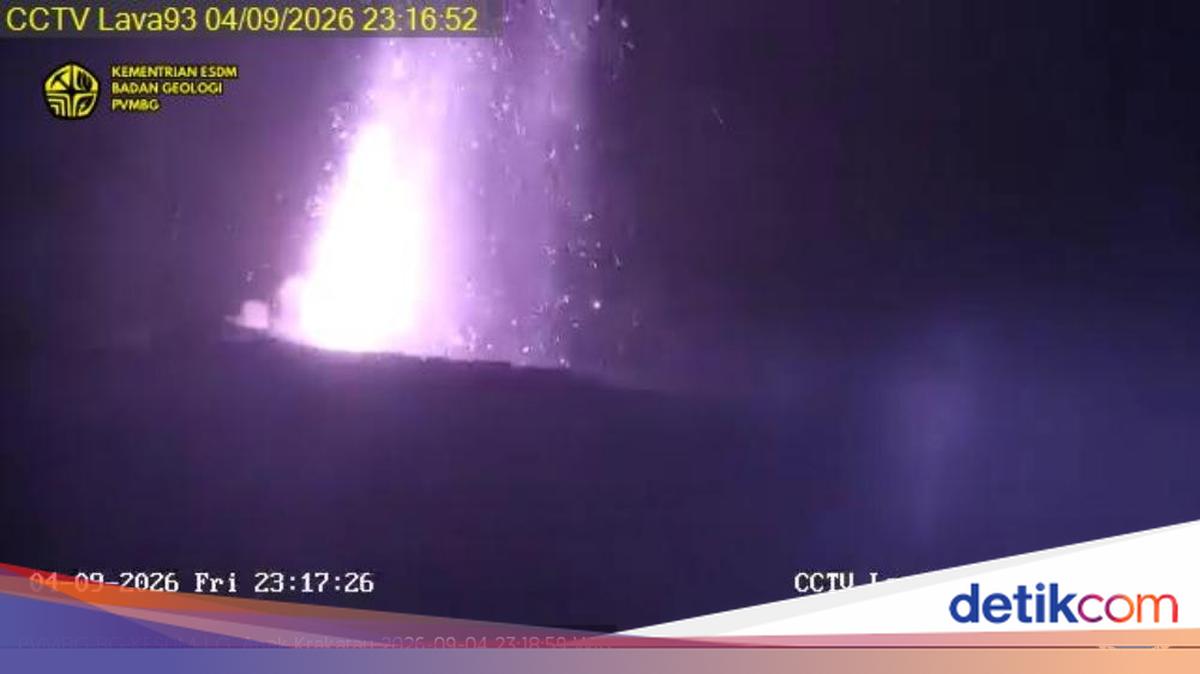
The Head of the Centre for Volcanology and Geological Disaster Mitigation (PVMBG) of the Ministry of Energy and Mineral Resources, Rita Susilawati, has explained the reason why the sound of a boom, suspected to be related to the eruption of Mount Anak Krakatau, could be heard as far as Bandung, West Java. According to her, acoustic energy from an eruption can propagate for hundreds of kilometres.
“From our observations, not only for Anak Krakatau but also for several other volcanoes in Indonesia, when a large eruption occurs—or not just large eruptions, but eruptions of a certain type, because phreatic types are usually accompanied by loud booms,” said Rita during a press conference via the Geological Agency’s YouTube channel on Saturday (5/9/2026).
“When this happens, the release of acoustic energy can be very large, and it is this acoustic energy that can propagate for hundreds of kilometres,” she added.
Rita stated that the long-distance propagation of eruption sounds is not an impossible phenomenon. She cited the explosive eruption of Mount Kelud on 13 February 2014 as an example.
“We can look at the explosive eruption of Mount Kelud on 13 February 2014; the sound of the boom could be heard in several areas of Central Java, far from the source of the eruption. The eruption at Mount Kelud at that time had a column of 17 kilometres, thus releasing very large acoustic energy,” she explained.
Therefore, according to her, based on monitoring data, the sound of the boom can be heard from a great distance. However, she could not yet confirm the exact cause of the boom, though she suspects it originated from an eruption of Mount Anak Krakatau.
“Regarding the cause, as we mentioned, we suspect the sound was related to the eruption of Anak Krakatau that occurred last night; there is a strong suspicion that it is indeed related to the Anak Krakatau volcano,” she said.
She noted that her agency still needs to cross-reference data to confirm the cause of the vibrations and the boom. She reiterated that it is not impossible for the sound of a boom to be heard from a great distance.
“It is indeed possible for it to reach hundreds of kilometres based on the information and literature we possess, and based on the eruption history of several volcanoes in Indonesia. Including Mount Kelud, the sound could propagate as far as Yogyakarta and several areas in Central Java,” she explained.
Furthermore, Rita explained that atmospheric conditions, such as temperature differences, wind direction, and wind speed, can affect sound propagation. However, she noted that further explanation would be required from relevant meteorological institutions.
“Considering the 2020 Anak Krakatau event and the 2014 Kelud eruption, we suspect that the eruption of Mount Anak Krakatau is one of the possible sources of the boom heard in several areas of West Java on 4-5 September 2026,” she explained.
“Literature states that differences in temperature and wind speed can indeed cause this, but this may fall within the domain of weather agencies, which can provide further explanation,” she added.
In the Geological Agency’s Threads account, they also explained the reasons why the Anak Krakatau boom could be heard in Bandung, citing two primary causes.
“Why could the boom from Krakatau be heard in Bandung? It could be caused by, firstly, the rapid expansion of gas release. Secondly, the friction and turbulence of high-speed lava flow within the conduit (vent hole),” wrote the Geological Agency.