
Experts Urge Government Not to Hastily Change Mining Revenue-Sharing Scheme
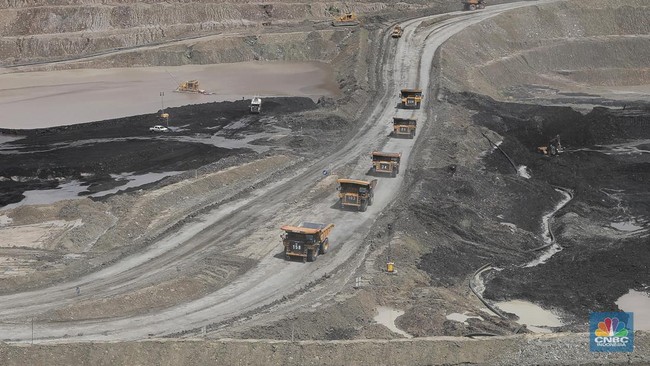
Jakarta, CNBC Indonesia - The Indonesian Mining Experts Association (Perhapi) has voiced concerns regarding the government’s plan to implement the oil and gas (migas) revenue-sharing scheme in the mineral and coal mining (minerba) industry.
Perhapi General Chairman Sudirman Widhy believes the government should not rush into implementing the policy. As is known, in the migas sector, there are cost recovery and gross split schemes used in cooperation contracts between the government and private parties.
“The government needs to study it first to understand the impacts on the mining industry if the scheme is applied; it should not end up deteriorating the mining industry’s climate,” Widhy told CNBC Indonesia on Thursday (7/5/2026).
According to him, the mining industry is a sector that requires very large investments to operate. Therefore, investors need legal certainty so that the invested capital can yield positive results.
“And for such large investments, it will naturally take considerable time to produce profitable outcomes,” he said.
Widhy added that guarantees of legal and regulatory certainty are crucial for business actors who have invested capital in the mining sector. This is because business players have calculated their investments based on current conditions and regulations, including the royalty revenue-sharing scheme.
Furthermore, if the government changes the mining revenue-sharing scheme, it will affect the investment return calculations that have already been made by business actors. Therefore, Perhapi urges the government to first open space for discussion with mining industry players before implementing cost recovery or gross split schemes in the minerba sector.
“It is important for the government to first engage in talks and discussions with mining industry players, who in this case can be represented by mining industry associations such as IMA, APBI, APNI, and others, regarding the plan to implement cost recovery or gross split as revenue-sharing schemes in the mining industry,” Widhy said.
Previously, the Minister of Energy and Mineral Resources (ESDM) Bahlil Lahadalia explained that the government wants to ensure that both old and new mines can contribute maximally to state revenues. One approach being considered is adopting cooperation patterns similar to those in the migas sector.
In the migas sector, there are at least cost recovery and gross split schemes used in cooperation contracts between the government and private parties. This model is seen as a reference for application in the minerba sector.
“And we will use examples like the revenue sharing from our migas management. Our migas has cost recovery and gross split; perhaps those patterns will be what we try to exercise to build cooperation with private parties,” he said.
Nevertheless, Bahlil emphasised that the concession scheme will not be abolished. The government will retain that system but with adjustments to increase the state’s revenue share and make it more balanced.
“It remains a concession, but we will optimise it for revenues to be balanced with the state, and the state should get a larger share,” Bahlil stated.