
Experts Surprised to Find Earth’s Shape Is Changing: Here’s Why
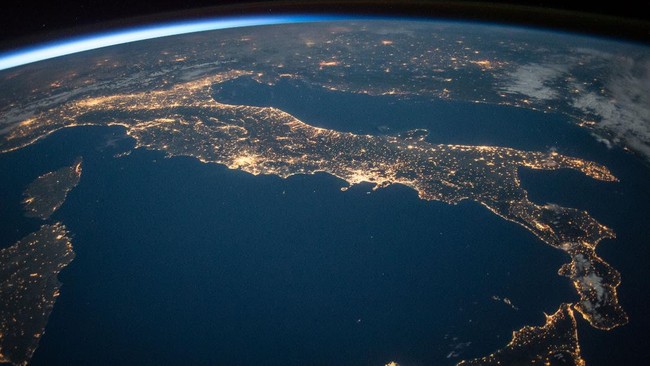
Climate change affects not only temperatures and extreme weather but is also beginning to alter the Earth’s physical shape. New research has found that the planet, long known to be spherical, is gradually changing shape and becoming rounder.
The change is closely linked to the melting of polar ice sheets caused by global warming. This is shifting the Earth’s solid surface: the polar regions are slowly rising, while the bulge around the equator is shrinking.
As reported by Live Science, the findings are another indicator of the impact of human-driven climate change on the planet. Researchers say monitoring changes in the Earth’s shape could help reveal the extent to which melting polar ice affects its physical condition.
The Earth is not a perfect sphere. Because of its rotation, it is slightly flattened at the poles and bulges around the equator. However, the latest study shows that the Earth is becoming rounder at an accelerating rate, primarily because of changes caused by melting polar ice.
The findings apply only to the solid Earth; the oceans continue to bulge outwards at the equator.
Published on 9 September in the journal JGR Solid Earth, the study used direct measurements from the global navigation satellite system (GNSS) to track changes in the planet’s shape over time. The system provides direct measurements but has limitations. For example, there are few GNSS stations near the North and South Poles or in remote ocean areas, as the equipment must be installed on buoys there.
Christoforos Kotsakis, a professor of geodesy at Aristotle University of Thessaloniki in Greece, developed a new method for analysing GNSS data to detect changes in the planet’s surface more accurately.
His findings showed that the polar regions are rising while the equatorial bulge is shrinking. Both changed by around 0.04 inches, or 1 millimetre, a year between 2011 and 2015.
That figure is small compared with the Earth’s equatorial diameter of about 7,926 miles, or 12,756 kilometres. However, it is greater than the rate recorded between 1997 and 2000, when the Earth became rounder by around 0.02 inches, or 0.5 millimetres, a year.
This means the rate at which the Earth is becoming rounder has increased by around 0.016 inches, or 0.4 millimetres, per year each decade.
The change is driven by melting polar ice. As ice sheets melt, pressure on the Earth’s crust decreases, allowing the surface to rise gradually. Kotsakis likened this to bread dough expanding again after being pressed with a finger.
Meanwhile, an increase in mass around the equator puts pressure on the Earth’s crust, reducing its bulge. However, the picture changes when the solid Earth and the oceans are considered together.
Taken together, they show the Earth becoming flatter by around 0.03 inches, or 0.8 millimetres, a year. This happens because seawater bulges further around the equator as water mass shifts away from the polar regions. The added mass of water outweighs the rounding effect on the rock beneath it.
Other research has also found that this redistribution of mass is slowing the Earth’s rotation.
In addition to GNSS, researchers monitor changes in the Earth’s shape by measuring its gravitational field, which can change as mass is redistributed across different regions.
Kotsakis found that GNSS and gravity-field measurements do not show entirely matching patterns. This suggests that changes in the Earth’s physical shape and gravitational field do not always move in step.
Nevertheless, the two methods can be used together to monitor the main impacts of climate change, particularly the melting of ice sheets in Greenland and Antarctica and changes in the distribution of seawater.