
Experts Refute Claims That Volcanic Eruptions are Result of Technological Manipulation
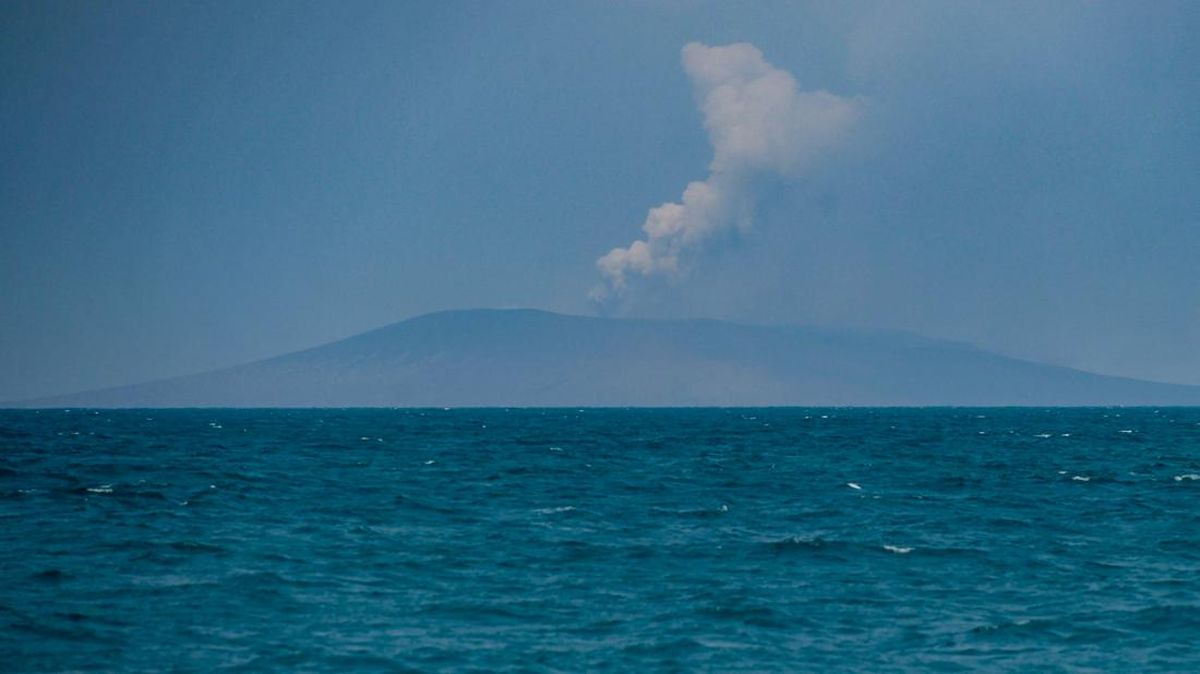
Agung Harijotoko, a volcanology expert from the Faculty of Geography at Gadjah Mada University (UGM), believes that the phenomenon of eruptions in several Indonesian volcanoes, including Mount Anak Krakatau, is not caused by technological manipulation or other conspiracy narratives.
Agung explained that volcanic eruptions, as he understands them, are geological processes. Eruptions occur when gas and magma pressure within the earth increases until it is forced out through cracks in the earth’s crust or volcanic craters.
“Therefore, there is no connection to frequency technology or anything of that sort. There is no evidence to support such claims. I maintain my belief that this is a natural, geological process,” said Agung during a discussion at UGM, Sleman, DIY, on Wednesday (3/9).
For Agung, the phenomenon of six volcanoes erupting or being active in close proximity is also scientifically explainable.
“It is very possible; there is no human intervention,” he asserted.
Agung referred to the recent simultaneous eruptions of six volcanoes in Indonesia, namely Mount Anak Krakatau in the Sunda Strait, Mount Semeru in East Java, Mount Ili Lewotolok in East Nusa Tenggara, Mount Ibu in North Maluku, Mount Lewotobi Laki-laki in East Nusa Tenggara, and Mount Sinabung in North Sumatra.
Agung views these eruptions as occurring due to coincidence and not as a chain reaction. According to him, these eruptions are purely independent natural processes, as each volcano possesses its own magma chamber deep within the earth.
“It is very possible (for eruptions to occur in close proximity) because they have their own individual systems. It does not mean one volcano influences another; it does not. Rather, it is a coincidence that the conditions in each volcano were already conducive to an eruption,” he explained.
Furthermore, Agung noted that the vast distances between the volcanoes make it impossible for one eruption to ‘infect’ another.
Indranova Suhendro, a lecturer at the UGM Faculty of Geography, also explained that every volcano has its own unique characteristics and activity cycles. He suggested that the similarity in eruption timing is better viewed as an intersection of different activity cycles.
He stated that some volcanoes, such as Semeru and Anak Krakatau, have high eruption frequencies, while others have longer periods of dormancy before becoming active again.
According to him, when these cycles overlap during a single period, several volcanoes may appear to be active simultaneously.
“In my view, this is more a matter of timing,” said Indranova, according to the official UGM website, on Tuesday (3/9).
The shared subduction zones in Indonesia do not automatically indicate a direct link between magma systems. Each volcano has a local magma system, meaning an eruption on one volcano does not automatically trigger another.
Potential links may be more likely between volcanoes located close to one another. However, the current situation is different, as the volcanoes are spread across Sumatra, Java, the Sunda Strait, Nusa Tenggara, and Maluku.
“Currently, the volcanoes experiencing eruptions are positioned very far from one another, making it nearly impossible for one to trigger the other,” he explained.
He noted that these differing systems are reflected in the eruption mechanisms of each volcano.
In the cases of Mount Sinabung, Ibu, and Semeru, there is a mechanism where heat from the magma beneath the volcano heats the water stored within the volcano’s structure, increasing pressure and triggering phreatic eruptions without always being accompanied by signs of increased volcanic seismic activity.
This mechanism differs from the magmatic eruption of Anak Krakatau, which is related to magma with high gas content.
He likened this magmatic mechanism to a carbonated drink, as it is explosive due to massive gas nucleation caused by intense decompression processes.
According to Indranova, while most activity occurs through the internal processes of each volcano, external factors can play a role in certain conditions. He cited the increase in volcanic seismic activity at Lewotobi Laki-laki and Ile Lewotolok following the Flores earthquake, which was subsequently followed by eruptive activity.
He linked this possibility to the influence of earthquake tremors on the gas dissolved in magma, though he emphasised that this mechanism cannot be confirmed to apply to all volcanoes.
“The evidence that volcanic seismic activity at Mount Lewotolok and Lewotobi Laki-laki increased drastically post-earthquake is a strong indicator that they were awakened by the Flores earthquake activity,” he stated.