
Experts Raise Concerns Over MPR-MK Agreement on Constitutional Interpretation
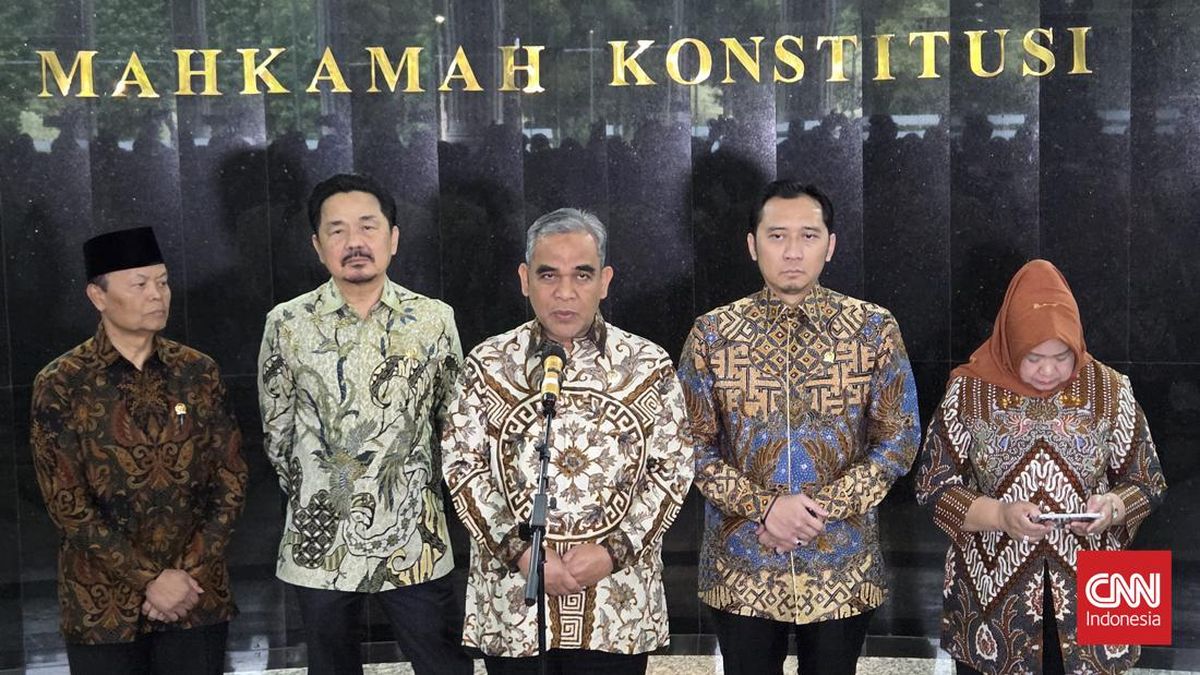
A number of leaders of the People’s Consultative Assembly (MPR) visited the Constitutional Court building to discuss the respective powers of the two institutions regarding the interpretation and amendment of the 1945 Constitution.
As well as delivering an invitation to the MPR’s annual session in August, they also agreed a memorandum of understanding (MoU).
The content of the MoU is that the MPR is to be involved in constitutional interpretation and in decisions of the Constitutional Court.
“We have already signed [the MoU], myself as Speaker of the MPR and Mr Suhartoyo as Chief Justice of the Constitutional Court, an MoU between the MPR and the Constitutional Court concerning copies of the Court’s decisions, which the MPR will also receive in circulation, and in many respects the MPR will later be asked to provide its statements when the Court formulates the operative part of its rulings,” said MPR Speaker Ahmad Muzani at a press conference following the meeting on Wednesday (8/7).
In response, a number of constitutional law experts voiced their opinions.
Herdiansyah Hamzah, also known as Castro, a member of the Constitutional and Administrative Law Society (CALS), commented on the memorandum concerning MPR involvement in constitutional interpretation and Court decisions. At first glance, Castro said, there appears to be nothing wrong with this, because Article 54 of the Law on the Constitutional Court provides for such a matter.
The Article reads: The Constitutional Court may request information and/or minutes of meetings relating to the petition under examination from the People’s Consultative Assembly (MPR), the House of Representatives (DPR), the Regional Representative Council (DPD), and/or the President.
“When I read the intention behind it, there is an impression that when the MPR met with the Constitutional Court, it was essentially emphasising that if the Court needs an interpretation of a petition process before it, it is as if they wanted to say, don’t hesitate to involve the MPR,” Castro said in a voice message on Thursday (9/7).
However, on closer inspection, Castro suspects there is an attempt to make the MPR the sole interpreter of constitutional changes or amendments.
“If we read this through the lens of political psychology, it is a kind of attempt to make the MPR an institution that is, in inverted commas, more authoritative in explaining interpretations of changes or amendments to the Constitution,” he said.
“That is really the intention of this meeting, as if to assert authorisation over interpretation which could ultimately become the sole interpretation,” he added.
Castro, a lecturer at the Faculty of Law of Mulawarman University, stressed that the Constitutional Court can interpret the constitution by building a kind of constructed way of thinking, by referring to the minutes and readable documents such as the Memorie van Toelichting (MvT).
The MvT is an official explanatory memorandum or record containing the background, objectives and debates behind the drafting of an Article of the Constitution.
“Not all current MPR members were involved in the amendment process anyway. The documents would suffice. That is the logic,” Castro said.
“Just look, for instance, at the current MPR members — not all of them took part in drafting the amendments from 1999 to 2002,” he continued.
For that reason, Castro questioned the MPR’s attempt to present itself as the sole authority on interpreting the constitution.
“The intention, I believe, is as if to make the MPR an institution that is ‘authoritative’ — note the inverted commas — the only one, and therefore with the potential to become the sole interpreter of constitutional amendments,” he said.
Castro further suspects that the MPR’s meeting with the Constitutional Court on Wednesday was connected to the issue of constitutional amendment.
“We cannot yet be certain whether there is a link to the constitutional amendment issue, but by engaging the Constitutional Court in such intense discussions — this has happened several times now — this could well be heading towards the issue of amending the constitution,” Castro said.
Separately, Violla Reininda, a researcher at the Indonesian Centre for Law and Policy Studies (PSHK), said there were at least two points to be drawn from the information about the MoU between the MPR and the Constitutional Court.
“First, the MPR’s constitutional interpretation lies within the legislative chamber, in line with the powers attached to the MPR,” she said.
“Namely, amending the constitution, inaugurating the President and/or Vice-President, deciding on the DPR’s proposal to impeach the President and/or Vice-President, electing a Vice-President from two presidential nominees in the event of a vacancy, and electing a President and Vice-President in the event that both have died or are simultaneously unable to discharge their duties, based on two nominations from a political party or coalition of political parties,” she continued.
Second, Violla continued, the MPR must understand that under the Constitutional Court’s procedural law, Article 54 of the Law on the Constitutional Court provides that the MPR’s involvement in hearings is as a provider of information when required by the Court. In such cases, she added, the Court may request information and/or minutes of meetings from the MPR.
“Therefore, its position is not that of a party involved in formulating rulings and interpreting the constitution,” Violla said.
According to Violla, the MPR is indeed an interpreter of the constitution, but it must bear in mind the context of its constitutional powers and the operation of checks and balances in the exercise of state power.
“So, the MPR must not read this as an attempt to intervene in the independence of constitutional adjudication,” Violla said.
Previously, following the visit to the Constitutional Court on Wednesday, Muzani insisted that under the constitution both institutions carry out their duties within their respective corridors. This means neither institution interferes in the other’s powers.
However, he said, because under the constitution the MPR is regarded as the institution that best understands the constitution, it must be involved in every decision taken by the Constitutional Court.
“Therefore, before the Constitutional Court takes a decision on an interpretation, we remind it, we convey, that it should also listen to the MPR’s views from the time the constitution was drafted or amended,” said the Gerindra politician.
Meanwhile, the Constitutional Court stated that there is no problem with the matter, because for relevant petitions the MPR may provide information to the Court as provided in Article 54 of the Law on the Constitutional Court.
“That is indeed in accordance with Article 54 of the Law on the Constitutional Court, and the Court has previously also requested information from the MPR where necessary,” said Constitutional Court spokesperson and Constitutional Justice Enny Nurbaningsih when contacted in writing on Thursday (9/7).