
Experts Highlight Alleged Formal Flaws in the Formation of the National Police Law
Jakarta - Experts presented by the petitioners in the formal review hearing of Law Number 5 of 2026 regarding the Third Amendment to Law Number 2 of 2002 concerning the National Police of the Republic of Indonesia (UU Polri) have assessed that the law-making process suffered from formal defects.
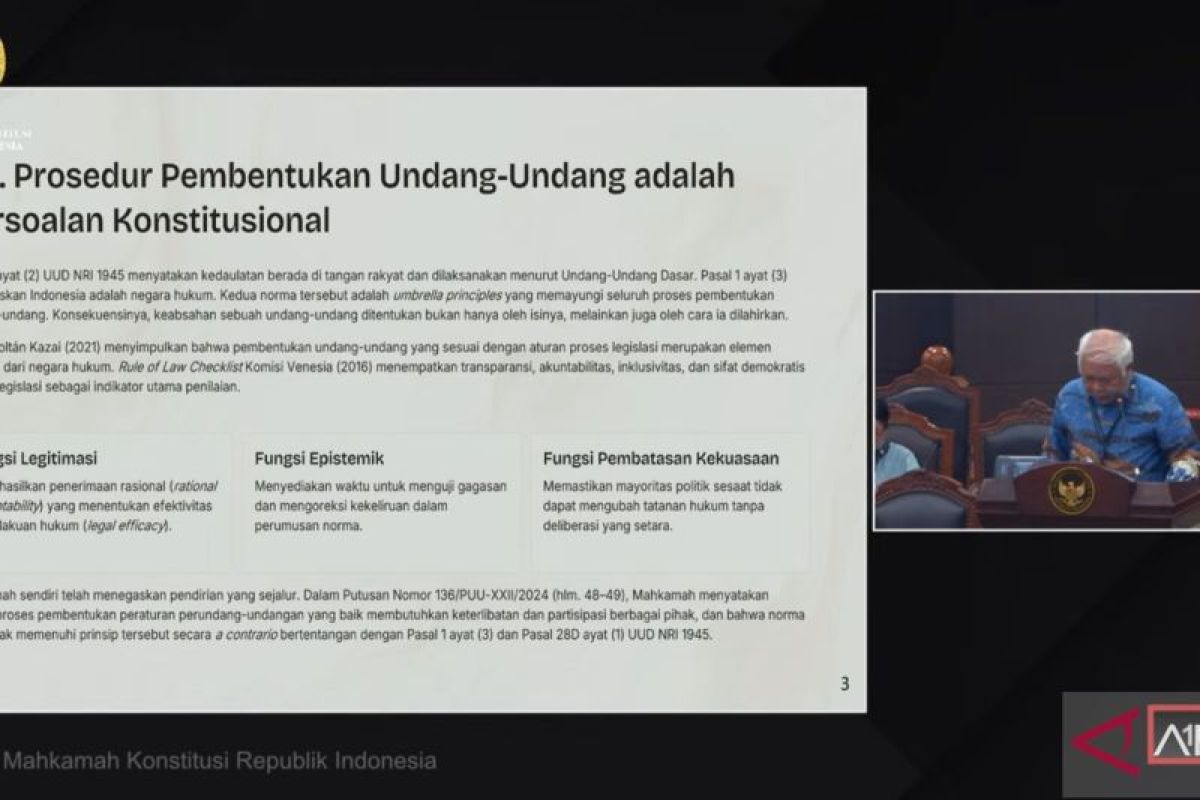
At the Constitutional Court (MK) in Jakarta on Wednesday, a hearing for Case Number 258/PUU-XXIV/2026 was held to hear testimony from two experts submitted by the petitioners, namely Soleman B. Ponto and Salfius Seko.
In his testimony, Soleman B. Ponto highlighted the need for meaningful public participation in the formation of the National Police Law. Ponto argued that if it is proven that the draft law, which subsequently became Law Number 5 of 2026, did not undergo the harmonisation stage at the Legislative Body before being established as a House of Representatives (DPR) initiative, then a violation of the provisions for the formation of laws and regulations has occurred.
“Such a violation is classified as a fundamental defect, not merely an administrative technical error,” he stated.
He also emphasised the fulfilment of meaningful public participation in the law-making process. According to Ponto, if documents cannot be presented showing how public input was processed into regulatory norms and how such input was responded to, then the formation of Law Number 5 of 2026 has failed to meet the public’s right to be considered and the right to receive an explanation regarding the opinions provided.
These rights are part of meaningful public participation as emphasised by the Constitutional Court in Decision Number 91/PUU-XVIII/2020. “In conclusion, as long as the above facts are proven in court, then the formation of Law Number 5 of 2026 does not meet the provisions of the 1945 Constitution of the Republic of Indonesia, specifically Article 1 paragraph (2), Article 1 paragraph (3), Article 20, Article 22A, Article 28D paragraph (1), and Article 28F,” said Ponto.
Another expert, Salfius Seko, requested that the Constitutional Court examine and reassess the procedures for forming the National Police Law to ensure compliance with constitutional provisions. Salfius highlighted, among other things, the status of the ‘carry over’ discussion of the draft law from the previous DPR period and the harmonisation stages of said draft.
According to him, the continuation of discussions on draft laws from the previous DPR period must comply with the regulations regarding the formation of laws and regulations. He assessed that the harmonisation stage is one of the issues that needs to be scrutinised in the formation process of the National Police Law.
Salfius also assessed that public participation in the formation of the National Police Law suffered from time constraints, selective filtering of input, and the disregard of certain contributions, rendering it merely tokenistic. “A formal defect. The loss of mandatory stages and poor public participation creates a fundamental formal defect that cannot be rectified administratively,” he said.
The petition for Case Number 258/PUU-XXIV/2026 was filed by Syamsul Jahidin, Singgih Tomi Gumilang, Kharisma Jomenta Surbakti, Dimas Yoga Pratama, and Stepanus Febyan Babaro. The petitioners are questioning the formation process of the National Police Law, particularly regarding meaningful public participation, and are requesting the Constitutional Court to declare that the formation of the law contradicts the 1945 Constitution. The petitioners also request the Court to declare that Law Number 2 of 2002 concerning the National Police of the Republic of Indonesia remains in effect.
In previous hearings, the DPR and the Government have denied the petitioners’ arguments. The DPR stated that the formation process of the National Police Law has met the principles of law-making, including transparency and public participation. Several related parties have also provided testimony throughout the series of hearings for this case.
Source: jawawa.id (https://jawawa.id/newsitem/experts-highlight-alleged-formal-flaws-in-the-formation-of-the-national-police-law-1790773649)
Originally published by Antara (Indonesian) (https://www.antaranews.com/berita/5765140/ahli-pemohon-soroti-dugaan-cacat-formil-pembentukan-uu-polri), translated from Indonesian