
Experts explain possible causes of electric taxi stalling on railway tracks
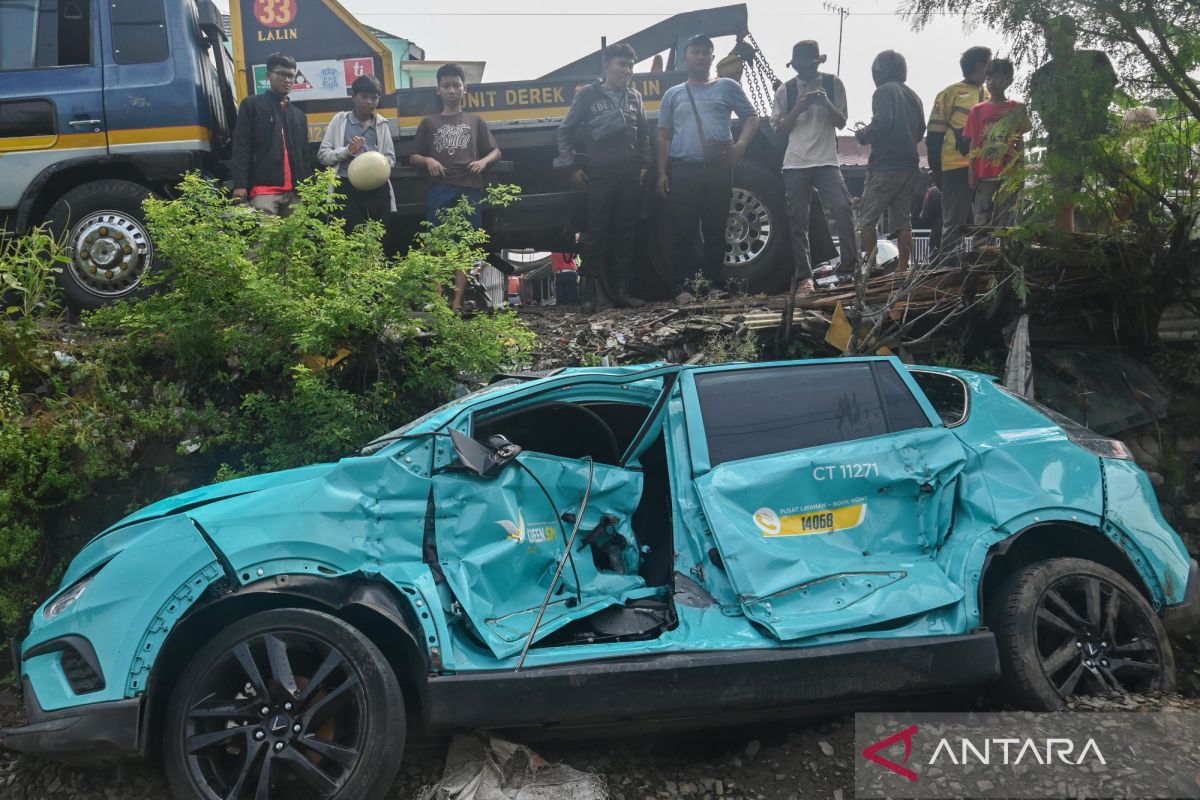
Jakarta (ANTARA) - The incident involving an electric taxi in a collision with a long-distance train and a commuter train on Monday (27/4) at Bekasi Timur Station, Bekasi, West Java, has drawn public attention to the possibility and suspicion that the electric vehicle suddenly stalled, particularly while crossing the tracks.
Automotive expert from the Bandung Institute of Technology, Yannes Martinus Pasaribu, explained to Antara on Wednesday several technical possibilities that could have caused the incident.
According to Yannes, one possible factor relates to the battery with low voltage, also known as the battery.
“Technically, various possibilities that could occur include the 12V low-voltage battery, which serves as the initial power source to activate the computer system, relay and contactor, safety system, sensors, and control modules, as well as the booting process when the car is started, so when the voltage drops too low, all the mentioned systems will be affected,” he said.
In addition, he highlighted the factor of vibrations when the Green SM electric taxi crossed the tracks.
“Prolonged vibrations while driving on the sensor and ADAS system can loosen various parts, and when added to hard vibrations, it has the potential to cause various connections or components to detach, resulting in the motor stopping or a decrease in the efficiency of the drive transmission mechanism, thus causing the EV to stop,” Yannes explained.
Another possibility is the automatic activation of the vehicle’s intelligent safety system when an anomaly is detected.
“When the system detects an anomaly, safety features such as steering lock or immobiliser can activate automatically and lock the entire vehicle system,” Yannes explained.
“Disruption in the battery management system communication that has the potential to cause errors in reading electric current, incorrect SOC estimation, which could lead to decision-making such as sudden shutdown,” he added.
In addition, failure of main components can also have a significant impact.
If the inverter or DC-DC converter fails, the vehicle can experience a sudden loss of power, reduced acceleration, or total system failure.
Nevertheless, he emphasised that all these possibilities are still technical in nature and require further investigation to confirm the exact cause of the incident.
The accident involving the long-distance train and commuter train on Monday (27/4) occurred at Bekasi Timur Station, Bekasi, West Java, resulting in 16 deaths and several injuries.
In that accident incident, the Argo Bromo train collided with the KRL Commuter Line that had stopped at Bekasi Timur Station after a taxi blocked the KRL in the train crossing area near Bulak Kapal, according to the spokesperson for PT Kereta Api Indonesia’s Daop I Jakarta.