
Expert Warns MSCI Could Weaken Rupiah, with Capital Flight Potentially Reaching US$25bn
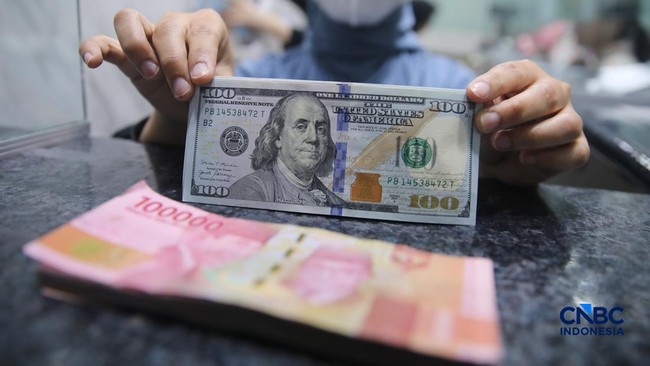
Jakarta, CNBC Indonesia – Anthony Budiawan, managing director of Political Economy and Policy Studies (PEPS), has warned that the risk of further rupiah weakness is rising amid increased market uncertainty after Morgan Stanley Capital International (MSCI) opened a consultation on the possible downgrade of Indonesia’s stock market from emerging-market to standalone-market status.
According to Anthony, foreign investors’ share sales since the end of last week could trigger capital outflows that would also weigh on the rupiah.
He forecast that the rupiah could weaken to around Rp18,100–Rp18,200 per US dollar by the end of this week. However, on Tuesday’s trading (20 October 2026), it instead closed 0.28% stronger at Rp17,980 per US dollar.
Anthony cited a UBS projection that foreign fund outflows from Indonesia’s equity market could reach US$19 billion, encompassing both passive and active funds. This would be equivalent to around 13% of foreign ownership in Indonesia.
For context, foreign investors had recorded net share sales of about US$6 billion from the start of 2026 to mid-October, even before the announcement of the MSCI consultation.
“The market will be turbulent and unstable during the consultation period, which runs until 30 April 2027. During that time, it will be difficult for the index to recover. While we wait for improvements in exchange governance, foreign investors are likely to sell Indonesian shares,” Anthony said in a press release, quoted on Tuesday (20 October 2026).
Anthony said pressure on the rupiah could spread beyond the equity market. In his view, declining investor confidence in Indonesia’s financial markets could spill over into the government bond market and Bank Indonesia (BI) instruments, as foreign investors also have exposure to both.
He also highlighted Indonesia’s external debt, which stood at US$459.3 billion in August 2026. That was equivalent to around 3.13 times the country’s foreign exchange reserves, which totalled US$146.5 billion in the same period.
Anthony said that if foreign investors sold shares and debt securities simultaneously, pressure on the rupiah could intensify. The situation could also deplete foreign exchange reserves if the central bank intervened to curb exchange-rate volatility.
He cited financial-market pressure from September 2014 to September 2015, when Indonesia’s foreign exchange reserves fell by US$9.4 billion and the rupiah weakened by 20.2%.
During the market turmoil caused by the Covid-19 pandemic in February–March 2020, reserves fell by US$10.7 billion in one month, while the rupiah weakened by 21.2%.
Anthony warned that if share and bond selling continued, foreign capital outflows could reach US$20–25 billion.
“If sales of shares and government and Bank Indonesia debt securities continue, foreign capital outflows could reach US$20–25 billion. It is not impossible that the rupiah could plunge, breaching Rp20,000 and approaching Rp22,000 per US dollar,” he said.
Current-account deficit also in focus
Anthony also said pressure on the rupiah could increase as the current-account deficit (CAD) widens, which he said had reached 3.3% of gross domestic product (GDP) in the second quarter of 2026.
He said the combination of potential large-scale share sales, rising external financing needs and external-debt risks could intensify pressure on the exchange rate.
“This means the risk of the rupiah breaching Rp20,000 per US dollar is not an illusion: Indonesia faces the prospect of large-scale share sales, rising external financing needs and increasing external-debt risks,” he said.
To reduce these risks, Anthony called on the Financial Services Authority (OJK) and the Indonesia Stock Exchange (BEI) to strengthen capital-market governance effectively and transparently.
He urged greater disclosure of ultimate beneficial owners, checks on links between shareholders when calculating public shareholdings (free float), and the prosecution of stock-trading manipulation as a criminal offence.
Source: jawawa.id (https://jawawa.id/newsitem/expert-warns-msci-could-weaken-rupiah-with-capital-flight-potentially-reaching-us-25bn-1792504228)
Originally published by CNBC Indonesia (https://www.cnbcindonesia.com/market/20261020183432-17-777960/pakar-ingatkan-efek-msci-ke-rupiah-waspada-dana-kabur-bisa-us-25-m), translated from Indonesian