
Expert Tells Constitutional Court That Polri as Principal Investigator Under the Criminal Procedure Code Cannot Control Other Investigators
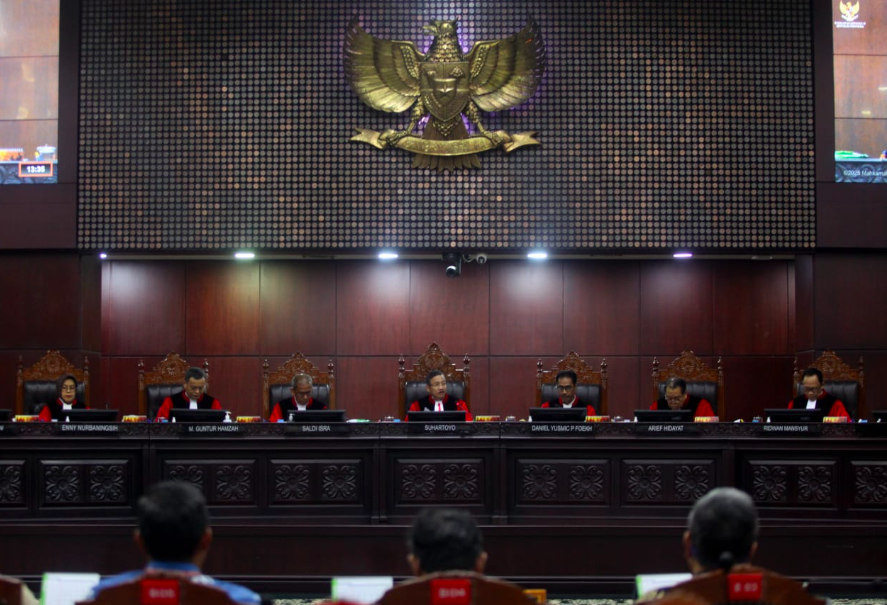
The controversy over the position of the Indonesian National Police (Polri) as “Principal Investigator” has resurfaced in the judicial review of Law Number 20 of 2025 on the Criminal Procedure Code (KUHAP) at the Constitutional Court.
Susi Dwi Harijanti, Professor of Constitutional Law at Universitas Padjadjaran and an expert for the applicants, argued that the provision placing Polri as principal investigator must not be construed as giving the police a higher constitutional standing or the authority to control investigators from other institutions.
According to Susi, Article 30 paragraph (4) of the 1945 Constitution assigns Polri the tasks of maintaining public security and order, protecting, sheltering and serving the community, and upholding the law. However, that provision concerns Polri’s function, not a superior position in relation to other law enforcement officials.
“This is often interpreted to mean that Polri holds a higher constitutional position in the investigation system. In my view, that is a mistake that damages the constitutional design adopted by the 1945 Constitution after the amendments,” Susi said at the fourth hearing of Case Number 274/PUU-XXIV/2026 at the Constitutional Court on Tuesday (8/9).
Susi explained that Indonesia’s criminal justice system recognises a division of tasks among law enforcement institutions. The aim is not merely to divide the work, but to create a mechanism of mutual oversight to prevent abuses of power that could harm citizens’ rights.
Therefore, Polri’s existence as an institution carrying out investigative functions does not automatically mean the police can control other institutions that also hold investigative authority under statute.
“If functional differentiation exists for the sake of horizontal oversight, and horizontal oversight exists for the protection of rights, then a norm that transforms a horizontal relationship into a vertical one cannot be assessed merely as institutional arrangement,” Susi said.
She argued that if Polri were considered a superior institution merely because it performs a law enforcement function, other institutions could advance similar claims.
“If such reasoning were accepted, then by the same logic the Attorney General’s Office could claim a controlling position, because the law places it as controller of case proceedings,” she said.
According to Susi, if a body is genuinely needed to oversee the exercise of law enforcement authority, that position should lie under the authority of an independent court.
Susi also stressed that the 1945 Constitution does not explicitly name Polri as the sole investigator. Polri’s position as principal investigator, if it exists at all, derives from statute rather than directly from the constitution.
Therefore, in her view, the phrase “Principal Investigator” in Article 6 paragraph (2) of the KUHAP is better understood as an indication that Polri holds general authority to investigate various types of criminal offences, not exclusive authority to control all investigators.
“The phrase ‘Principal Investigator’ must be understood as denoting the breadth of Polri’s investigative competence over all criminal offences, and not as a source of authority to command or substantively control investigators whose powers are granted by sectoral laws,” Susi asserted.
Under that interpretation, the existence of investigators from other institutions remains respected — for example, Civil Servant Investigators (PPNS) whose authority derives from sectoral laws, as well as specific investigators whose authority is granted directly by statute.
At the same hearing, Fachrizal Afandi, a criminal law lecturer at the Faculty of Law of Universitas Brawijaya, explained that an investigation system does indeed require coordination, but coordination must not turn into a hierarchical relationship between superior and subordinate.
According to Fachrizal, Polri investigators hold general competence, whereas PPNS and specific investigators hold more specific competences in accordance with the laws forming the basis of their authority.
“Coordination is a systemic necessity. However, coordination should regulate how various legitimate powers meet; coordination must not become a new source that determines the existence or otherwise of powers previously granted by sectoral laws,” Fachrizal explained while attending online.
He highlighted the phrase “under the coordination and supervision of Police Investigators” in Article 7 paragraph (3) of the KUHAP. According to him, this phrase must be restricted so that it does not give rise to an interpretation that PPNS or specific investigators occupy a subordinate position to Polri.
“The words ‘under’ and ‘supervision’ can indeed carry an element of control in ordinary language. Therefore, if the law does not clarify its limits, practice can drift from coordination into subordination,” Fachrizal said.
He insisted that Polri’s supervision of other investigators should be limited to procedural and administrative matters, the exchange of information, and the integration of case handling. “Supervision must not become a substantive veto over investigative decisions that lawfully fall within the attribution of PPNS or Specific Investigators,” he asserted.
Fachrizal also highlighted the phrase “on the orders of Police Investigators” in Articles 93 paragraph (3) and 99 paragraph (3) of the KUHAP. In his view, these provisions have the potential to grant Polri substantive authority over the actions of other investigators, because PPNS or specific investigators may lose the freedom to exercise their powers if they must first obtain a decision from Polri.
According to Fachrizal, this situation could create problems if not accompanied by time limits, clear reasons, and an objection mechanism. “That accumulation of functions places the Principal Investigator in a quasi-adjudicative position resembling a judge over other investigators,” he said.
He took the view that oversight of actions touching on citizens’ fundamental rights, such as arrest and detention, should be increasingly placed under the supervision of an independent court.
“The ideal constitutional design preserves Polri’s general competence and the sectoral expertise of PPNS/Specific Investigators, regulates measured horizontal coordination, and shifts the centre of control over rights from police scrutiny towards judicial scrutiny,” Fachrizal said.
Previously, the applicants in Case Number 274/PUU-XXIV/2026 considered that several provisions of the new KUHAP have altered the design of the national investigation system. They challenged provisions deemed to position Police Investigators as the controlling hub over PPNS and specific investigators.
The applicants also argued that the rules could expand investigators’ discretion in the use of coercive measures. According to them, these changes risk diminishing the independence of investigators whose authority is granted directly by sectoral laws.
Source: jawawa.id (https://jawawa.id/newsitem/expert-tells-constitutional-court-that-polri-as-principal-investigator-under-the-criminal-procedure-code-1788861091)
Originally published by Media Indonesia (https://mediaindonesia.com/politik-dan-hukum/931003/ahli-di-sidang-mk-tegaskan-polri-sebagai-penyidik-utama-di-kuhap-tak-bisa-kendalikan-penyidik-lain), translated from Indonesian