
Expert Reveals Why the US Military is Eager for Access to Indonesian Airspace
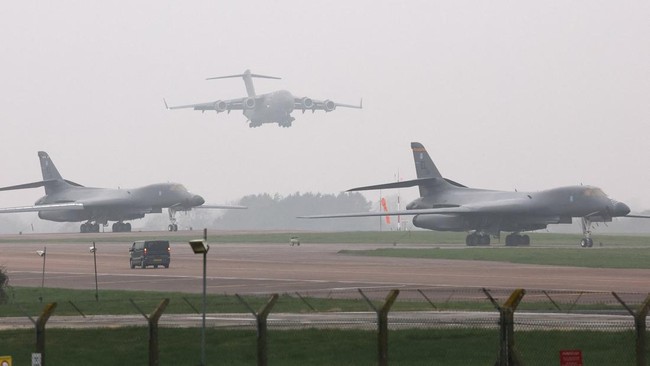
Jakarta, CNBC Indonesia - The United States (US) has officially requested Blanket Overflight Clearance from the Indonesian government, a special permit that would allow their military aircraft to cross Indonesian airspace without needing to apply for permission repeatedly. This request has triggered strong warnings as it is seen to potentially undermine the country’s sovereignty and damage the principles of an independent and active foreign policy.
Professor of International Law at the University of Indonesia, Hikmahanto Juwana, explained that Blanket Overflight Clearance is a permit granted once for any number of military aircraft passing through a country’s airspace for a certain period or indefinitely. He stated that the US Secretary of Defense desires a single approval that applies perpetually, so Indonesia would only receive notifications without granting permission each time their aircraft transit.
Hikmahanto emphasised that this request directly contravenes the applicable laws in the country, particularly Government Regulation No. 4 of 2018 on the Security of the Republic of Indonesia’s Airspace (PP 4/2018). He elaborated that foreign state aircraft, including military ones, are legally required to obtain permission from Indonesian authorities.
“Foreign State Aircraft flying to, from, or through the Airspace must have Diplomatic Clearance and Security Clearance. Aircraft flying without permission constitute a violation,” said Hikmahanto, referring to Article 10 of PP 4/2018, on Tuesday (28/4/2026).
For the US side, the procedure of obtaining permission each time is considered inefficient and unable to meet deadlines for reaching conflict zones if a war breaks out in the East Asia region. If the US had to avoid Indonesian airspace to bypass bureaucracy, they would take a longer route with significant costs and time implications.
However, Hikmahanto provided a critical note that approving the request would set a bad precedent for law enforcement in Indonesia. He questioned the dignity of national sovereignty if the government compromises laws that should be upheld in the eyes of other countries.
“Undermining sovereignty because PP 4 of 2018, as the applicable law in Indonesia, is not enforced by the government but instead violated. Shouldn’t the government enforce the law as a reflection of national sovereignty in the eyes of other countries?” Hikmahanto firmly questioned the government’s commitment.
In addition to sovereignty issues, granting this unrestricted flight permission is predicted to drag Indonesia into the vortex of great power competition. Hikmahanto warned that Indonesia could be seen as siding with the US in the eyes of Washington’s adversaries, similar to how Gulf states facilitating US military bases are viewed as aligned by parties like Iran.
In conclusion, Hikmahanto urged the government to calculate and thoroughly review before making a decision on the US request. He reminded that national interests should not be sacrificed merely to maintain good inter-state relations.
“Don’t let sovereignty and national interests be compromised just for the sake of good relations!” Hikmahanto concluded.