
Expert Recommendations to Prabowo for Managing Peatland Forest Fires
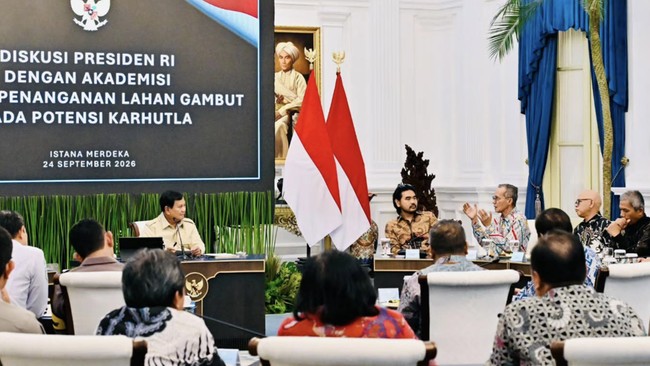
President Prabowo Subianto held a discussion with several academics and experts at the Merdeka Palace on Thursday (24/9/2026). Several proposals were presented to Prabowo to address the issue of forest and land fires (karhutla) in peatlands.
From the video broadcast by the Presidential Secretariat, five experts presented their proposals to the President: Dr Bagus Muljani from Nottingham University, Prof Yulianto S. Nugroho from the University of Indonesia, Dr Sigit Sutikno from the University of Riau, Prof Indratmo Soekarno from ITB, and Prof Ahmad Kurnain from Lambung Mangkurat University.
Understanding Indonesia’s Importance
Bagus Muljadi explained that scientists must understand the importance of Indonesia, as a global ecosystem chokeppoint, which holds a crucial geographical location for calculating greenhouse gas levels. “Without us, it would be impossible to accurately calculate the carbon cycle. We essentially hold the fate of many nations in our hands,” he said.
To that end, he believes the nation must recognise and understand this responsibility. On this occasion, he stated that there are three vital points that must be discussed: protecting and cultivating peat forests, monitoring and detecting peatland hotspots, and determining the necessary actions when fires occur.
Water Bombing is Ineffective for Extinguishing Peatland Fires
Yulianto S. Nugroho explained that fires in peatlands are extremely difficult to extinguish. Based on his simulations, at least one hectare of peatland requires between 200,000 and 1 million litres of water to be extinguished.
This means that fire prevention is key. He noted that early detection of potential fire risks is more important, using technologies such as thermal cameras and infrared to locate hotspots. During the session, Yulianto emphasised that water bombing is ineffective for extinguishing peatland fires.
“Is water bombing effective? Looking at the data we have, it is not effective, Mr President,” he said. “That method can only be used for extremely extreme conditions.”
Consequently, he urged corporations to possess early fire detection equipment to enable prevention. He also requested that hotspots be extinguished immediately.
Strengthening Fire-Aware Communities and Creating Small Reservoirs
Sigit Sutikno stated that the community serves as the front line for firefighting if a fire occurs. Therefore, he requested the revival of Fire-Aware Communities (MPA), equipped with better firefighting capabilities. One method involves creating shallow boreholes so that the community can access water quickly.
“In our experience, it only takes 10 to 15 minutes to create a borehole. The equipment is simple: using a pole, inserting a pipe, and connecting it to a Robin pump to draw out water,” he said.
He also suggested the creation of small reservoirs (embung) around peatlands, measuring 1 to 2 square metres every 200 metres, to ensure easier water access for the community.
Establishing a Peatland and Mangrove Management Agency
Indratmo Soekarno highlighted the vital role of the Peatland and Mangrove Restoration Agency. “We have a peatland and mangrove restoration agency. Several handling steps and plans have actually been mapped out. There is even a manual on how to manage these peatlands. This could serve as a lesson learned,” said Indermato.
Prabowo immediately approved the formation of the National Peatland and Mangrove Management Agency (BPGMN). This institution will fall directly under the responsibility of the President. “I agree, good,” said Prabowo.
The Role of Villages in Disaster Mitigation
Ahmad Kurnain suggested that every village should be capable of monitoring and performing mitigation when fire disasters occur. “It is important to have good practices that the President can implement. For example, in every yard, we could create biopores. No matter how small, it is about promoting their self-reliance,” said Ahmad.