
Expert proposes voluntary licence scheme to curb book piracy
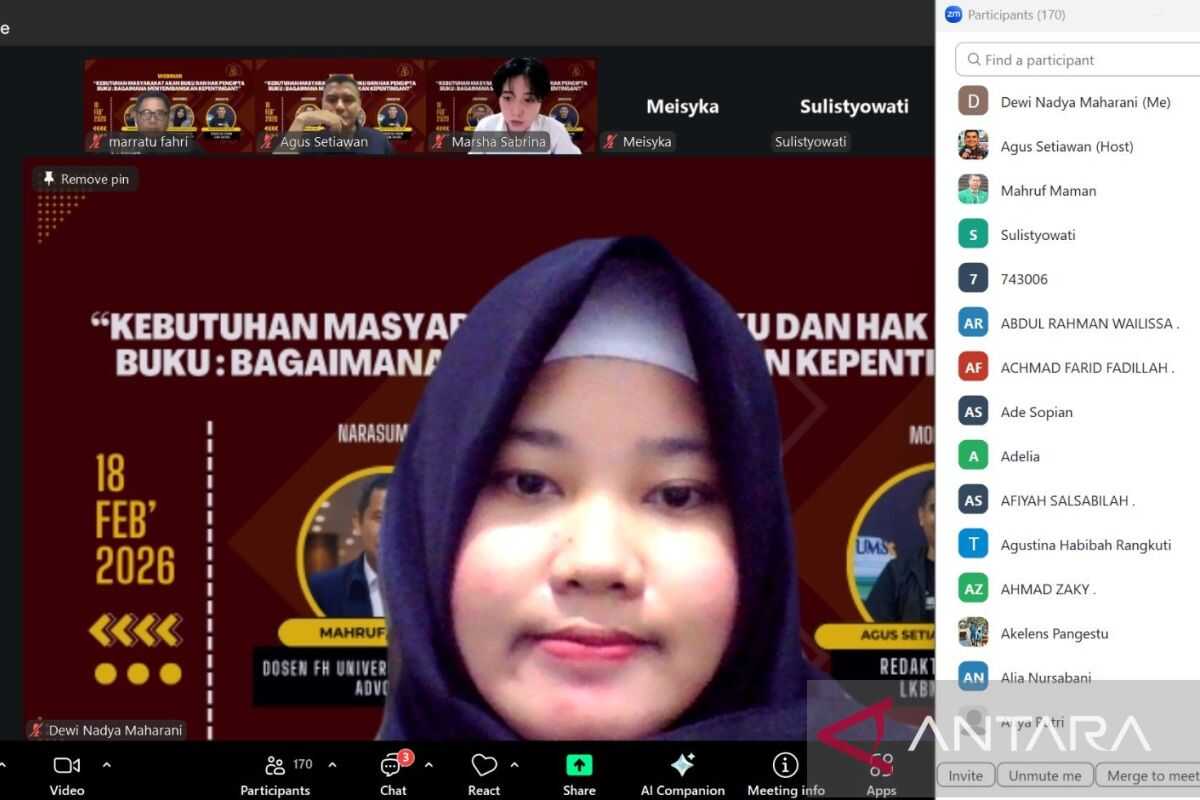
Jakarta (ANTARA) - Legal expert Dewi Nadya Maharani of Universitas Muhammadiyah Jakarta (UMJ) has proposed a voluntary licence concept that would enable copyright holders to grant permission for the use of their works to other parties, including the government, with specified compensation as a means of curbing book piracy.
The proposal was raised during a Debinra Training webinar entitled “Public Demand for Books and Authors’ Rights: How to Balance Interests”, held in Jakarta on Wednesday (18 February).
Nadya said in a statement received on Thursday that under the scheme, the government could act as a facilitator or even a producer by appointing third parties to supply quality books at affordable prices, particularly textbooks frequently used as teaching materials in universities.
“The protection of economic rights would no longer be absolute, but fair compensation would still be provided to copyright holders. This is where the balance is built,” she explained.
She also proposed reforms to strengthen the function of Collective Management Institutions, reactivating the role of Balai Pustaka, and explicitly incorporating the voluntary licence concept into the revision of the Copyright Act to ensure a robust legal foundation.
“The high public demand for books amid rampant piracy necessitates copyright policy reform in Indonesia,” she said.
In her presentation, she highlighted a number of factors driving book piracy in Indonesia, ranging from relatively high book prices, uneven distribution, high educational demand, ease of digital access, to low public awareness of the law.
According to Nadya, copyright protection is governed by Law Number 28 of 2014 on Copyright, which covers moral rights (Articles 5-7) and economic rights (Articles 8-11). Article 10 explicitly prohibits managers of commercial premises from allowing the sale or reproduction of goods resulting from copyright infringement at locations under their management.
However, a law enforcement approach alone was deemed insufficient. The state needs to introduce policies that provide legal and affordable access for the public.
Dewi outlined practices in several countries aimed at curbing piracy whilst safeguarding creators’ rights. In the United States, for example, the fair use doctrine permits the use of works without permission in the context of education and research.
European countries apply national library licensing schemes and public lending rights that compensate authors for books that are lent out. Meanwhile, South Korea has developed a licence-based national digital library.
Book piracy in Indonesia was assessed as increasingly alarming and potentially fatal to writers’ creativity, as well as broadly damaging to the publishing industry.
This view was expressed by the second speaker, Mahruf, a lecturer at the Faculty of Law at Universitas Nasional (Unas) Jakarta, in a presentation entitled “Copyright Infringement and Book Piracy”.
Mahruf affirmed that books are among the works explicitly protected under Law Number 28 of 2014 on Copyright. Under Article 1, paragraph (1), copyright is an exclusive right of the creator that arises automatically once a work is realised in tangible form, without the need for registration.
“Copyright comprises moral rights and economic rights. Moral rights are perpetually attached to the creator, whilst economic rights provide financial benefits from the work,” he said.
He explained that Article 40, paragraph (1) of the Copyright Act explicitly includes books, pamphlets, and all other written works as legally protected creations. In practice, however, books are among the most frequently pirated works, in both print and digital formats.
According to Mahruf, piracy constitutes the unauthorised reproduction of a work and the widespread distribution of its copies for economic gain. The impact is felt not only by authors who lose royalties, but also by editors, illustrators, translators, printers, publishers, and bookshops.
“Authors are the most disadvantaged party because the works born of their time and intellect are simply seized. This can kill the spirit of creativity,” he said.
The event was organised by Debinra Training, a division of PT Dewi Bintang Maharatu, which operates in publishing, legal consultancy, health consultancy, and training. The company’s commissioner, Sulistyowati, said the event represented a form of concern for the development of literacy in Indonesia.