
Expert: Kumamoto disaster a lesson in shallow earthquake mitigation
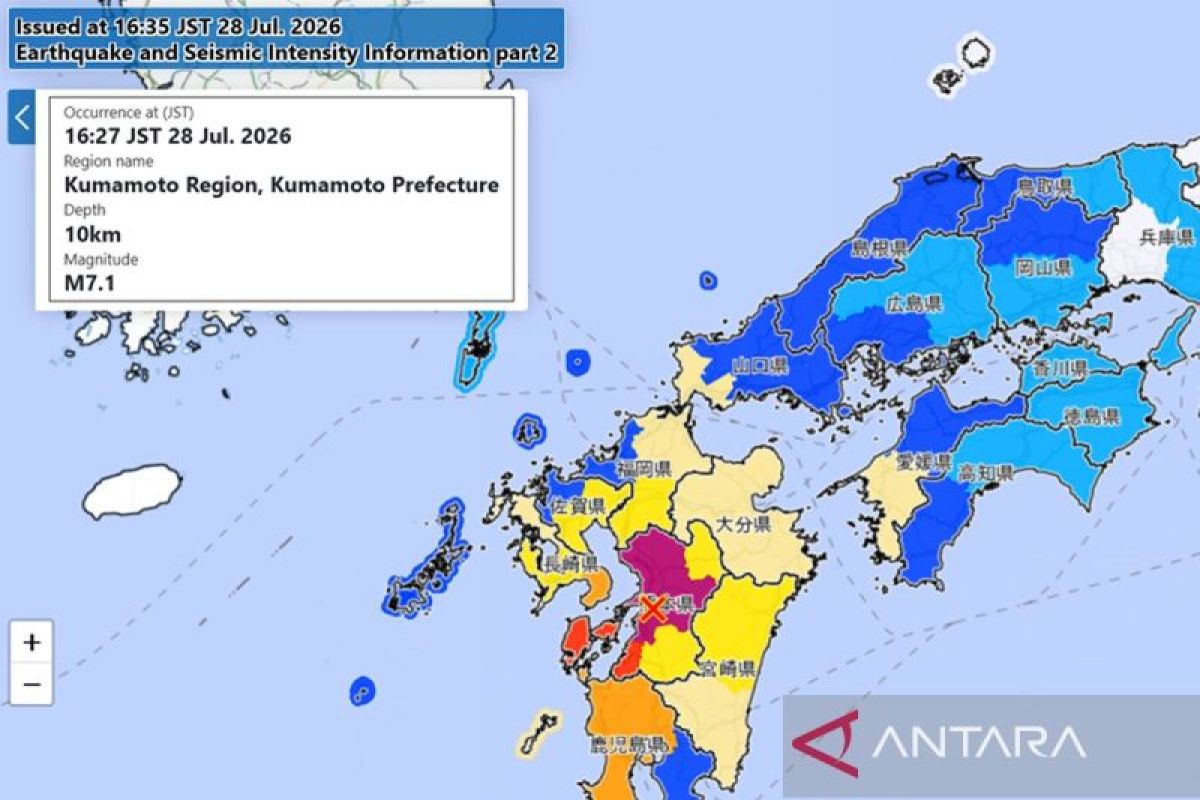
Jakarta (ANTARA) - A member of the Indonesian Disaster Experts Association (IABI), Daryono, assessed that the magnitude 6.8 earthquake in Kumamoto Prefecture, Japan, on Tuesday (28/7) serves as an important lesson regarding the high destructive risk from active onshore fault activity. In a statement received in Jakarta on Wednesday, he said the shallow depth of the earthquake’s hypocentre was the main factor triggering ground shaking that reached Shindo intensity scale 7. Under Japan’s seismic mapping standards, Shindo 7 is the highest level, describing violent shaking capable of toppling earthquake-resistant building structures. “This earthquake was triggered by tectonic activity at a very shallow depth, namely 10 km,” he said. The former Director of Earthquakes and Tsunamis at the Meteorology, Climatology and Geophysics Agency (BMKG) explained that the Shindo 7 intensity reading depicts the highest level of shaking capable of collapsing ordinary buildings and testing the endurance limits of modern infrastructure. An important lesson can be seen from how the extreme shaking immediately triggered the automatic shutdown of the Shinkansen bullet train system and power cuts to mitigate the risk of subsequent disasters. However, he added that the violent shaking still resulted in damage to a historic castle, shifting of a highway bridge span, and triggered landslides and injuries to dozens of residents. “In addition to large ground cracks severing main roads, Shinkansen bullet train operations across the Kyushu corridor were halted for safety procedures. Thousands of settlements also experienced total blackouts, while the strong shaking triggered landslides on Mount Mayu in Shimabara, Nagasaki Prefecture, which stretches across Kumamoto Bay,” he said. Learning from this event, he emphasised the importance of periodic evaluation of old building structures and the strengthening of automatic early warning systems in residential areas located above active fault zones. He said seismologists warn that the energy release in this M6.8 earthquake does not necessarily mark the end of seismic activity. It remains uncertain whether all rock stress has been released or if locked stress remains in the southern segment. “If stress accumulation in the southern segment persists, the potential for a strong aftershock could occur, repeating the pattern of successive seismic crises like the 2016 Kumamoto earthquake sequence. On this basis, the public and local authorities are urged to remain at the highest level of alert,” he stated.