
Expert: Falling global oil prices an opportunity to reform regulations
Jakarta (ANTARA) - Yayan Satyakti, a researcher and lecturer at the Faculty of Economics and Business at Universitas Padjadjaran, believes the fall in global oil prices presents an opportunity for the government to put its regulations in order.
“The momentum lies in fiscal space and the chance to reform the rules. When oil prices are calm, that is when reform is cheapest to carry out,” Yayan said when contacted by ANTARA in Jakarta on Tuesday.
Yayan outlined several steps the government could take while global oil prices ease, namely using the respite to narrow the subsidy tier gap, replenishing the fuel stock buffer, and strengthening targeted protection.
In his view, transfers to vulnerable households already registered in government data are more effective than subsidising commodities that wealthier groups can also take advantage of.
Furthermore, Yayan noted that several risks remain that the government must watch, as they could push fuel prices soaring once again.
The most obvious risk, he said, lies in geopolitical turmoil. Brent breached 100.17 US dollars per barrel on 23 July, its highest since May. The figure rose 6.5 per cent in a single day from 94.07 US dollars per barrel, driven by threats to the Strait of Hormuz and Bab el-Mandeb.
The next risk is the exchange rate. Yayan reminded that the fuel pricing formula uses the exchange rate.
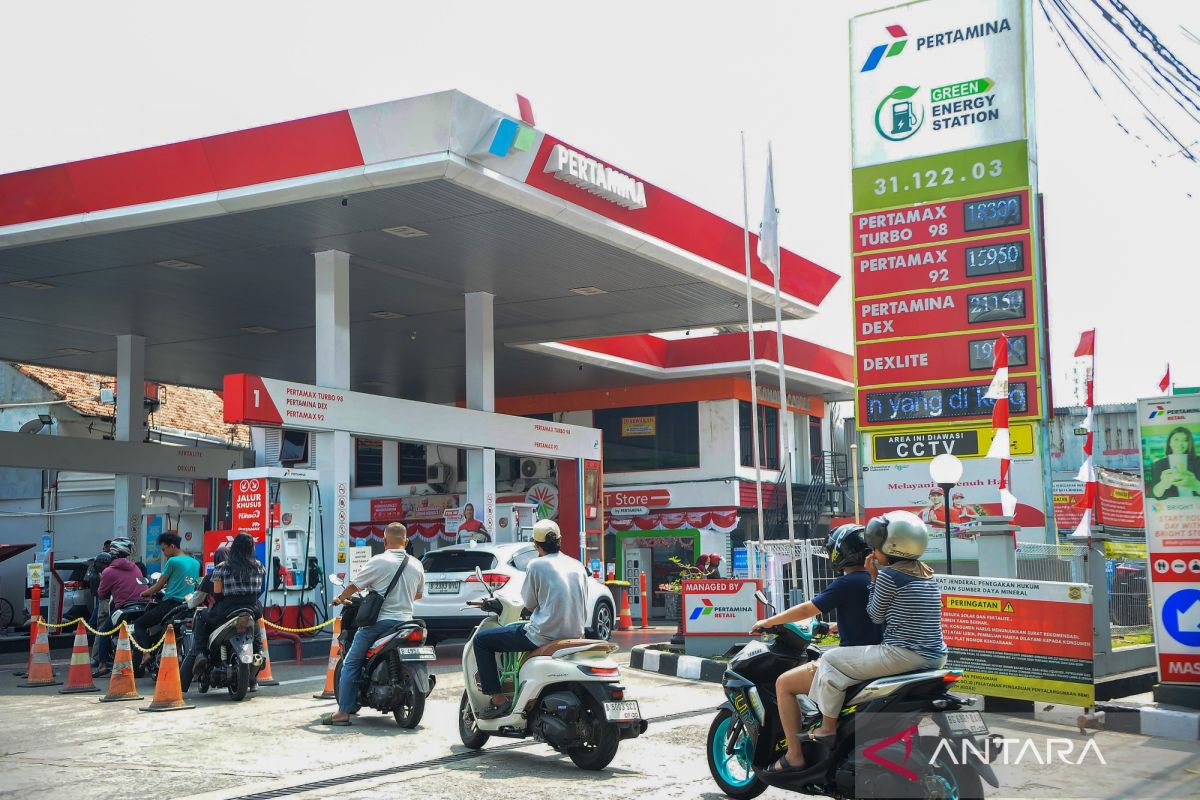
Every 500-rupiah weakening against the US dollar raises the economic price of fuel by around 350 rupiah per litre, more than the 300-rupiah reduction recently set by Pertamina for its Pertamax product. In early August 2026, Pertamina set the price of Pertamax down from 16,250 rupiah per litre to 15,950 rupiah per litre.
“What is most often overlooked is the exchange rate. A depreciation of just 500 rupiah would wipe out this 300-rupiah cut, without oil prices moving at all. So the risk comes not only from Hormuz, but also from the exchange rate,” Yayan said.
Oil prices fell more than 5 per cent on Monday after US President Donald Trump said peace negotiations with Iran would continue and announced his decision to call off a planned military strike against Iran.
Brent crude, the international benchmark, fell to around 83.40 US dollars per barrel (roughly 1.5 million rupiah) on Monday at 06.05 GMT (13.05 WIB).
Meanwhile, West Texas Intermediate (WTI), the US benchmark, also fell 6 per cent to 79.60 US dollars (around 1.4 million rupiah) per barrel.
Prices dropped sharply as hopes grew for a resumption of diplomacy to ease concerns over further disruption to energy supplies from the Middle East.
Source: jawawa.id (https://jawawa.id/newsitem/expert-falling-global-oil-prices-an-opportunity-to-reform-regulations-1785822836)
Originally published by Antara (Indonesian) (https://www.antaranews.com/berita/5678851/pakar-harga-minyak-dunia-turun-jadi-kesempatan-menata-aturan), translated from Indonesian