
Expert at Constitutional Court: Trend in Europe to Abolish Military Courts During Peacetime
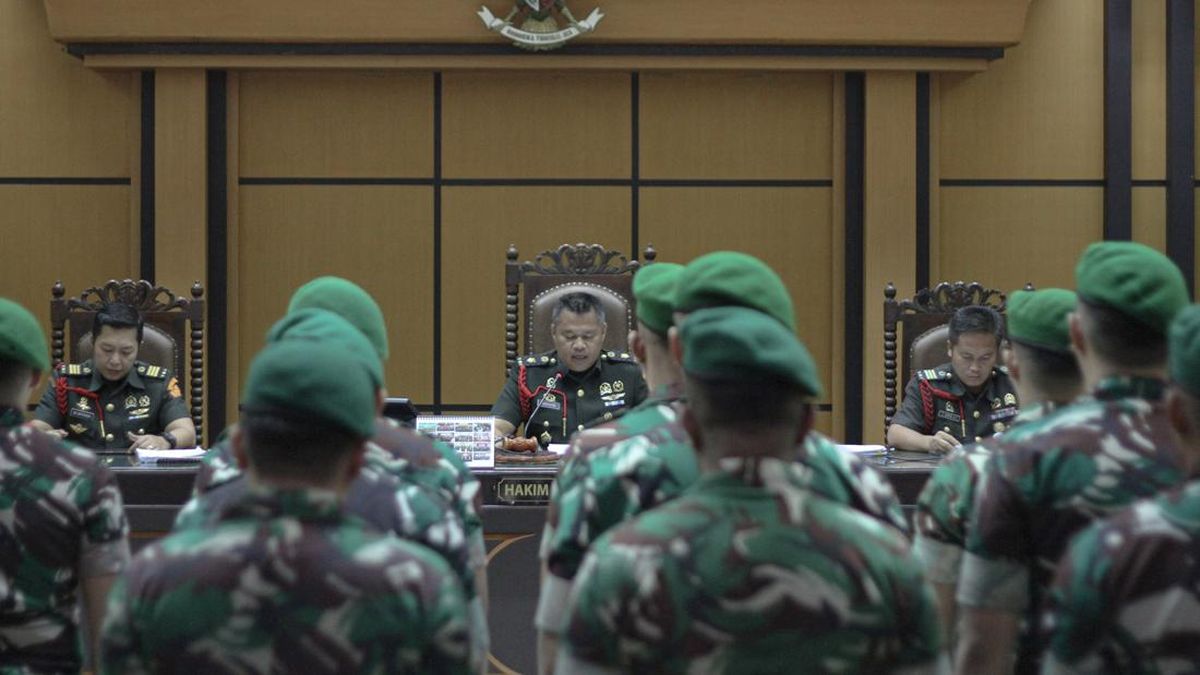
Chairman of the Al-Araf Centre Initiative Board revealed a strengthening trend in Europe to integrate or even abolish military courts, particularly during peacetime. This was stated by Al-Araf while providing expert testimony in case number 260/PUU-XXIII/2025 regarding the material review of Law No. 31 of 1997 on Military Justice at the Constitutional Court (MK) on Tuesday (14/4). “Countries such as Denmark, Slovakia, Czech Republic, Portugal, France, and Sweden apply a pure civilian model where all cases, including those involving the military, are handled by civilian courts,” Al-Araf said before the constitutional judges. “In addition to those countries, there are nations that do not even have military courts during peacetime. Military courts only operate during wartime,” he continued. Al-Araf exemplified Germany, which does not maintain military courts in peacetime and hands over criminal handling to civilian courts, while disciplinary violations are addressed through administrative mechanisms. “The same applies to the Netherlands. Why is that? Because military courts are essentially needed in relation to military interests in wartime duties and functions. So, they exist during war,” he explained. Al-Araf added that the issue of military courts in Indonesia is not merely a technical matter but concerns the protection of human rights (HAM) and the supremacy of law. The state’s inability to ensure that perpetrators from military members are tried through independent, transparent, and accountable courts ultimately reflects a failure to fulfil constitutional obligations to guarantee public safety. On this occasion, Al-Araf discussed several issues related to military courts. First, regarding the Military Court Law (31/1997), which was not created in a vacuum. This law was formed in 1997 during the authoritarian New Order political regime that ignored the principles of the rule of law and human rights. “During the New Order era, legal products formed in laws tended to be repressive and merely served as instruments of control for those in power,” he said. “The state formed laws at that time not within the framework of the rule of law, but solely to meet the needs of rule by law,” he continued. According to Al-Araf, military courts do not meet fair trial principles. This is because military courts for active soldiers potentially provide special treatment. Additionally, there is discriminatory treatment where civilians are tried in open and transparent general courts, while military personnel in similar cases are tried in military courts that tend to be closed. “… that all citizens must be subject to the same law and tried through the same judicial mechanisms without privileges for certain groups,” he emphasised. In addition to Al-Araf, the expert presented in this material review case regarding the Military Court Law is a lecturer from the Constitutional Law Department at the Faculty of Law, Gadjah Mada University (FH UGM), Zainal Arifin Mochtar. Uceng, his familiar name, concluded that there is a tangled or chaotic situation in the current military justice system. In his testimony as an expert, Uceng grouped his discussion into four concepts: the rule of law, equality before the law, the right to legal certainty, and judicial independence. He used textual, systematic, theological methods, and some aspects analysed philosophically in constitutional law to deliver his expert testimony before the constitutional judges. “I think it’s more than enough for us to say there is a tangled mess in military justice, in our concept of building a military justice system,” said Uceng. In the first hearing at the MK on Thursday, 8 January 2025, the Petitioners, represented by their attorney Ibnu Syamsul Hidayat, emphasised that impunity for soldiers contradicts the rule of law and equality before the law principles. The Petitioners also highlighted broader consequences, namely the weakening of civilian supremacy in the democratic governance system. The dominance of military court jurisdiction over general courts is deemed contrary to the principles of a constitutional democratic state that places civilian power above military power. According to the Petitioners, this dual jurisdiction stems from the provisions of Article 9 paragraph 1 of the Military Court Law, which gives special status to active TNI soldiers to be tried exclusively in military courts, even if they commit general criminal offences. This regulation is considered potentially to breed impunity and violate the principle of equality before the law. “The phrase ‘trying criminal offences’ in Article 9 paragraph 1 of Law No. 31 of 1997 opens opportunities and a broad basis for interpretation of military court authority, not only to try soldiers or those equated with soldiers who commit military crimes and disciplinary violations, but also to authorise trials for other criminal cases such as corruption, traffic, domestic violence, narcotics, psychotropics, and child protection,” said Ibnu, quoted from the MK website.