
Expert Analysis on Solok Flash Floods: Rain is Not the Sole Cause
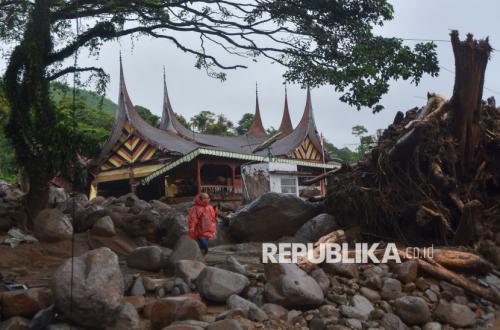
Daryono, a member of the Indonesian Disaster Experts Association (IABI), has analysed the causes of the flash floods that struck Solok, West Sumatra. Daryono stated that rainfall was not the sole cause of the flash flood’s occurrence.
Daryono noted that a rainfall rate of 94 mm/day acted as the trigger for the flash flood. However, to conclude why the flow developed into a flash flood carrying so much material, he believes it is necessary to analyse the upstream conditions, including slope gradient, soil saturation, landslides, sedimentation/loose material in the river channel, land cover, and runoff concentration.
“Therefore, it is inaccurate to conclude immediately that rain is the only cause. Essentially, the Solok ‘Galodo’ (flash flood) demonstrates a paradox common in meteorology: a month can be drier than normal, yet heavy rain of 9lag94 mm can still occur in a single day, triggering a disaster,” Daryono said on Wednesday (23/09/2026).
Daryono detailed that heavy rain with an accumulation of approximately 94 mm/day caused the water supply to the River Basin (DAS) to increase rapidly. Rain lasting several hours caused both infiltration and surface runoff to rise.
“When the soil’s ability to absorb water is exceeded, water concentrates directly towards the river channel,” said Daryuno.
Daryuno also explained that the upstream area of Solok has a hilly-mountainous topography with relatively steep slopes. These steep slopes accelerate surface runoff and provide significant gravitational energy, enabling the water to erode and transport soil, rocks, and wood into the river.
“Continuous rain fills the soil pores until they approach saturation. Pore water pressure increases, causing soil shear strength to decrease, which subsequently makes slopes more prone to landslides,” Daryuno added.
Daryuno noted that landslides on slopes or upstream areas can introduce soil, rocks, trees, and other materials into the river channel. This is what distinguishes a flash flood from ordinary flooding.
“The flow can transform into a mixture of water and solid material with much greater destructive power,” said Daryuno.
This can be worsened if there were already deposits of sand, gravel, boulders, wood, or landslide material at the riverbed and banks. Consequently, a sudden increase in discharge can re-mobilise these materials, increasing the volume and energy of the flash flood flow.
“A reduction in vegetation or disturbances to the land surface can decrease interception and infiltration while increasing erosion and runoff. However, the contribution of land cover changes to the Solok incident must be proven with land-use data,” Daryuno stated.
Furthermore, water from many slopes and tributaries eventually gathers in valleys and the main river channel. In steep river basins, the concentration time is short, meaning that according to Daryuno, the discharge can rise very rapidly.
“When combined with the supply of landslide material and sediment, a rapid flow laden with mud, rocks, and wood—known as ‘galodo’—is formed,” said Daryuno.
The Regional Disaster Management Agency (BPBD) of Solok Regency, West Sumatra, recorded that four residents were injured due to the flash floods that hit several areas in Arosuka, Gunung Talang District, on Monday night (21/09/2026). Subsequently, one resident was reported dead due to the disaster, while another was reported missing.
In addition to the injured, the Solok Regency BPBD noted that nine heads of households, or 32 individuals, were forced to evacuate due to the flash flood. The evacuees have been placed in two locations prepared by the local government to handle disaster-affected residents.
Furthermore, 11 government offices were affected by the flash flood. The BPBD also recorded that 21 cars and seven motorcycles were damaged by the disaster.
The flash flood hit the Solok Regent’s Office Complex in Bandar Baliang, Jorong Kayu Aro, Nagari Batang Barus, and Nagari Koto Gaek Guguk, Gunung Talang District.