
Expert Affirms Government Non-Discriminatory in Handling Sumatra Disasters
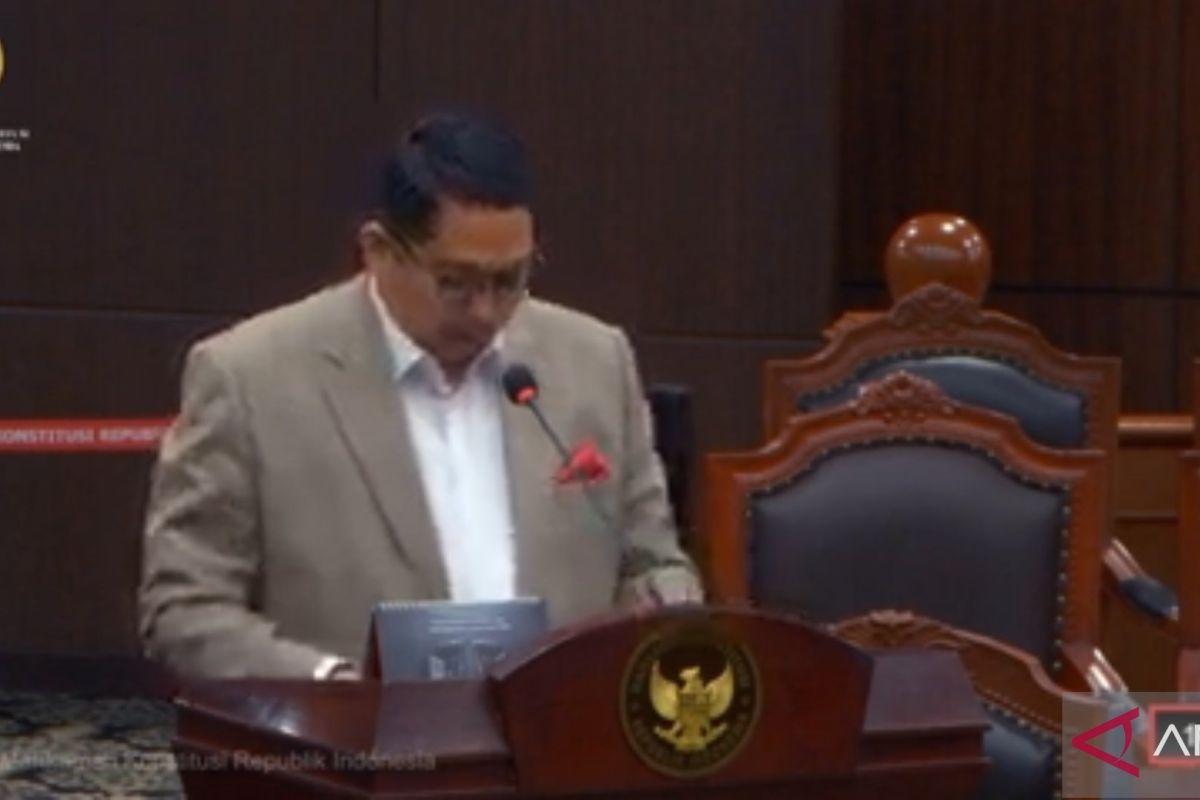
The central government’s responsibility in handling disaster mitigation is greater than that of regional governments, with the central government having seven indicators of responsibility and authority, while regional governments have only four.
Jakarta (ANTARA) - Constitutional law expert Dr. Muhammad Rullyandi has affirmed that the government does not discriminate in handling disaster mitigation in Sumatra (Aceh, North Sumatra, and West Sumatra).
During the hearing at the Constitutional Court on Monday, the expert explained that Law No. 24 of 2007 on Disaster Management contextually positions the president’s actions as administrative legal actions inherent in broad discretionary authority to assess and consider priority scales in disaster handling, which is also part of the constitutional mandate to protect the people.
“Your Honours (Constitutional Court judges), regarding what is stated in Law No. 24 of 2007, the expert assesses that there is no failure in formulating the law, as it aligns with the fact that Law No. 24 of 2007 has established rules without any legal vacuum in the implementing regulations,” said Rully.
“Including in the context of juridical integration and continuity in Articles 66, 67, and 68 as per the aforementioned law, the government does not discriminate in handling disasters, whether national or regional,” he added.
The government presented Rully, a lecturer at the Faculty of Law, Jayabaya University, as an expert witness in the material examination hearing of the Disaster Management Law for petition number 261/PUU/XXIII/2026, filed by five advocates.
The articles under review are Article 7 paragraphs (2) and (3) of the Disaster Management Law against the 1945 Constitution. This examination stems from the floods and landslides in Sumatra in December 2025, which resulted in 1,016 deaths and the displacement of 850,000 people, yet the government did not declare it a national disaster.
In the hearing, while providing testimony from the government’s expert, Rully stated that in the Disaster Management Law, the norms for determining a national disaster do not fall under the definition or general provisions.
Disasters are classified into three categories: natural factor disasters, non-natural disasters, and social disasters. There is no definition of a national disaster in the law. It is then operationalised in the main body norm of Article 7, with conditions that are singular in nature.
“The determination between a national disaster and a regional disaster is operational in the field, objective, subjective, and measurable in nature, and it is within the government’s domain to assess,” said Rully.
According to him, when implementing these norms is not uniform with other regions—for example, the government has previously declared national disaster status for the 2004 Aceh Tsunami, the 1992 Flores earthquake, and COVID-19 (a non-natural disaster) in 2020—such actions reflect the president’s view in prioritising the disaster situation.
“Whether the assessment is subjective or objective, the measure is to implement the law,” he clarified.
He emphasised that as long as the government’s objective is to implement the law and it is carried out in practice without violating any articles in the implementation of disaster mitigation, there is no unconstitutional norm in the formulation of Article 7 paragraph (2), which is then linked to indicators in the government’s assessment as subjective conditions that must be met to avoid non-uniformity in determining status between national and regional disasters.
The expert also conveyed that the central government’s responsibility in disaster mitigation handling is greater than that of regional governments, with the central government having seven indicators of responsibility and authority, while regional governments have only four.
“This proves that the president’s role is greater as the guarantor of protection for every citizen,” he said.
Therefore, he continued, disaster handling is not solely the responsibility of regional governments but must also be intervened by the central government, as this is crucial for implementing the legal ideals in the fourth preamble, that the Indonesian government is formed to protect the entire Indonesian nation and all of the homeland’s territory based on Pancasila, which is the state’s ideology, in this case, for welfare.
After hearing the expert’s testimony, Chief Justice Suhartoyo stated that this petition hearing is the final session. Subsequently, the parties—in this case, the petitioners, the DPR, and the president—are given seven working days after the final hearing to submit revisions to their conclusions before the judges issue a ruling.
“Before closing the hearing, thank you to the expert; hopefully, the testimony is beneficial for the panel in considering this petition,” said Suhartoyo.