
Experiencing a Friendly Islam and Indonesia at Al-Hikmah Mosque in New York
“Our focus is discussion, sharing knowledge and listening to one another, not debating and attacking each other.”
New York, United States (ANTARA) — As soon as I appeared at the entrance of Al-Hikmah Mosque in New York, a member of the congregation immediately offered to show me in.
“Oh, thank you, sir. But I am not a Muslim, is that alright?” I asked to make sure.
With a smile, the man replied, “This mosque is open to everyone.”
Feeling reassured, I followed his steps towards a small dining room in a corner of the mosque.
“There is some pizza here, because we happened to have an event earlier. If you want coffee or tea, we have that too. Please, help yourself,” he said.
Warmth immediately filled the encounter. The conversation flowed easily, and I was eventually welcomed by the Imam of Al-Hikmah Mosque, Rasul Amin.
Rasul, a man originally from South Sulawesi, greeted me with the characteristic family warmth of Indonesia.
“Welcome, Brother, to Al-Hikmah Mosque,” he said.
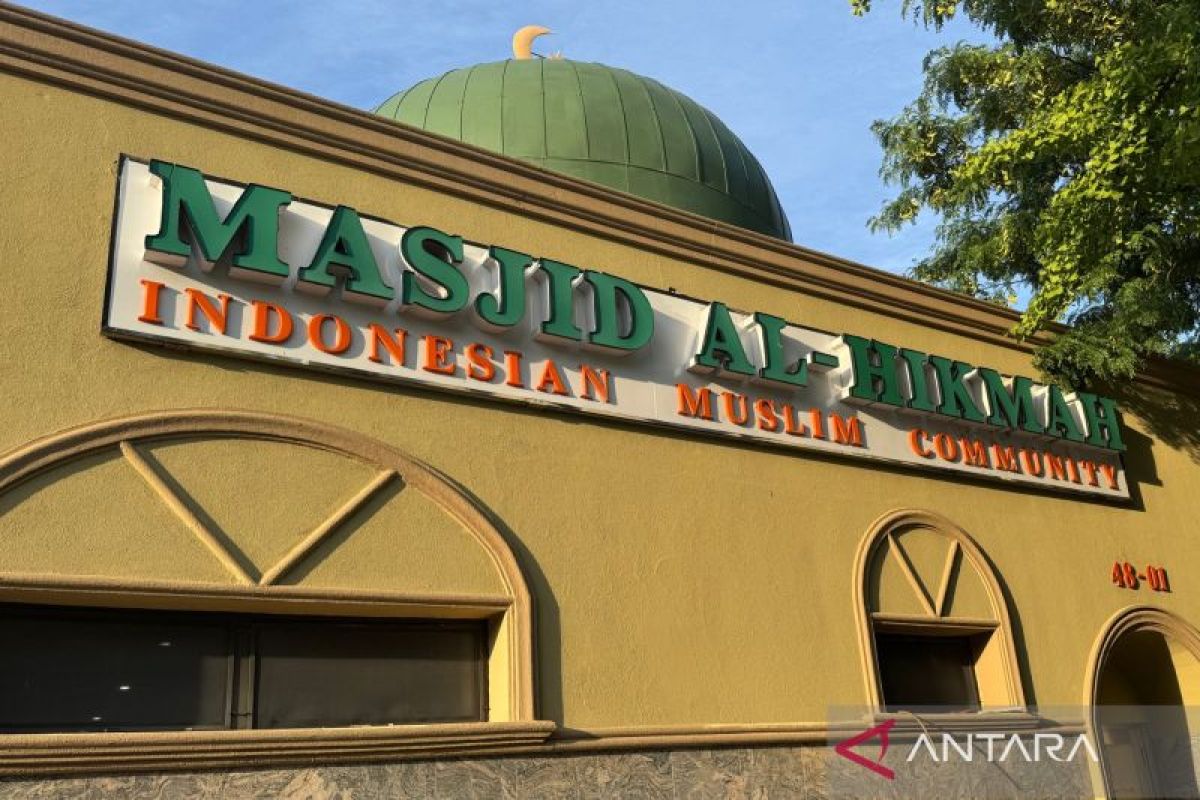
Rasul spoke enthusiastically about Al-Hikmah Mosque, which is managed by the Indonesian Muslim Community and located at 48-01 31st Ave, Astoria, New York 11103.
Although run by the Indonesian community, the mosque’s congregation is not only Indonesian, but also comes from other countries such as the United States, Pakistan, Bangladesh and India.
“This mosque can accommodate around 700 people,” said Rasul.
Al-Hikmah Mosque and the Indonesian Muslim Community have spent nearly 31 years introducing the friendliness of Islam in the United States, particularly in New York.
The building housing Al-Hikmah Mosque, the first Indonesian mosque in the US, was originally a former warehouse purchased by The Indonesian Muslim Community, Inc (IMCI) in the mid-1990s.
The purchase money came from fundraising by IMCI. Most of the donors were businesspeople in Indonesia.
IMCI, then led by Prang Sakirman, began as an organisation formed by a Quranic study group of Indonesian Muslims in New York City, tasked with finding and acquiring a building to establish a mosque.
The Indonesian Muslim diaspora there felt the need for a permanent and spacious place to perform prayers, religious study and other Islamic activities. Before the mosque existed, their study sessions were held from house to house, and at times they had to borrow the premises of the Indonesian Consulate General in New York because their numbers kept growing.
After finding a suitable location and building, extensive renovations were carried out. On 17 August 1995, exactly 50 years after Indonesian Independence, Al-Hikmah Mosque, meaning the Mosque of Wisdom, was established.
Two months later, in October 1995, IMCI received an injection of funds of around 150,000 US dollars from the Amal Bakti Muslim Pancasila Foundation, chaired by Indonesia’s second President, Soeharto, to develop the mosque. The magnificent Al-Hikmah Mosque has stood firm ever since.
Interfaith
The presence of Al-Hikmah Mosque in New York is regarded as an oasis, not only for Indonesian Muslims there, but also for followers of Islam from other countries.
“It feels like all the communities (around Al-Hikmah Mosque) gather here, not only those from Indonesia. There are so many good things about this mosque,” said Sami Zaman, a New Yorker who is part of the Al-Hikmah congregation and lives not far from the mosque.
Sami Zaman said the Muslim community nearby always views Al-Hikmah Mosque positively because of its contributions. What has left the deepest impression on him are the simplest things, such as teaching the Quran to children as well as adults.
For the communities surrounding Al-Hikmah Mosque, that “small” attention is highly valuable. They feel cared for and nurtured as part of one big family.
According to Rasul Amin, Al-Hikmah Mosque indeed holds many activities to strengthen bonds among the faithful, including the Indonesian diaspora.
Every Wednesday, for example, there is the Wednesday Halaqah. On Saturdays, there is a youth programme for young people. On Sundays, it is the turn of religious study for men.
Each month, Al-Hikmah Mosque also holds a large joint study session and a bazaar featuring Indonesian food. At the bazaar, it is not only Muslims who take part.
“Indonesian nationals who have just come from church usually also drop by and eat here. So, if anyone living in or visiting New York misses Indonesian food, please come along,” said Rasul.
Of the many activities, the most interesting is the interfaith programme, or interreligious dialogue. Al-Hikmah Mosque has been running this agenda for many years.
Rasul said the mosque’s interfaith dialogue is directly guided by the renowned Muslim scholar Imam Shamsi Ali.
Under the programme, Al-Hikmah Mosque receives visits from other religions and faiths who come to learn about Islam. Or, representatives from the mosque visit other houses of worship and share knowledge there.
For the managers of Al-Hikmah Mosque, openness is the best means of proclaiming the friendliness of Islam as well as the warmth of Indonesian society.
Islam, Rasul continued, should ideally be seen as a religion that brings peace, especially amid the complexity of human relations in the diverse United States.
At Al-Hikmah Mosque, interreligious dialogue takes place quite frequently, up to three times a month.
The spirit of building bridges amid differences has further cemented the position of Al-Hikmah Mosque and the Indonesian Muslim Community in the United States.
The serenity of Islam and the courtesy of Indonesia that are consistently highlighted have become all the more meaningful, given that a country like the United States is often gripped by Islamophobia.
The Council on American-Islamic Relations (CAIR) stated in March 2026 that Islamophobia and hostility targeting the Muslim community in America continue to rise across the country.
CAIR recorded that in 2025 it received 8,683 complaints related to these issues from all US states.
“That is the highest since 1996,” it wrote.
The situation in the US has not gone unnoticed by Al-Hikmah Mosque and the Indonesian Muslim Community.
However, they are confident that by consistently showing warmth, friendship and openness, Islam can find its place amid America’s plurality.
“That is why, in our interfaith programme, our focus is discussion, sharing knowledge and listening to one another, not debating and attacking each other,” said Rasul Amin.