
Examining the Role of the National Defence Council: Experts Emphasise the Need for Clarity on Inter-Agency Functions
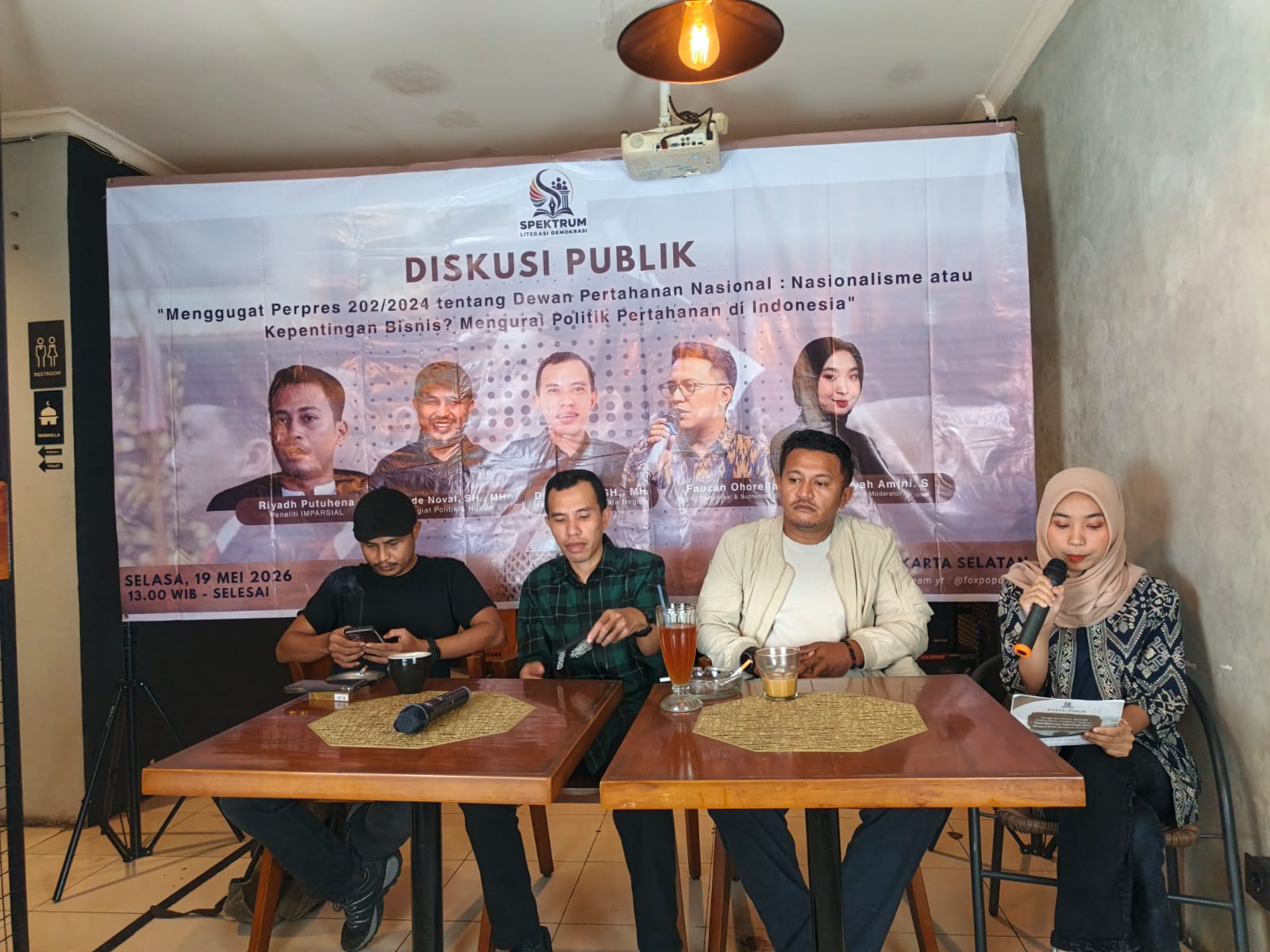
The Presidential Regulation (Perpres) Number 202 of 2024 on the National Defence Council (DPN) has attracted attention from various quarters. While the government regards the DPN’s presence as crucial for strengthening coordination of defence strategy amid tight global geopolitics, cyber threats, and non-military challenges, some analysts and legal activists have begun to highlight questions of mandate boundaries and the effectiveness of the new body. This issue was the central topic in a public discussion organised by Spektrum Literasi Demokrasi (SLD) titled ‘Challenging Perpres 202/2024 on the National Defence Council: Nationalism or Business Interests? Unpacking Indonesia’s Defence Politics’ in Jakarta on Tuesday (19 May 2026). The discussion featured democracy activist Fauzan Ohorella, constitutional law academic Rorano S. Abubakar, and political and legal activist La Ode Noval. In his presentation, Fauzan Ohorella stressed the need for robust and transparent supervisory mechanisms within the DPN to keep civilian supremacy primed in a democratic climate. He pointed to Article 6 of Perpres Number 202 of 2024, which designates the Minister of Defence as the DPN’s Acting Chairman. ‘This raises ambiguity because the Minister of Defence is simultaneously part of the defence policy executor, but also leads a coordinating body that provides considerations to the President,’ he said. In addition to governance, Fauzan also noted that several programmes within the Ministry of Defence touch on the public sector and state-owned enterprises, including management of education funding allocations and procurement programmes for operational armoured vehicles. To ensure accountability, he urged strong external oversight of every policy formulated by the DPN. From a constitutional law perspective, academic Rorano S. Abubakar of Universitas Muslim Indonesia outlined the historical evolution of defence institutions in Indonesia, from the Dewan Pertahanan Negara in 1946, Wantannas since 1969 to 2024, to the current DPN established by the latest Perpres. He reminded that the formation of government institutions should adhere to the doctrine “form follows functions,” emphasising functional clarity and simplicity as guiding principles. Aligning with this view, political and legal activist La Ode Noval questioned the technical necessity of the DPN as a coordinating and advisory body, arguing that the government should clarify the DPN’s scope to avoid overlap with existing defence and security agencies. He noted that bodies such as Lemhannas, TNI, Polri, and Kemenko Polhukam already have duties in security and defence, and that clarification is essential to prevent concerns about militarisation of civilian spaces. One of the key concerns is potential overlaps with existing ministries and agencies. The government, through the Ministry of Defence, has signalled the need for clear boundaries and external oversight to ensure proper functioning of the DPN.