
Examining the Harmonized System and Indonesia’s Leadership at the HSC
JAKARTA — Have you ever wondered why imported goods such as shoes, mobile phones or coffee machines are assigned particular classifications when they enter Indonesia? These classifications are among the foundations for determining customs tariffs, compiling trade statistics and applying export and import rules.
The international system used to classify goods is known as the Harmonized System (HS). It covers more than 5,000 groups of goods, each identified by a six-digit code, and is used by more than 200 countries and economies as the basis for setting customs tariffs.
The HS serves as a universal language for trade, used by governments, international organisations and the private sector to support trade policy, goods monitoring, taxation, trade statistics and economic analysis.
The system was developed by the World Customs Organization (WCO), an international organisation that promotes effective customs administration through common standards, trade facilitation, oversight and cooperation between countries.
Netty Hartawati, Head of the Customs Public Relations and Outreach Subdirectorate, explained that the HS provides a nomenclature, or list of goods classifications, used by its member countries. With a common reference, goods can be identified more consistently in international trade.
“For example, sports shoes and safety shoes may both be called shoes in everyday conversation, but their characteristics and functions need to be considered when determining their classification,” she said.
In ASEAN, the HS underpins the ASEAN Harmonized Tariff Nomenclature (AHTN), while in Indonesia its application is set out in the Indonesian Customs Tariff Book (BTKI). Both adapt the international classification structure to regional and national needs, including the details required for customs administration and trade policy.
For businesses, accurate classification helps determine the requirements they must meet when importing or exporting goods. For governments, consistent classification supports the compilation of trade statistics and the implementation of policy. Differences in how a product is classified can therefore affect the tariff applied and the fulfilment of customs obligations.
Netty said the HS must be maintained and developed regularly to keep pace with changing types of goods and the needs of trade. This work is undertaken by the Harmonized System Committee (HSC), a WCO committee that considers classification issues, interprets HS provisions and addresses differences of view among members.
The HSC currently has 163 contracting parties, comprising countries and customs or economic unions that are parties to the HS Convention.
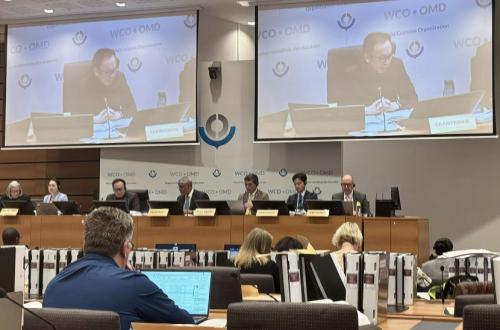
At the HSC’s 78th session, held from 7 to 18 September 2026 at WCO headquarters in Brussels, Belgium, 67 members — 66 countries and the European Union — took part in discussions alongside the WCO Secretariat and a number of observers.
Of the 99 items on the agenda, the committee examined and discussed 91. Indonesia, represented by Customs as an HSC member, made history by taking up the strategic position of HSC Chair for the first time. Taufik Ismail, Head of the Class I Customs and Excise Laboratory in Jakarta, was elected to lead the committee in 2026.
The session’s agenda covered goods classification, improvements to HS reference instruments, preparations for implementing HS 2028 and the development of HS 2033. Classification discussions are important to ensure that the characteristics of goods are applied consistently, particularly as product names, functions and technologies evolve.
“For example, in trade involving machinery, electronic devices or products with multiple functions, classification must be based on the goods’ characteristics and the applicable HS provisions, not merely the trade name used by the seller. A shared understanding helps customs administrations apply the rules more consistently and gives businesses a reference when preparing export and import documents,” Netty explained.
The session’s outcomes form part of the process of maintaining and developing the HS. However, discussions at international level do not mean that every change takes effect immediately in Indonesia.
Implementation depends on the status of the decisions, the process of adapting the nomenclature and follow-up through the relevant regional and national mechanisms.
“HS development should be understood as part of the effort to maintain consistent goods classification in international trade. For the public and businesses, correct classification helps clarify how to meet customs requirements; for governments, it supports more consistent administration and trade data,” Netty said.
At the session, Taufik Ismail was re-elected by acclamation as HSC Chair to lead its 79th and 80th sessions in 2027. The decision reflects members’ confidence in Indonesia’s ability to lead technical discussions and facilitate the exchange of views among members.
As chair, Indonesia is responsible for ensuring the sessions run effectively, helping with coordination and ensuring discussions follow the committee’s procedures. The role does not confer authority to make decisions unilaterally.
Decisions on classification and HS development continue to be discussed collectively by HSC members. Meanwhile, Indonesia will continue to put forward technical views and safeguard national interests as an HSC member, working with its delegation and relevant technical units.
Indonesia’s re-election offers an opportunity to continue contributing to international customs cooperation. For the public and businesses, the process matters because it helps keep the goods classification system in line with developments in trade, while supporting consistent customs administration and certainty in import and export activities.
Source: jawawa.id (https://jawawa.id/newsitem/examining-the-harmonized-system-and-indonesias-leadership-at-the-hsc-1793263914)
Originally published by Republika (https://republika.co.id/berita//tnnswu416/menyelisik-harmonized-system-dan-kepemimpinan-indonesia-di-hsc), translated from Indonesian