
Exactly 28 Years Ago: 21 May 1998 — Soeharto Officially Resigns and the New Order Falls
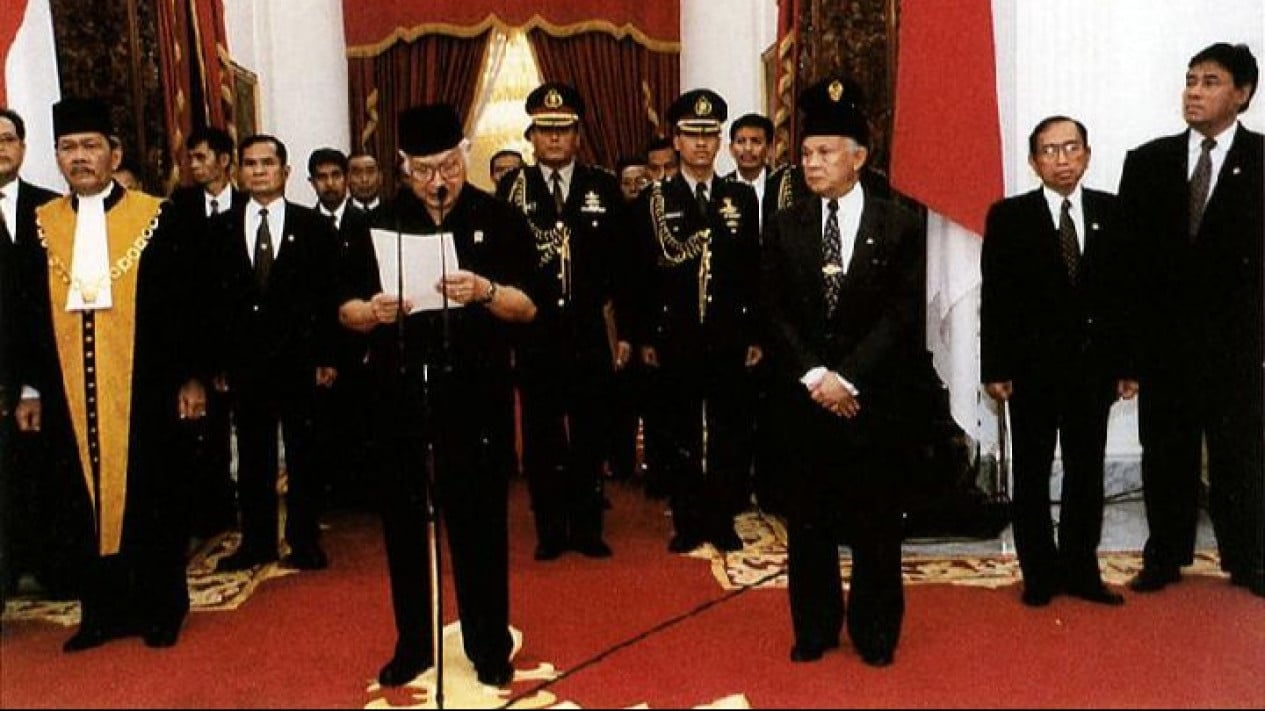
Exactly 28 years ago, on 21 May 1998 at 09:00 WIB, Indonesia entered one of the most historic moments in the nation’s history. Indonesia’s second president, Soeharto, officially announced his resignation after leading the country for 32 years. The brief speech delivered at the Merdeka Palace in Jakarta marked the end of the New Order era and the birth of a new chapter of Indonesian democracy through Reformasi in 1998.
The capital’s morning atmosphere was tense. The main streets of Jakarta remained heavily guarded by security forces. Tanks and military vehicles stood at strategic points after waves of student demonstrations and large-scale riots had rocked Indonesia in the days prior.
However, Soeharto’s collapse did not occur overnight. The Asian financial crisis (Krismon) that began affecting the country in 1997 became the starting point of a major shock to the New Order regime. The rupiah’s exchange rate plummeted, prices of essential goods jumped, companies went bankrupt, mass layoffs occurred in various regions, and poverty rose sharply.
Economic conditions deteriorated, fuelling rising public anger. The people began losing confidence in a government that had been known for decades for its strength and stability.
On 15 January 1998, Soeharto even signed a Letter of Intent with the IMF as part of attempts to save Indonesia’s economy. Yet conditions worsened. The rupiah continued to weaken, breaking through more than Rp10,000 per US dollar.
Student Protests Demand Reform
Amid this climate, waves of student demonstrations began to appear in various cities. Students demanded a total reform of the New Order government, which they regarded as rife with Corruption, Collusion, and Nepotism, or KKN. They also criticised a political system deemed undemocratic, including the Dwifungsi ABRI practice which granted a major role to the military in governance and national politics.
Although the protest wave grew larger, Soeharto still proceeded to the 1998 General Session of the MPR (People’s Consultative Assembly) and was re-elected as Indonesia’s president for the seventh time on 11 March 1998.
That decision further inflamed public anger. Student demonstrations continued at universities across Indonesia. The situation intensified after the government raised fuel prices and the base electricity tariff in early May 1998, at a time when the economy for the people was already depressed.