
Ex-Jampidsus Camp Reveals 30 Legal Defects in Suspect Designation
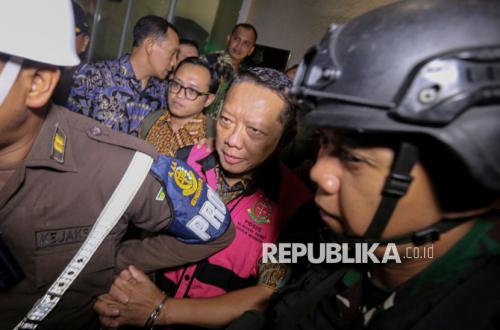
The defence team for suspect Febrie Adriansyah has revealed at least 30 procedural errors committed by the Indonesian National Police against the former Deputy Attorney General for Special Crimes. Lawyer Febri Diansyah explained that several of these relate to defects in the suspect designation procedure, a search conducted without court permission, an overseas travel ban, and the transfer of the case to the Attorney General’s Office.
Febri conveyed this briefly after reading out the pretrial motion filed by Febrie as a suspect at the South Jakarta District Court on Tuesday (18/8/2026). “Simply put, the core of our application concerns five aspects. We have identified around 30 procedural violations within the five aspects we are requesting,” he said.
Febri explained that the five aspects concern the designation of Febrie as a suspect in a money laundering case. However, the designation of his client as a money laundering suspect did not include the predicate offence. “In this matter, there is also an error concerning the combination of the predicate offence and money laundering in a single investigation order,” Febri said. Secondly, he addressed the search and seizure process carried out by police investigators at Febrie’s residence.
Thirdly, Febri said the suspect designation was made without any preliminary inquiry, and was also carried out without examining him as a witness or prospective suspect. “Fourth is the overseas travel ban, and fifth concerns the handling of the case at the Attorney General’s Office,” Febri stated.
The legal defence team asked the sole pretrial judge to annul Febrie’s suspect status because it was carried out through unlawful means. They also requested the pretrial court to return assets seized through a search conducted without proper authorisation.
In the pretrial motion, the applicant’s team stated that Febrie’s suspect designation was based on the issuance of Investigation Order Number SP.Sidik/2932/VII/RES.3.3/2026/Polda Metro Jaya dated 6 July 2026. The investigation order was issued half a year after Police Report Model A Number LP/A/2/2026/SPKT. DIRRKRIMSUS/POLDA METRO JAYA dated 13 January 2026. However, during the six months from the report to the investigation, no preliminary inquiry was conducted.
During that period, police investigators never once summoned or examined Febrie as a witness who would be made a prospective suspect. “This is clearly evidenced by the absence of any preceding process in the preliminary inquiry involving a summons as a witness or prospective suspect, and a case review to establish a criminal event,” said lawyer Parlin Sihombing while reading the pretrial motion. Without such a process, he said, police investigators had acted arbitrarily.
The legal defects and arbitrariness became even clearer because after the investigation order was issued, Polda Metro Jaya investigators immediately conducted a search on 8 July 2026. “Thus, the issuance of the investigation order in question is absolutely without legal basis because it ignores the formal procedural stages regulated in the Criminal Procedure Code,” Parlin said. The error was compounded by the search conducted by police investigators based solely on the 6 July 2026 investigation order, without going through a preliminary inquiry.
It is commonly understood that legal enforcement must begin with a preliminary inquiry before reaching the investigation stage. “A preliminary inquiry is not a formality, but rather a determining stage to assess whether an event can be elevated to an investigation. Skipping that stage means eliminating the filtering function designed to protect citizens from arbitrary investigations,” Parlin said.
Parlin continued that because the investigation order was issued through a legally defective process, all subsequent legal actions taken by the police should also be considered legally defective, including the search. “Because the investigation order is legally defective, the search based upon it is also legally defective and has no binding legal force,” Parlin said. Regarding the search, Parlin also revealed that it was further legally defective because the process did not obtain permission from the chief judge of the court in the jurisdiction where the search took place.
The search conducted by police investigators took place in Sentul City, Parahyangan Golf-2 Cluster, located in Babakan Madang, Bogor, West Java. The search location falls under the jurisdiction of the Cibinong District Court. Article 112 in conjunction with Article 113 paragraph (1) in conjunction with Article 116 of the Criminal Procedure Code requires that a search be conducted with permission from the chief judge of the district court in the area where the search is conducted. Police investigators only provided a search letter based on Search Order Number SP.Dah/3006/VII/RES.3.3/2026 issued by Polda Metro Jaya itself on 8 July 2026.
Parlin acknowledged that there was indeed a search permit issued by the Cibinong District Court numbered 26/Pid.B-Geledah/2026/PN.Cbi. However, the search permit only referred to another investigation order issued by Polda Metro Jaya. “In such circumstances, legally it is the same as a search conducted without permission,” Parlin said.
On that basis, Parlin also told the sole pretrial judge that all legal actions in the form of asset seizures carried out by police investigators based on the legally defective investigation order and search order would become irrelevant for use as evidence in the designation of Febrie as a suspect.