
Evaluation of Anti-Corruption Law: DPR Legislative Body Holds Public Hearing with Criminal Experts and Former KPK Leaders
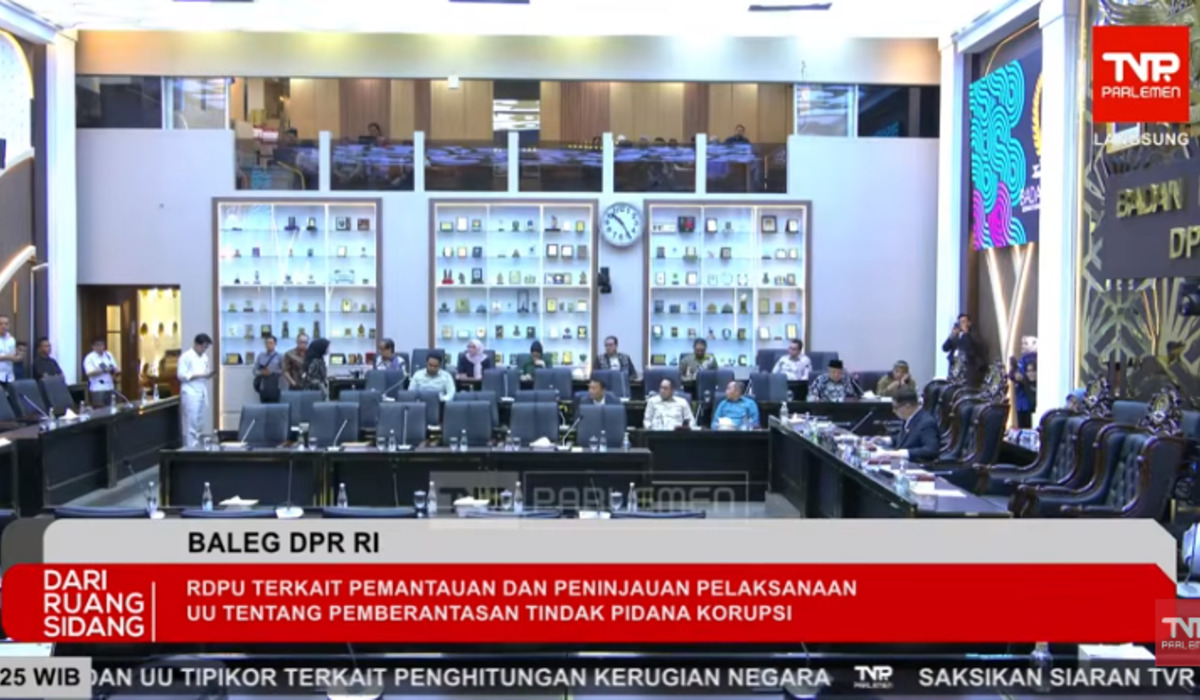
The Legislative Body (Baleg) of the Indonesian House of Representatives (DPR RI) held a Public Hearing (RDPU) to monitor and review the implementation of Law Number 20 of 2001, which amended Law Number 31 of 1999 concerning the Eradication of Corruption Crimes (Anti-Corruption Law), at the Parliament Complex, Senayan, Jakarta, on Monday (18/5/2026).
Experts in attendance included criminal law specialists from Padjadjaran University, Romli Atmasasmita and Firman Wijaya. In addition to academics, the Legislative Body also invited Amien Sunaryadi, the former Deputy Chairman of the Corruption Eradication Commission (KPK) from its first term.
The Chairman of the DPR Legislative Body, Bob Hasan, explained that the focus of today’s monitoring is the alignment of law enforcement spirit in addressing state financial losses. He noted that the focus includes Articles 603 and 604 of the new Criminal Code (KUHP) and Criminal Procedure Code (KUHAP) regarding state losses and profits for individuals or corporations, as well as the impact on the national economy.
Bob also referenced Constitutional Court Decision Number 28/PUU-XXIV/2026, which rejected the judicial review of the phrase “harming state finances” in Articles 603 and 604 of Law Number 1 of 2023 (the new KUHP). He emphasised that the issue of state losses due to corruption has become a crucial discourse involving the entire national legal structure to ensure justice and legal certainty. He noted that this discourse involves the DPR, the Indonesian National Police, the Attorney General’s Office, and the Supreme Court.
Criminal law expert Romli Atmasasmita criticised current law enforcement practices in Indonesian corruption cases, which he believes often deviate from the law. He argued that prosecutors must be able to prove the existence of kickbacks from project tender winners to officials. Furthermore, the Constitutional Court has ruled that violations regulated in sectoral laws—such as forestry, banking, or environmental law—can still be prosecuted under the Anti-Corruption Law.
The changes to the KUHP and KUHAP are described as increasingly complex and progressive, prompting corporations to shift their perspectives and approaches toward criminal subjects and objects.