
European Giant Fighter Jet Project Worth Rp2,080 Trillion Officially Disbanded, Why?
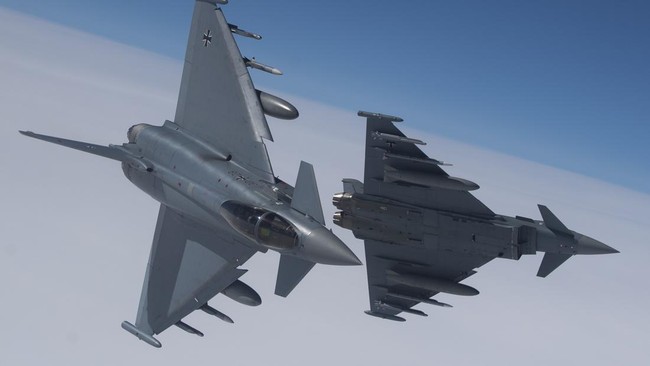
France and Germany have officially halted the development of Europe’s next-generation fighter jet, the Future Combat Air System (FCAS), after years of disputes between the companies involved. The decision marks a major blow to Europe’s ambitions to strengthen defence cooperation amid escalating global geopolitical tensions. French President Emmanuel Macron and German Chancellor Friedrich Merz assessed that the firms involved in the project are no longer able to reach an agreement on the programme’s development direction. “They reached a joint assessment that the companies would not be able to come together. They acknowledge this reality,” an official said.
FCAS was first launched in 2017 by former German Chancellor Angela Merkel and Macron as a strategic project to replace France’s Rafale fighter jets and the Eurofighters used by Germany and Spain around 2040. The programme had a value of approximately 100 billion euro. However, the giant project was continually plagued by conflicts between France’s Dassault Aviation and Airbus, which represented the interests of Germany and Spain. The disputes primarily concerned the division of control and programme leadership. Dassault reportedly wanted to be the prime contractor to protect its intellectual property rights, whilst Airbus pushed for a more balanced cooperation model with broader technology transfer. Beyond industrial issues, Paris and Berlin also held differing views regarding the aircraft specifications to be developed. France wanted a single European combat platform that could meet all of its military needs, including the ability to carry nuclear weapons and operate from aircraft carriers. Germany, on the other hand, assessed its military requirements differently and did not need the same specifications. Mr Merz had even previously questioned the relevance of developing a manned sixth-generation fighter jet for the German air force, noting that EU member states have diverse military equipment needs, making it difficult to unify one design for all parties.
The end of FCAS represents a setback for Europe’s efforts to build defence independence after years of facing limited military investment. The move also comes as European nations seek to strengthen defence capabilities in the face of threats from Russia and uncertainty over security commitments from the United States. Nevertheless, several European sources indicated that not all elements of FCAS would be stopped. The combat drone programme and a high-security military data cloud system stand a chance of being continued. A German government source stated that “the actual core of FCAS will be continued as a European system,” describing it as a “nervous system” connecting fighter jets, drones, and various other defence components in one integrated network. The decision to terminate the project was reportedly discussed by Macron and Merz during a meeting on the sidelines of the EU and Western Balkans Summit in Montenegro. Previously, the two leaders had tried to push Airbus and Dassault to reach a compromise, including appointing mediators from each country last March. However, various rescue efforts failed to bear fruit. Dassault’s chief even asserted that his company was capable of developing the project alone and rejected the concept of joint management. To date, neither Dassault nor Airbus has provided official comment regarding the termination of the FCAS project.