
European Economic Giant Faces a Real Threat of Recession as Outlook Darkens
Paris, CNBC Indonesia — France, one of Europe’s economic giants, is facing an increasingly serious threat of recession. Persistently weakening business activity, a wave of job cuts and political uncertainty ahead of the 2027 presidential election have darkened the country’s economic outlook.
The latest warning came as activity in France’s private sector fell to a six-month low in November 2026. The figures suggest that economic pressures have not eased, even as the country seeks to maintain growth.
According to the S&P Global Purchasing Managers’ Index (PMI), released on Monday, France’s manufacturing sector performed worse than its services sector. Companies also continued to cut jobs, with redundancies recorded for the seventh consecutive month.
The survey found that private-sector pessimism about the outlook for the coming year was at its highest level since late 2012, excluding the early months of the Covid-19 pandemic. The latest PMI data have also increased the likelihood that France will experience a technical recession in the fourth quarter of 2026.
A technical recession occurs when an economy contracts for two consecutive quarters. France’s gross domestic product (GDP) had already contracted by 0.1% in the third quarter of 2026.
Joe Hayes, chief economist at S&P Global Market Intelligence, said the eurozone’s second-largest economy was struggling with weak domestic demand. One factor was that many clients were reluctant to commit to new projects ahead of the uncertain 2027 presidential election.
“We have seen business confidence fall rapidly in recent months as other longstanding issues, such as concerns about France’s fiscal position, have resurfaced with the election approaching,” Hayes said, as quoted by CNBC International on Thursday (25 November 2026).
France faces pressure from several directions. High government borrowing costs, a weakening stock market and a downgrade to the country’s rating outlook by Fitch have compounded the difficulties.
Weak domestic demand, political uncertainty, competition and high operating costs are also making it harder for businesses to expand.
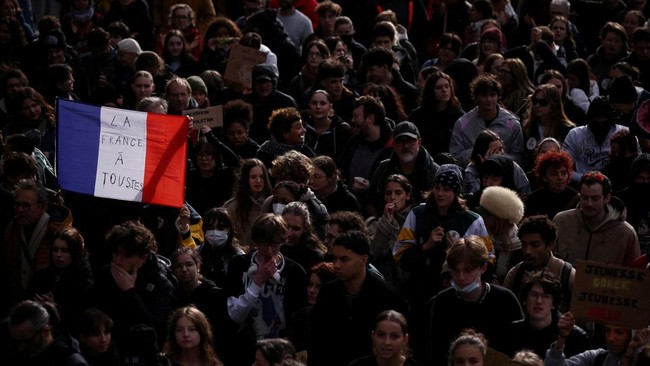
The situation has been further aggravated by major demonstrations in October and November. Hundreds of thousands of people took to the streets to protest against inadequate education funding, the high cost of living, poor public services and housing conditions.
The 2027 election weighs on the outlook
Political uncertainty is one of the main factors clouding France’s economic prospects. The country will hold a presidential election in April 2027, with several candidates offering a departure from President Emmanuel Macron’s policies attracting voters’ attention.
Politico polling throughout the year has consistently placed far-right candidate Marine Le Pen among the frontrunners. Uncertainty about the election outcome has led many companies to postpone investment decisions, slow negotiations and suspend business commitments that were close to completion.
Helene Gans, president and co-founder of investment fund Renaissance Capital, said companies were delaying decisions to a worrying extent ahead of the 2027 presidential election.
Another source of pressure is the high yield on French government bonds. Rising borrowing costs mean companies must spend more to refinance debt and fund new projects.
The yield on France’s 10-year government bond has approached 5%.
Property developer Nexity said the situation had reduced households’ ability to obtain loans. As a result, its home sales to individual buyers fell by 18% in the first nine months of the year.
Is there still hope of avoiding recession?
Despite the growing threat of recession, the Bank of France does not expect the economy to fall into contraction. Governor Emmanuel Moulin said the central bank still forecasts positive growth in the fourth quarter of 2026.
“We do not see a recession coming. We expect positive growth in the fourth quarter,” Moulin said.
He said that, based on a monthly survey of 8,500 companies, some industrial and services sectors in France remained resilient. Electricity, defence and aviation were among the industries considered capable of withstanding various global shocks.
Easing energy price pressures could also help the French economy. Moulin acknowledged that political uncertainty and concerns about the country’s finances had weighed on consumption and investment.
He also said the spread between French and German government bond yields was currently too wide given France’s economic conditions, arguing that markets had overreacted. Nevertheless, the government needed to demonstrate its commitment to reducing the budget deficit.
The French government has proposed a budget aimed at reducing the deficit from 5.4% to 5% of GDP. Finance Minister Roland Lescure has also acknowledged that the 1% growth forecast for 2027 may have to be lowered.
One option being promoted is a ‘golden rule’ for the budget: a reform to tighten oversight of public spending and prevent the government from running excessive deficits.
Moulin said most presidential candidates had pledged to reduce the deficit to 3% of GDP. But, he said, promises alone would not be enough.
“We need more than words. We need action. And the first action to demonstrate the government’s commitment to fiscal discipline is to have a budget,” he said.
Source: jawawa.id (https://jawawa.id/newsitem/european-economic-giant-faces-a-real-threat-of-recession-as-outlook-darkens-1795668634)
Originally published by CNBC Indonesia (https://www.cnbcindonesia.com/news/20261125232530-4-788531/raksasa-ekonomi-eropa-benar-benar-terancam-resesi-semua-suram), translated from Indonesian