
European Commission opens door for Canada to become EU associate member
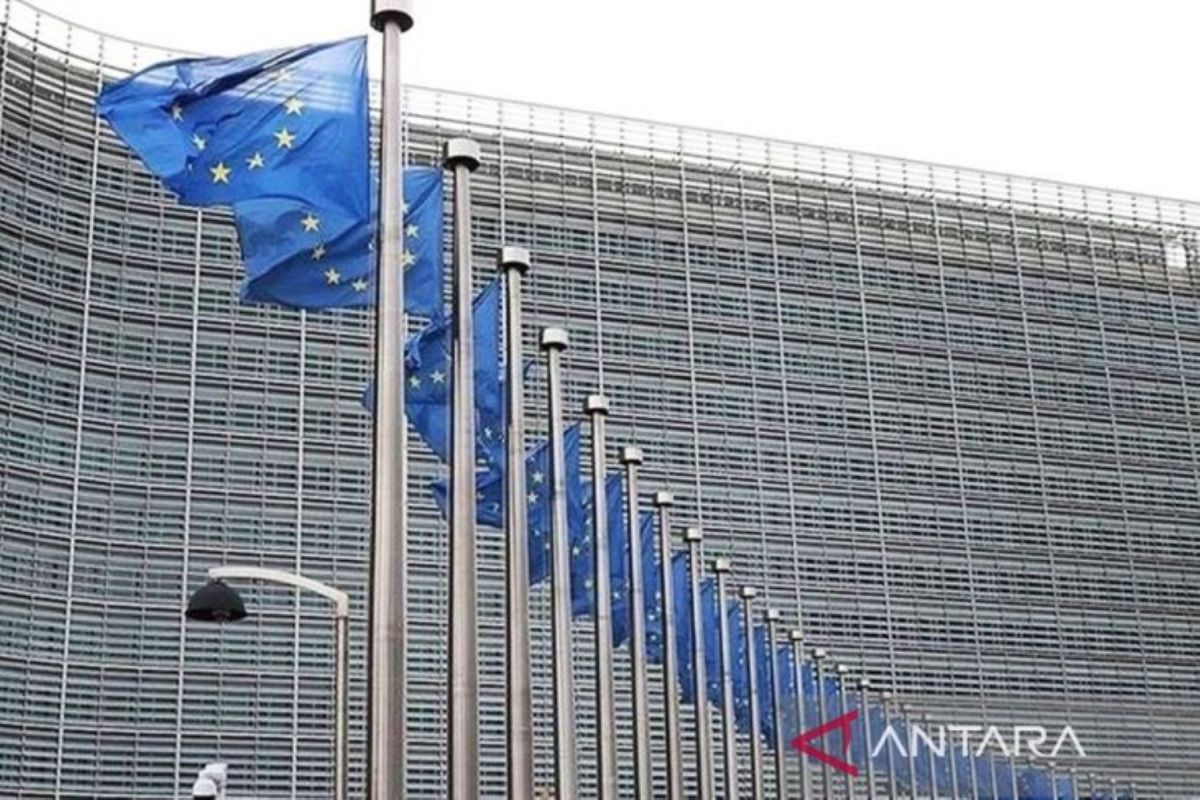
Brussels (ANTARA) - The European Commission, on Wednesday, opened the possibility for Canada to become the first ‘associate member’ of the European Union (EU), while calling for a fundamental review of the bloc’s partnerships amidst increasing geopolitical and economic challenges.
In her annual State of the Union 2026 speech to the European Parliament, European Commission President Ursula von der Leyen stated that Europe must “immediately redesign our partnerships.”
She also proposed cooperation with Canadian Prime Minister Mark Carney to bring the relationship between the EU and Canada to the “highest level possible.”
“I want to work with you to open opportunities for Canada to become the first associate member of the European Union,” she said.
Von der Dis Leyen presented this proposal as part of a broader effort to deepen cooperation with partners who share a similar vision in strategic areas, including energy, critical minerals, batteries, artificial intelligence, quantum technology, cybersecurity, and economic security.
The proposal would create a new form of relationship between the EU and non-EU countries, although von der Leyen did not detail the scope of this ‘associate member’ status or the institutional arrangements required.
Von der Leyen stated that the EU must secure access to essential raw materials, strengthen its energy independence, and develop its own capabilities in emerging new technologies, while continuing to work with trusted partners.
She emphasised that Europe has chosen to pursue a more autonomous path, stating that a stronger, more prepared Europe is emerging to defend itself, secure its energy supplies, and protect its economic interests.
Economy and Energy
Von der Leyen set Europe’s economic recovery as a “top priority” for the EU, highlighting the bloc’s large single market, industrial base, savings, and currency, while acknowledging existing fragmentation in capital markets, networks, and purchasing power.
She stated that the EU has reached a political agreement on the “one Europe, one market” roadmap and called for the overhaul of the single market to be completed by the end of next year.
Von der Leyen also announced a new international connectivity initiative linking the South Caucasus and Central Asia to European markets through a route known as the Middle Corridor.
She further noted that Europe cannot maintain its position as an industrial power if energy prices remain structurally high.
She highlighted EU efforts to reduce dependence on Russian gas through supply diversification and investment in renewable energy and nuclear power.
Von der Leyen also called for increased electrification, stating that the EU’s goal is to double the share of electricity use by 2040.
“In short, let us make Europe’s future electricity-based. This is a necessity,” she said.
China and Critical Raw Materials
Von der Leyen also warned that Europe’s trade relationship with China has reached a “critical point,” noting that the EU’s trade deficit with China reaches approximately 1 billion euros (Rp20.4 trillion) per day.
She stated that the bloc is seeking dialogue with Beijing to rebalance trade, but emphasised that such dialogue must yield results.
At the same time, she highlighted Europe’s dependence on China for critical raw materials; she noted that the EU relies on China for more than 80 percent of many such materials and is 90 percent dependent for certain types of rare earth metals.
She announced plans to establish a new “European Critical Raw Materials Corporation” to help secure and stockpile supplies needed for electric vehicles, chips, batteries, clean technology, and the defence sector.
Artificial Intelligence
Von der Leyen described the issue of artificial intelligence (AI) as a second major “critical point,” alongside climate change.
She expressed concerns regarding cyberattacks, self-developing models, and AI systems operating outside intended environments, while defending the EU AI Act as an essential framework for establishing safeguards.
According to her, Europe needs to cooperate with various partners, including Canada and the UK, regarding the evaluation of AI models, verification, early warning, and AI security.
At the same time, she emphasised that Europe requires its own technological capabilities, particularly in areas related to national security.