
Europe Quietly Draws Up Strategy If the US Exits NATO, Here Is Its Plan B
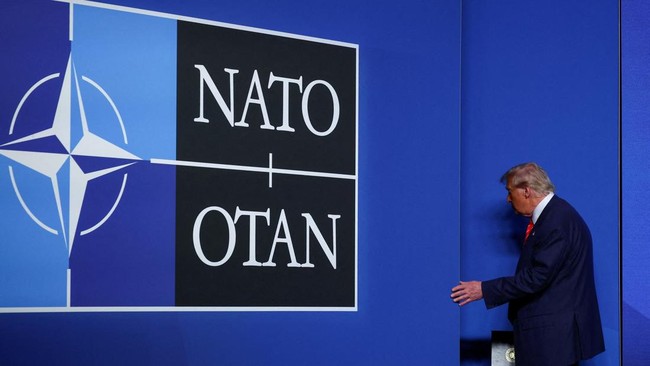
Jakarta, CNBC Indonesia - Dissatisfaction with the leadership of United States President Donald Trump toward NATO is beginning to threaten the security of Europe. In the face of rising Russian threats and Trump’s moves to cut back the American military presence in Europe, Europe is forced to prepare a ‘Plan B’. The small military alliance named Joint Expeditionary Force (JEF) is now seen as Europe’s alternative defence system. The coalition led by the United Kingdom is considered more flexible because it can operate without waiting for the unanimous approval of all NATO members.
Concerns in Europe increased after Donald Trump again questioned the US commitment to NATO and Article 5, the principle that an attack on one member is considered an attack on all. Trump even cancelled a number of US troop deployments and military facilities in Europe, including reductions of troops in Germany.
The situation became more delicate when Trump threatened to seize Greenland from Denmark. The threat triggered fresh concerns within NATO, not only about the possibility that the United States would not help Europe in a war against Russia, but also about the potential for the United States to become a new foe for NATO itself.
For decades, NATO has operated with a structure heavily dependent on the United States, spanning from military leadership, communications systems, intelligence, to air surveillance. Many of NATO’s key bases in Europe are still under American command.
Therefore, building Plan B is not merely about adding tanks or buying new weapons, but about reshaping Europe’s military command chain so that it can run without American support.
JEF as the precursor to a European ‘Mini-NATO’
The Joint Expeditionary Force (JEF) was formed in 2014 by the United Kingdom together with several Nordic and Baltic countries as a rapid-response force to address regional security crises. Unlike NATO, which requires consensus among all members to take major decisions, the JEF can move faster without a full consensus mechanism.
In recent years, the JEF’s position has grown more strategic after Sweden and Finland joined in 2017, even before both formally joined NATO. Edward Arnold of RUSI — a think-tank in London — says the JEF is the most tangible NATO alternative at present. Its main headquarters is near London with capabilities in intelligence, planning, and logistics. The JEF also has a private communications network, though still limited.
For some Northern European and Baltic states close to Russia, models like the JEF are seen as more relevant for rapid threats than NATO’s more bureaucratic mechanism.
Europe Still Faces Many Hurdles
Although considered the most ready alternative, the JEF still has many limitations. The coalition currently focuses on the Nordic and Baltic region and has not fully involved major European powers such as France, Germany, and Poland.
On the other hand, the UK as the JEF’s leader also faces capacity issues due to long-term underfunding of defence. Some NATO officials even doubt the readiness of Britain’s battle fleet, submarines, and fighting troops to face a major conflict quickly.
Therefore, Germany is seen by some analysts as key to Europe’s future defence. Berlin is now significantly increasing its defence budget as threats from Russia rise again since the war in Ukraine.
Ultimately, Europe is seen to need a new, more autonomous collective defence system. After all, deterrence effects against an adversary will not be effective if it relies on allies who may choose not to come to their aid at any time.