
Europe on High Alert: Supermarkets in Eight Countries Hit by Cyberattacks, Tonnes of Food Discarded
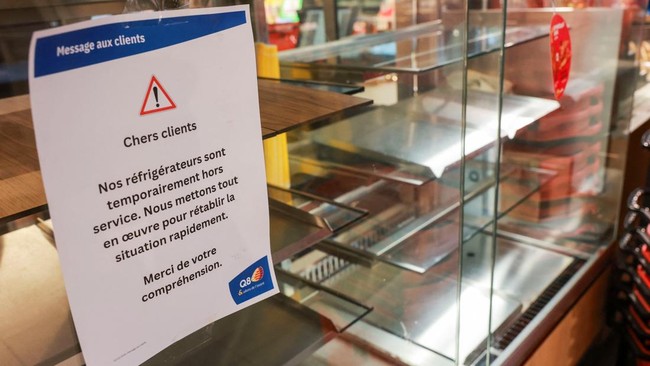
Jakarta, CNBC Indonesia — Supermarkets across Europe are being targeted by cyberattacks, Reuters reported on Monday. This is the second such wave of attacks.
The attacks caused refrigerator and freezer temperatures to rise. Many major supermarkets rushed to update their systems on Tuesday to protect themselves against further hacking attempts.
Stores in eight European countries were forced to discard large quantities of food after hackers tampered with their refrigeration systems on Monday. The attacks were identical to those that hit dozens of supermarkets in France three weeks ago.
Here is a summary of the affected countries.
- Italy
In Italy, at least four Coop supermarkets in Sicily and one business in Tuscany were affected, according to media reports and the national cyber security agency. The government held a cyber security meeting with intelligence agencies on Tuesday to discuss the incident.
“The attack took place at 4am,” Giuseppe Spadaro, head of the Radenza Group, which operates Coop-branded supermarkets, told Italian news agency ANSA.
“The attack targeted our remote-control system for the frozen food section and has now been dealt with,” he added.
- Belgium
Belgium was among the worst-affected countries. Dozens of stores belonging to several supermarket chains reported refrigeration system failures.
“This is a cyberattack, there is no other explanation,” said Mich Vergauwen, a spokesperson for Carrefour Belgium, which reported disruption at around 15 of its 700 stores.
Ikea also said it had been targeted. Its store in Mons suffered a cyberattack that caused freezer temperatures to rise.
Belgian refrigeration company Sabcobel said it had begun securing its system installations following an attack in France in October. However, updates to some systems had not been completed, and those systems were among the ones affected on Monday.
Delhaize, Colruyt and Intermarché also reported refrigeration system problems at some of their stores in Belgium. Four Delhaize outlets in Luxembourg were affected as well.
- Ireland
In Ireland, retailer Musgrave said 13 SuperValu stores were affected by a cyber incident. A small number of its grocery stores in the Netherlands also experienced disruption.
- Portugal
In Portugal, the Mosqueteiros group confirmed to AFP that seven Intermarché stores had experienced an incident linked to a cyberattack. The attack “appears to have targeted an external service provider responsible for managing the refrigeration system”.
- Sweden
In Sweden, Coop confirmed that six of its approximately 800 stores had been targeted. It said it did not know who was behind the attack, but noted that the affected stores were still connected to a 4G mobile network rather than an upgraded 5G system.
“We can confirm that this was a cyber incident. The problem has now been resolved and the refrigerators and freezers are working normally,” spokesperson Carlos Cancino told AFP.
Another Swedish supermarket chain, Ica, also reported refrigeration system problems at a small number of stores, although it did not confirm that they had been cyberattacks.
Ica spokesperson Helena Johansson said all the affected stores were connected to an external refrigeration control system supplied by Danish manufacturer Danfoss. The same supplier was targeted in a cyberattack on French retailers on 12 October.
Johansson referred all questions to Danfoss. The company had not responded to journalists’ requests for comment.
- Finland
Similar incidents were reported in Finland. Abnormal temperatures were detected in a small number of smaller grocery stores owned by the Kesko group.
“We are currently investigating the cause and have not ruled out the possibility of interference through the network,” Petri Käyhkö, Kesko’s head of corporate security, told AFP.
Roni Kokkola, an information security specialist at the National Cyber Security Centre, part of the Finnish Transport and Communications Agency (Traficom), also did not rule out cyber interference.
“We have seen incidents like this in Europe over the past few months. So the spread from France to other countries was actually expected,” he said.
“Nowadays, it is very common for different kinds of vulnerabilities to be exploited increasingly actively and quickly,” he added.
- Estonia
In Estonia, hackers attacked at least one supermarket, raising the temperature of its refrigeration unit to 50 degrees Celsius, public broadcaster ERR reported.
“The refrigeration unit was an older model supplied by Danfoss, similar to the equipment targeted in France,” said Jann Mutso, managing director of Kitman Coldtech, a manufacturer and distributor of advanced refrigeration systems.
Meanwhile, Paolo Falcioni, director-general of the European home appliance association APPLiA, told Euronews that supermarkets’ cyber resilience could be tested in very practical terms.
“If remote access is disrupted, can staff still check temperatures and take action to protect the cold chain? Manufacturers and retailers both have a role in ensuring the answer is yes,” he said.
“APPLiA supports a common European framework for the cyber security of internet-connected products. Security must start at the design stage and be maintained throughout a product’s lifetime, through security updates and clear procedures for handling vulnerabilities,” he said.
“As Europe implements the Cyber Resilience Act, we need practical standards that reflect how products are used and what can happen if they are hacked,” he added.
- United Kingdom
In the UK, hackers attempted to target a small meat-processing company. However, the National Cyber Security Centre (NCSC) said the impact was minimal.
“The NCSC works with a range of organisations to detect vulnerabilities and close them before anyone exploits them,” chief executive Richard Horne told Reuters.
“We are clearly on high alert,” he stressed.
“Attacks on supermarket refrigerators are just an early sign of disruption that is likely to become more frequent, as older technology struggles to keep pace with hackers’ growing capabilities.”