
Europe, Islam, and the Politics of Fear
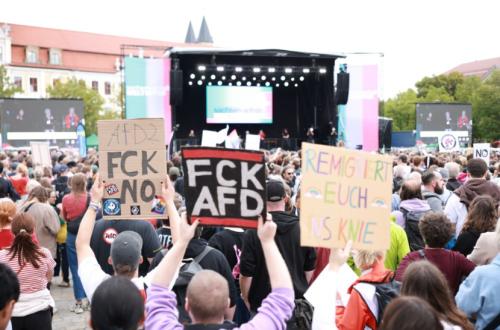
A paradox is unfolding in Europe. Muslims make up only around 6 per cent of the continent’s more than 500 million inhabitants, yet fear of Islam continues to grow. What is feared today is no longer primarily terrorism, as after the attacks of 11 September 2001, but something far more fundamental: that Islam will slowly change Europe’s identity from within.
The symptoms are visible in politics. In the September 2026 state election in Saxony-Anhalt, Germany, the Alternative für Deutschland (AfD) won 44 per cent of the vote while warning of the danger of ‘Islamisation’. In France, Marine Le Pen’s proposal to ban the Islamic headscarf in all public spaces is supported by around 60 per cent of voters. In several European countries, roughly half of society considers Islam incompatible with Western values.
That fear has spawned increasingly dramatic narratives: Islamic takeover, great replacement, no-go zones, the creeping spread of sharia law, even civilisational erasure. The question is whether Europe truly faces a threat of Islamisation, or is instead trapped in the politics of fear.
The Economist made Islam in Europe its cover story in its 12 September 2026 edition, offering an important analysis: there is no evidence that Europe is experiencing a takeover by Islam, mass radicalisation of Muslims, or large-scale demographic replacement. Real threats do exist, but their form and scale differ from what is often portrayed.
Islam and Islamism
It is necessary to distinguish between Islam, Muslims and Islamism — yet that distinction is often lost in public discourse.
Islam is a religion. Muslims are a highly diverse community, ranging from secular to deeply religious. Islamism, meanwhile, is a political ideology that seeks to make Islam the organising principle of government and society. A socially conservative Muslim is therefore not automatically an Islamist, let alone an extremist.
The distinction matters because, as The Economist notes, there are genuine problems that must not be covered up. In Britain, for instance, 52 per cent of Muslims surveyed by the magazine considered homosexuality wrong. Meanwhile, 41 per cent of Muslims under 35 said violence could be justified if someone insulted the Prophet Muhammad, compared with 25 per cent of older cohorts.
In France, a survey cited by The Economist found 44 per cent of Muslims preferred to obey Islamic law rather than French law; among those under 25 the figure reached 52 per cent. Although these numbers are significant, according to The Economist conservative religious views do not automatically imply rejection of democracy. Herein lies the challenge for European governments: how to distinguish conservative religious attitudes from political movements seeking to overturn the liberal order, because the two are not the same.
The concerns of security agencies have indeed shifted from terrorism towards what Germany calls legalistic Islamism. Some Islamists do not use violence. They are accused of employing a strategy of entryism: entering schools, social organisations, mosques, charities or political institutions to gradually expand their influence and push a non-liberal agenda.
The problem is real, but its scale needs to be kept in proportion. France has around 7.5 million Muslims. A report by the French Interior Ministry estimates Muslim Brotherhood membership at only around 400–1,000 people, linked to 139 of the country’s roughly 2,800 mosques. One German researcher cited by The Economist even said there is no data showing the Muslim Brotherhood threat is commensurate with the moral panic spreading through society.
The often-overlooked integration
The picture of Europe’s Muslim communities is also not as frightening as political debates often suggest. Across all Western European countries, Muslims remain around 6–7 per cent of the total population. Their numbers have indeed risen fairly quickly, partly due to the wave of refugees from Syria and elsewhere that peaked in 2015. But many indicators show integration is underway.
In Germany, for example, 64 per cent of refugees who arrived in 2015 had found jobs by 2022, approaching the national employment rate of 70 per cent. Some 88 per cent of Muslims say they feel comfortable living in Germany and 73 per cent say they want to integrate fully. In Britain, 67 per cent of Bangladeshi children who took standard exams in 2021 had entered university by age 19, compared with 38 per cent of white British citizens.
Nor do demographics support the ‘great replacement’ narrative. Muslims are only around 6–7 per cent of Europe’s population. Birth rates among Muslim immigrants are indeed initially higher than those of local populations, but according to The Economist the difference tends to disappear within two generations. In other words, the fear that Muslims will demographically replace Europe’s population is not supported by these trends.
This does not mean integration is problem-free. There are pockets of highly segregated Muslim communities. There is also social pressure on women, liberal Muslims and gay people — who are often the first victims of Islamism. But to conclude from these local problems that hundreds of millions of Europeans face a takeover by Islam is a leap too far.
Two extremes that need each other
This is where the politics of fear begins to work.
On one side, Islamist groups have an interest in portraying every criticism of Islamism as an attack on Islam. Meanwhile, parts of the left are too quick to brand any discussion of Islamism, migration or criminality as Islamophobia or racism. As a result, genuinely real problems sometimes become difficult to discuss openly.
On the other side, right-wing populist groups have a political interest in expanding the problem of Islamism into a problem with Islam itself. A handful of extremists then become the representation of millions of Muslims. In other words, concern about radicalism transforms into fear of mosques, headscarves, immigration and, ultimately, of Muslims themselves.
Interestingly, these two extremes actually need each other. Hamburg official Andy Grote described the AfD and radical Islamists as ‘partners’ because both feed on polarisation. Quran burnings by right-wing activists become propaganda material for Islamists. Harsh reactions by Islamist groups then become new ammunition for the far right to prove that Islam is indeed incompatible with Europe. The circle becomes complete.
That is why responses such as mass deportation, segregation or banning the headscarf in all public spaces can be counterproductive. Such policies make the majority of Muslims who have no connection to Islamism feel that what is being rejected is not extremism but their identity as Muslims. Ultimately, such policies can hinder integration and provide new ground for extremists.
Europe must certainly not turn a blind eye to Islamism. Violence and threats of violence must be prosecuted. Entryism aimed at hollowing out democratic institutions must also be confronted. Freedom of speech must not be sacrificed in the name of cultural sensitivity. But firmness towards Islamism must not turn into hostility towards Islam.
Europe’s own history offers reasons not to be overly pessimistic. Past waves of Catholic, Jewish and Caribbean migration also raised fears about whether newcomers could become part of the societies they joined. In the end, they found their place. The Economist suggests Europe’s Muslims are undergoing the same process.
Europe’s challenge, therefore, is not how to save itself from Islam, but how to confront Islamism without antagonising Islam. For when fear replaces facts, liberal democracy can lose the very values it seeks to defend.
By way of closing, I often see videos on Indonesian social media giving the impression that waves of conversion to Islam are happening everywhere and that Islam is slowly taking over Europe. Many seem to welcome this gleefully. Yet that picture is misleading: Muslims remain a small minority in Europe — only 6–7 per cent of the total population! Ironically, the narrative that ‘Islam is taking over Europe’ can in fact amplify public fear and serve as ammunition for right-wing populists seeking votes in elections, while portraying Islam as a threat in Europe.
Source: jawawa.id (https://jawawa.id/newsitem/europe-islam-and-the-politics-of-fear-1789473319)
Originally published by Republika (https://analisis.republika.co.id/berita/tlejl7393/eropa-islam-dan-politik-ketakutan), translated from Indonesian