
Europe Hit by Mass Demonstrations: Could They Spread to Asia?
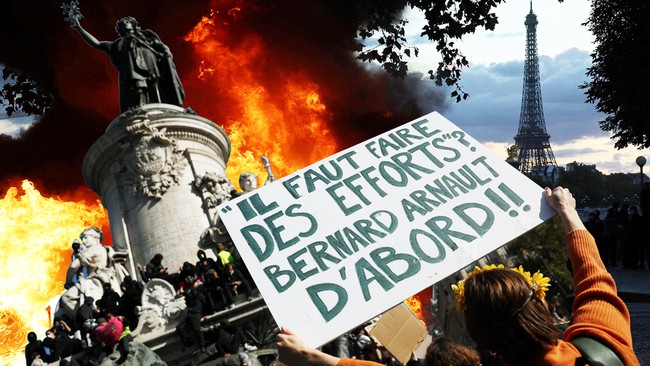
Jakarta, CNBC Indonesia – A wave of mass demonstrations is sweeping several European countries. Actions that began peacefully in some areas have turned into clashes with security forces, and in some cities have led to riots and damage to public facilities.
France has been among the countries hit hardest. The peak came last weekend, on Saturday 17 October 2026, when more than half a million people took to the streets to voice a range of demands, from improving education services to addressing the high cost of living.
The situation in several areas turned chaotic. Shops, both large and small, were looted. Public facilities and government buildings were also damaged, while clashes between demonstrators and security forces became unavoidable.
Similar unrest has occurred in Italy and Belgium. In Italy, demonstrations took place in several cities, including Milan, Turin and Bologna. Some ended in clashes with police, the burning of road barricades and looting.
In Belgium, demonstrations in Brussels and Liège also turned violent. Police used tear gas and water cannon to disperse crowds after clashes and damage to facilities.
Meanwhile, people in Spain, Portugal and Greece have also taken to the streets to voice various demands, particularly over the high cost of housing and everyday essentials. Most demonstrations in the three countries remained peaceful, although clashes were reported at some events.
The situation is no less tense in Albania. Demonstrations that have been going on for months have grown, with protesters demanding the resignation of Prime Minister Edi Rama. They were prompted by alleged corruption, dissatisfaction with the government and public concern about the economy.
In the capital, Tirana, some demonstrations have led to clashes with security forces, alongside attacks on government buildings, banks and businesses.
The wave of demonstrations in various European countries reflects a number of problems that have led people to take to the streets to express their dissatisfaction.
At least four key issues have fuelled the protests: the high cost of living; expensive homes and rents; the cost and quality of education; and dissatisfaction with governments.
Each country has its own problems and demands. Some are protesting the cost of everyday necessities, while others are calling for improvements to education or changes to government policy.
These four issues nevertheless offer a picture of the pressures facing people across Europe. How severe are conditions in these countries, and what is driving people to take to the streets?
The cost of living is becoming harder to bear
One of the concerns most frequently raised by people in Europe is the rising cost of living.
This is linked to higher prices for everyday necessities, particularly energy, food and transport. Households have to spend more to meet the same needs.
One of the most noticeable price rises has been in vehicle fuel, including petrol and diesel.
According to the European Commission’s Weekly Oil Bulletin, the average price of Euro 95 petrol in the European Union reached €2.010 per litre on 12 October 2026. This was a 24.4% increase on the same period a year earlier, when it stood at €1.616 per litre.
The rise in diesel prices was steeper. Over a year, the price jumped 39.7%, from €1.529 to €2.136 per litre.
High fuel prices affect not only people who own private vehicles. They can also push up transport and delivery costs, which in turn may contribute to higher prices for a range of everyday necessities.
Price pressures are also reflected in eurozone inflation, which has risen again in recent months.
Eurostat data show that annual eurozone inflation reached 3.8% in September 2026, up from 3.2% in August. Higher energy prices were one of the main factors driving inflation.
Some people in Europe had already been struggling to make ends meet for several years. Eurostat reported that in 2024, 17.4% of households in the European Union said they had difficulty or great difficulty meeting their everyday needs.
This is one reason the cost of living has featured in demonstrations across several countries.
In France, for example, protests initially led by students over poor education facilities later received support from trade unions and groups concerned about the high cost of living.
In Portugal, workers have taken to the streets to demand higher wages and pensions, hoping their incomes will go further in covering everyday expenses.
Housing is becoming more expensive
Alongside the high cost of everyday necessities, people in Europe face another significant problem: the growing difficulty of finding affordable housing.
Rising house prices mean people need more money to buy a home. For those who do not own one, rent is also a burden.
Portugal is among the countries facing this problem. Eurostat data show that house prices in Portugal rose 16.5% year on year in the second quarter of 2026, far above the European Union average of 4.7% over the same period.
Housing costs have been one reason people in Portugal have taken to the streets. In Lisbon, housing activists even set up tents to protest and demand that the government provide more affordable accommodation.
A similar issue has arisen in Spain. Demonstrators set up tents in Madrid’s Puerta del Sol to demand lower rents and protection for people at risk of losing their homes.
In Greece, the problem is not only high house prices but also the share of household income spent on housing.
Eurostat reported that in 2025, about 26.4% of people in Greece lived in households that spent at least 40% of their income on housing. That was far above the European Union average of 7.7%.
In other words, more than a quarter of Greece’s population faces a substantial housing-cost burden relative to household income.
Students are also affected. In Athens, some set up tents in Syntagma Square to protest against high rents and a lack of accommodation facilities.
But the problems facing Europe’s younger generation do not end with housing. Rising education costs and poor school facilities have also prompted pupils and students to take to the streets.
In Belgium, for example, higher tuition fees have been one trigger for demonstrations. From the 2026/2027 academic year, full tuition fees in French-speaking education institutions rose from €835 to €1,194 a year, although the government continues to provide reductions for certain groups.
In France, pupils have protested over staff shortages, overcrowded classrooms and the deteriorating condition of school buildings.
These issues show that the pressures facing Europeans are not limited to the rising cost of goods; they also concern essential needs such as housing and education.
This helps explain why young people have been among the groups actively involved in demonstrations across Europe.
Why has Asia not seen a similar wave of protests?
Why has a pattern of demonstrations similar to that in Europe not emerged across most of Asia?
One difference between the two regions is their economic conditions and how governments respond to rising prices for essential goods. Three factors help explain the contrast: Asia’s stronger economic growth; government subsidies that can still help restrain price rises; and the more varied causes of demonstrations in Asia.
In its October 2026 World Economic Outlook, the International Monetary Fund (IMF) forecast that the eurozone economy would grow by just 1.1% this year. By contrast, economic growth in the Asia-Pacific region was projected to reach 4.7%.
The difference indicates that Asia-Pacific economies are still growing much faster than the eurozone, although both regions face pressures from global economic uncertainty.
In its October Regional Economic Outlook, the IMF said Asia-Pacific economies remained relatively resilient in the face of various pressures, including rising energy prices resulting from conflict in the Middle East.
This resilience has been supported in part by stronger demand for technology products, advances in artificial intelligence (AI), and the ability of some countries to adapt their trade and economic activity.
The Asian Development Bank (ADB) has also noted that energy subsidies in some Asian countries help prevent increases in oil and gas prices from being passed on to the public in full.
Such support can ease household expenses, although it does not eliminate the pressure caused by the high cost of everyday necessities.
Source: jawawa.id (https://jawawa.id/newsitem/europe-hit-by-mass-demonstrations-could-they-spread-to-asia-1792767054)
Originally published by CNBC Indonesia (https://www.cnbcindonesia.com/research/20261023113022-128-778906/eropa-sudah-dilanda-demonstrasi-massal-bakal-menular-ke-asia), translated from Indonesian