
Europe Heats Up as Protests and Riots Spread Across 10 Countries
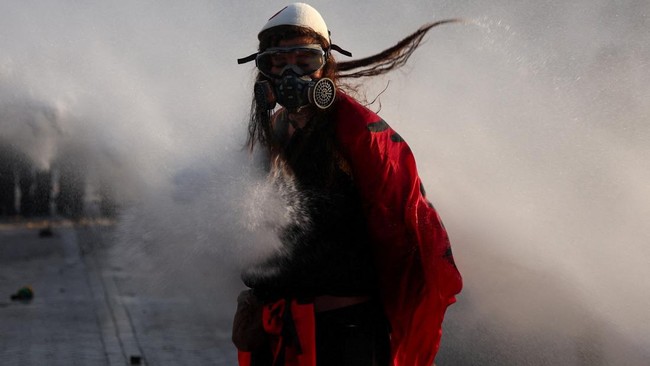
Demonstrations have swept across several European countries, fuelled by a range of grievances including education budgets, the high cost of living, the housing crisis and alleged corruption.
Protests have recently emerged in Germany and Austria, followed by reports of demonstrations and riots in France, Albania, Italy, Belgium, Portugal and Serbia.
The situation varies from country to country. In Germany, students are preparing to stage protests calling for improvements to education, while tens of thousands of people in Austria have demonstrated against cuts to university funding. Protests in Albania, Italy and Belgium have been marked by clashes, while demonstrations in Portugal have focused on economic and social demands.
Here is an overview of the protests across the European countries, compiled by CNBC Indonesia from various sources on Monday (26 October 2026).
- Germany: Students prepare national demonstrations
In Germany, student organisations and opposition party Die Linke are backing plans for demonstrations in cities across the country on 31 October. Protesters are calling for increased education funding, better school facilities, more teachers and smaller class sizes. Youth groups are also raising concerns about climate protection and the rising cost of living, and opposing compulsory military service.
Isabelle Seltenreich, a spokeswoman for the Federal Student Conference, said pupils and university students had strong reasons to demand improvements to the education system. She said their demands echoed those of protests in France and Italy, including the need for better school infrastructure and equal access to education.
Some German officials, meanwhile, have warned that violence could spread. Baden-Württemberg Interior Minister Manuel Hagel said there were concrete indications that demonstrations could extend to his state. Bavarian official Joachim Herrmann said police would be deployed to prevent riots while protecting the public’s right to assemble peacefully.
- Austria: Tens of thousands protest education budget cuts
About 50,000 people demonstrated in Vienna against what they said was insufficient funding for universities. The protest, organised by the Austrian National Union of Students (ÖH), was attended by students and academic staff from Vienna and other parts of the country under the slogan “Red Alert – Save the Universities!”
The ÖH said the federal government had allocated €16 billion (Rp322.7 trillion) to universities for 2028–30, while the Universities Conference estimated that at least €18 billion (Rp363.1 trillion) was needed simply to keep pace with inflation.
ÖH chair Viktoria Kudrna warned that budget cuts could reduce the range of academic programmes, weaken student support services and worsen working conditions.
The effects are already being felt, including reduced library opening hours at TU Wien. The university also supported the demonstration by allowing students and staff to take part.
- Albania: Anti-corruption protests turn violent
Albanian Prime Minister Edi Rama is facing mounting pressure after student-led demonstrations continued for six consecutive days. Protesters are demanding his resignation, amid anger over alleged government corruption, a lack of jobs and poor education standards.
Protests in the capital, Tirana, and other cities descended into clashes. Demonstrators set fire to government buildings and a bank, smashed shop windows and threw paving stones at police. Officers responded with tear gas, water cannon and rubber bullets.
Rama rejected calls to step down, saying the demonstrations threatened not his government but Albania’s ambition to join the European Union (EU).
“What is being challenged is not me, not the government, not the governing majority or the party that won the election, but a path and a mission,” Rama wrote on Facebook, as quoted by Reuters. Police said 388 people had been charged with criminal offences in connection with the protests.
- Italy: Police confront protesters as shops are looted
Riots have also broken out in Italy as demonstrations over the high cost of living and poor public services spread to several cities. In Milan, police clashed with protesters who threw stones, smashed shop windows and set rubbish bins alight near Piazza Duomo. Officers used tear gas and water cannon to disperse the crowds.
Similar clashes were reported in Milan, Bologna, Brescia, Bergamo and Turin. Dozens of people were arrested or taken to police stations for questioning. Prime Minister Giorgia Meloni condemned the violence, while the government scheduled discussions on how to handle the situation as it prepares for next year’s election.
- Belgium: Cost-of-living demonstrations turn violent
In Belgium, demonstrations against the cost of living led to clashes between protesters and police. Protests took place in Brussels and Liège on Saturday (17 October 2026), with officers using tear gas and water cannon to disperse groups of demonstrators. In Brussels’ Bourse district, police fired tear gas after some young people threw bottles and other objects at officers.
Belgian Interior Minister Bernard Quintin condemned the violence. “This is no longer simply a demonstration,” he wrote on social media. He described it as “pure, organised and repeated violence, aimed at destabilising our society”, and vowed to take steps to restore order.
Meanwhile, a Euronews crew covering demonstrations in Paris was reportedly attacked by a group suspected of being involved in looting a supermarket.
- Portugal: People take to the streets over living costs and housing
In Portugal, demonstrations have focused on economic and social demands. Trade unions affiliated with the CGTP confederation, alongside housing rights groups, staged protests in Porto, Coimbra and Lisbon, calling for higher wages, better pensions and adequate public services.
The protests were prompted by rising prices for essential goods and fuel, as well as increasingly unaffordable housing. CGTP Secretary-General Tiago Oliveira highlighted soaring house prices and the deteriorating quality of public services. Demonstrators also demanded access to decent housing amid rising rents and increasingly burdensome mortgage repayments.
- France: Cost of living and education “set the country alight”
France was hit by major riots on 17 October, in one of the country’s worst episodes of urban unrest in recent years.
Behind the unrest was public anger over the cost-of-living pressures, rising energy costs and concerns about deteriorating public services. The situation has also intensified France’s political divisions: the government has blamed radical left-wing groups for fuelling the disorder, while trade unions and student groups have also joined the wave of protests.
The uncertainty has also been felt in financial markets. The risk premium on French government debt compared with German bonds reportedly reached its highest level in 15 years on Thursday, while the yield on 10-year French government bonds hit 5.14%, its highest since July 2002.
- Serbia: Anti-government protests fuelled by corruption allegations
About 150,000 supporters of Serbia’s opposition student movement filled central Belgrade on Thursday (22 October 2026), calling for an end to the rule of the Serbian Progressive Party (SNS), led by Aleksandar Vučić. The movement, known as Student List, is fielding student-backed candidates to challenge the right-wing populist party in Sunday’s parliamentary election.
Student protests have been under way for almost two years, following the collapse of a canopy at Novi Sad railway station in November 2024, which killed 16 people. The tragedy, widely linked to corruption, sparked mass demonstrations that grew from demands for a transparent investigation into calls for an early election.
Vučić, who has dominated Serbian politics for more than a decade, announced an early election in September amid mounting pressure. He accused the student movement of attempting a foreign-funded coup.
- Spain: Housing unaffordable and education increasingly difficult
Riots broke out in Barcelona amid rising social tensions in Spain. In early October, tens of thousands of people demonstrated in cities across the country, demanding government action on the housing crisis after parliament rejected several tenant-protection measures.
The earlier eviction of an 87-year-old woman in Madrid had also fuelled public anger over the high cost of housing.
The unrest in Barcelona had a different immediate trigger. The demonstration, organised through social media, was linked to demands for better education and inspired by student movements in France. It later led to damage to shops and public facilities, as well as looting, drawing condemnation from Catalan leaders.
- Czechia: Media bill sparks concern
Thousands of people demonstrated in Prague, Czechia, on Sunday (25 October 2026), protesting the government’s plan to change the funding system for public-service broadcasters. The bill would abolish the household licence fees that currently fund Czech Television and Czech Radio, replacing them with funding from the state budget. Critics fear the change would leave public media more vulnerable to political pressure.
The controversy erupted after the proposal was unexpectedly brought before parliament outside the official agenda on Friday, with a vote scheduled for early Saturday morning. Speaker Tomio Okamura restricted debate and scheduled the vote for 04:36 local time. The bill is now at the committee stage before a further vote.
The changes are expected to cut funding for Czech Television and Czech Radio by about 15% and could take effect next year. Opposition groups have compared the plan with media reforms under Viktor Orbán in Hungary, which they say strengthened pro-government media. The European Broadcasting Union, Reporters Without Borders and 14 other organisations have called for wider public debate.
Source: jawawa.id (https://jawawa.id/newsitem/europe-heats-up-as-protests-and-riots-spread-across-10-countries-1793015486)
Originally published by CNBC Indonesia (https://www.cnbcindonesia.com/news/20261024114807-4-779116/eropa-memanas-demo-dan-kerusuhan-meluas-di-10-negara), translated from Indonesian