
EU Partners with Ukraine to Jointly Build Combat Drones
Under a clear sky, European Commission President Ursula von der Leyen arrived at Kyiv station after an overnight train journey. She was greeted with a bouquet of yellow and blue, Ukraine’s national colours. This marked her 11th visit to Ukraine since Russia launched its full-scale invasion in 2022.
At St. Michael’s Square in central Kyiv, rows of soldiers paraded. Women in traditional Ukrainian dress, young people in formal attire, political and community leaders, and heads of state and government from various Southeastern European countries were also present. They gathered to commemorate Ukraine’s Statehood Day, a national holiday newly established in 2021 to affirm that Ukraine’s history did not begin with its independence from the Soviet Union in 1991.
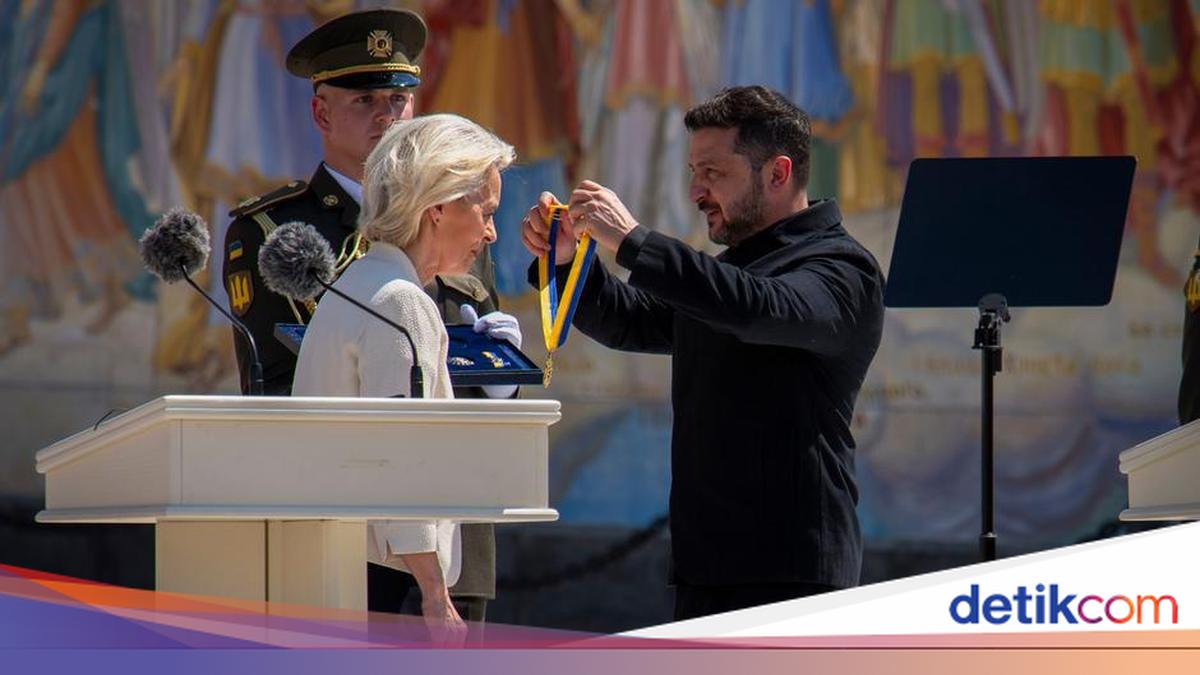
Under the blazing sun, President Volodymyr Zelensky awarded the Order of Europe to Ursula von der Leyen as a guest of honour. She became the first recipient of the award, in recognition of her exceptional support for Ukraine’s efforts to join the European Union. “I thank you for your support, Ursula,” Zelensky said with a serious gaze.
In the gardens of the Mariinsky Palace, the official presidential residence, the two leaders signed an agreement for closer cooperation in the development and production of drones. The deal is expected to benefit both sides. “We will produce drones faster than ever before,” von der Leyen stated. She said the move would ensure Ukraine receives its urgent needs while Europe builds industrial capacity that may be required in the future.
Under the cooperation, Ukraine contributes its experience and technological capabilities, which have advanced rapidly during the war against Russia. Meanwhile, European countries provide companies with secure production facilities and initial funding. According to von der Leyen, this step will transform Kyiv from a mere recipient of security guarantees into an active security provider for Europe.
Shortly after the ceremony, the importance of drone protection became evident once again. Air raid sirens suddenly sounded in Kyiv, forcing Ursula von der Leyen to be rushed to a shelter. A Russian drone was reported to be approaching the capital, though the situation was soon declared safe. The incident contrasted with previous days and weeks, when Kyiv residents repeatedly faced massive Russian air attacks that set homes ablaze and claimed civilian lives.
President Zelensky has recently used every opportunity to request additional air defence support from Western nations. He made such appeals at the NATO summit in Ankara last week and during a meeting of the coalition of states supporting Ukraine in France. From that meeting, Ukraine secured further commitments of military aid.
Despite ongoing Russian attacks on Kyiv and other cities causing continued destruction and civilian casualties, the direction of the war, now in its fourth year, is seen as increasingly favouring Ukraine. “The tide has turned,” Ursula von der Leyen remarked. She noted that Ukraine has managed to freeze the front lines while striking oil refineries and military logistics networks deep inside Russian territory. Russian oil supplies are now dwindling, and pressure on President Vladimir Putin is mounting.
“Our main goal is not a Russia without oil, but a Ukraine without war,” Zelensky said, adding that Europe must also be free from the Russian threat.
Von der Leyen also brought positive news regarding Ukraine’s EU accession process. The EU has opened the second package of negotiations out of a total of six negotiation clusters. This step demonstrates the bloc’s commitment to continuing Ukraine’s membership process. Under normal procedures, a new chapter is opened only after the previous one is concluded. Ukraine wants all EU regulations to be negotiated simultaneously to speed up the accession process, though some member states consider this step too far-reaching.
Prior to von der Leyen’s visit, the EU had targeted the adoption of a 21st sanctions package against Russia. The plan was delayed once again due to differing views among member states. Von der Leyen expressed optimism that a compromise would soon be reached, stating that the sanctions already imposed are showing results as they are “leaving a deep impact on the Russian economy.”
During the Statehood Day commemoration, Zelensky appeared calm. He acknowledged that economic sanctions burden both Russia and Western countries. However, he stressed that the most important question is who can endure longer. For Ukraine, Zelensky said, this war is about the nation’s survival. Therefore, it is crucial for the European Union to “get tired one day later than Russia.”