
EU Caps Imports of Hybrid Cars from China
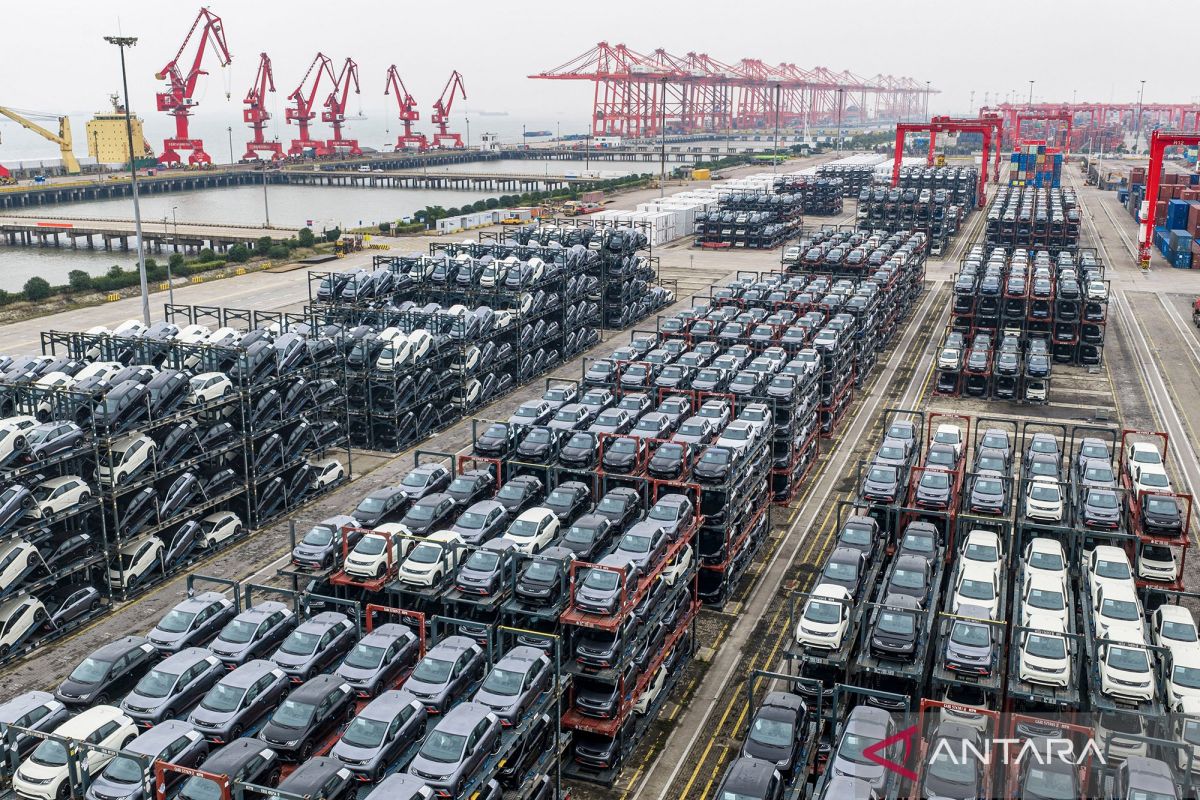
Europe (ANTARA) – The European Union will cap imports of passenger hybrid cars made in China at a maximum of 191,780 units from 1 December 2026 to 18 June 2027.
A report by Chinese automotive news outlet Carnewschina on Tuesday (23 November), local time, said the quota applies jointly to plug-in hybrid electric vehicles (PHEVs), conventional hybrids and mild hybrids (HEVs).
Range-extender electric vehicles (EREVs), whose combustion engines function only to generate electricity, are not covered by the restriction and are treated under the same policy as pure electric cars.
EREVs are therefore exempt from the import quota, but remain subject to the same anti-subsidy import duties as battery electric vehicles (BEVs).
For example, the EREV Xiaomi Skynomad N90 is outside the quota but will face a 45.3 per cent import duty. By contrast, the China-made BYD Seal U DM-i plug-in hybrid SUV is subject to the standard 10 per cent duty, but still counts towards the quota of about 192,000 units.
Dealers may continue selling vehicles that cleared EU customs before 1 December. Hybrid cars made by Chinese manufacturers within the EU will not count towards the quota.
China has been allocated 86,301 units for December to February, followed by 88,219 for March to May and 17,260 for the first 18 days of June.
Unused quota can be carried over to the following period. Once a period’s quota has been exhausted, EU customs cannot process further imports under that allocation.
According to the European Commission, the EU imported about 302,400 hybrid cars from China in 2025, up from 106,500 in 2024. The 200-day restriction is equivalent to about 350,000 units a year, around 16 per cent above the 2025 import figure.
Hybrid imports are forecast to reach about 800,000 units in 2026, more than twice the annual quota of 350,000. The European Commission is still investigating whether a longer-term restriction is needed.
Chinese models occupied the top three positions in Europe’s PHEV market during the first ten months of 2026. The BYD Seal U ranked first, followed by the BYD Atto 2 and Chery’s Jaecoo 7.
China’s Ministry of Commerce said on 24 November that it reserved the right to challenge the policy through the World Trade Organization (WTO) and seek trade compensation.
The Chinese government also called on the EU to “respect the understanding reached by both sides” in October regarding exports of hybrid vehicles.
Volkswagen is planning to increase exports of cars from China, while the EU’s hybrid import quota also applies to European carmakers.
Any PHEV made by a Volkswagen joint venture in China and imported into the EU will count towards the 191,780-unit quota. This is because the EU bases the restriction on where a vehicle is produced, rather than the origin of its brand.
Conversely, Chinese carmakers producing hybrid vehicles within the EU can sell them without using up the quota for imports from China. Several manufacturers already have production lines in Europe or are building facilities there.
BYD is building a factory in Szeged, Hungary, with its own steel-stamping, welding and painting facilities.
In October, Leapmotor began assembling its B10 SUV at Stellantis’s factory in Zaragoza, Spain, using completely knocked-down (CKD) vehicle kits shipped in parts.
Two other facilities use components shipped from China that are already partly assembled. Magna produces Xpeng’s G6 and G9 electric SUVs using this method in Graz, Austria. Meanwhile, Chery’s Spanish partner Ebro assembles the S700 plug-in hybrid SUV in Barcelona.
Source: jawawa.id (https://jawawa.id/newsitem/eu-caps-imports-of-hybrid-cars-from-china-1795600510)
Originally published by Antara (Indonesian) (https://otomotif.antaranews.com/berita/5877575/uni-eropa-batasi-impor-mobil-hybrid-dari-china), translated from Indonesian