
ESDM: Indonesia's Dependence on Petrol Imports Still at 59 Percent
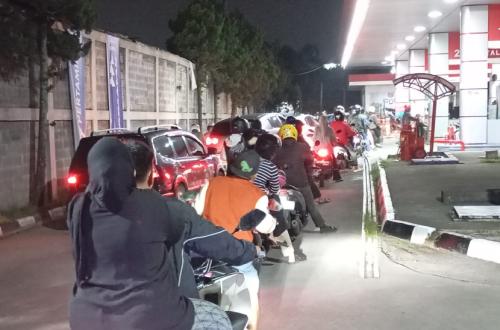
The Ministry of Energy and Mineral Resources (ESDM) has disclosed that Indonesia’s dependence on imports of petrol remains high because domestic production is unable to meet demand.
The Secretary of the Directorate General of Oil and Natural Gas (Ditjen Migas) of the Ministry of ESDM, Maompang Harahap, stated that petrol imports up to February 2026 still account for 59 percent of total national needs, a slight decrease from 60.18 percent in 2025.
“For petrol, in 2025 imports still dominate around 60.18 percent of needs, and in 2026 around 59 percent,” said Maompang during a hearing with Commission VII of the House of Representatives (DPR RI) on Wednesday (8/4/2026).
National petrol needs were recorded at 100,986 kilolitres (KL) per day in 2025, slightly decreasing to 99,661 KL per day up to February 2026.
Looking at the trend over recent years, national petrol consumption has continued to rise from 34.49 million KL in 2018 to 36.86 million KL in 2025. Meanwhile, domestic production has tended to stagnate, even declining from 14.94 million KL in 2018 to 14.51 million KL in 2025.
On the other hand, import volumes have continued to increase to meet needs, from 18.68 million KL in 2018 to 22.18 million KL in 2025.
This situation indicates a consistent gap between production and consumption, so domestic needs must be fulfilled through imports.
If broken down by type, subsidised petrol needs (JBKP) in 2025 reached 76,932 KL per day, then decreased to 74,407 KL per day up to February 2026. Meanwhile, non-subsidised petrol needs (JBU) increased from 24,055 KL per day to 25,254 KL per day.
According to ESDM, current petrol imports are still dominated by the regional area. “The most dominant petrol import comes from Singapore and Malaysia,” explained Maompang.
On the other hand, the government has noted improvements in the diesel commodity. Although consumption has increased, diesel imports have been reduced from 12.17 percent in 2025 to 6.26 percent up to February 2026.
National diesel needs were recorded at 110,932 KL per day in 2025, increasing to 111,356 KL per day up to February 2026.
In detail, subsidised diesel needs (JBT) rose from 50,466 KL per day to 52,373 KL per day, while non-subsidised diesel decreased from 60,466 KL per day to 58,983 KL per day.
To maintain national energy resilience, the government is implementing several mitigation measures, including diversifying import sources and optimising domestic refineries.
In addition, the government is also encouraging domestic crude oil production to be prioritised for processing in domestic refineries.
“All oil production from KKKS is endeavoured to be processed in domestic refineries,” said Maompang.
With this trend, ESDM assesses that the main challenge in the oil and gas sector currently is to increase domestic production and processing capacity to reduce the still-high dependence on fuel imports.