
ESDM Confirms No Mining in Ujung Kulon After On-Site Inspection
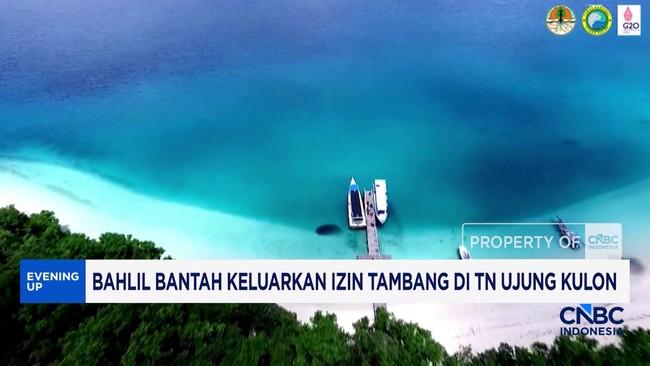
Jakarta, CNBC Indonesia — The Ministry of Energy and Mineral Resources (ESDM) has again confirmed that there are no mines in Ujung Kulon National Park (TNUK), following an inspection of the area by a joint team.
In an official statement, the ministry said its team of mining inspectors, accompanied by staff from the TNUK office and TNUK forestry police, surveyed the area by land and sea and conducted aerial monitoring using drones.
“The verification found no mining activity in the conservation area. ESDM Minister Bahlil Lahadalia also stressed that neither a Mining Business Licence Area (WIUP) nor a Mining Business Licence (IUP) has ever been issued within Ujung Kulon National Park,” the ministry said on Thursday (26 November 2026.
The joint team began its field inspection from Peucang Island. It surveyed the waters, checked several locations on the ground and carried out drone monitoring.
“The inspection was conducted by surveying the area by boat and monitoring it from the air with drones,” the ministry said.
Coordinating Minister for Downstreaming and Energy Bahlil Lahadalia sought to clarify reports that a Mining Business Area (WUP) had been designated within Ujung Kulon National Park in Banten. He said the government had never processed, let alone issued, a Mining Business Licence (IUP) or a Special Mining Business Licence Area (WIUPK) for the national park.
Bahlil, who also serves as ESDM Minister, explained that the Geological Agency’s inventory of potential mineral reserves is intended to map the country’s natural resources. He questioned claims that an operating permit for a mine had been issued in the Ujung Kulon conservation area.
“I’m confused: who says there is an IUP in Ujung Kulon? Since 2014, the state has designated areas with mining reserves. These are reviewed every five years. Areas were designated in 2014, again in 2017 and in 2022, based on proposals from regional governments. Mining areas do not include national parks,” Bahlil said after a press conference at the ESDM Ministry office in Jakarta on Monday (23 November 2026).
Bahlil said the Geological Agency checks locations across Indonesia, including volcanic areas, to assess the potential and availability of national mineral reserves, such as gold. Identifying a potential reserve in an area does not automatically lead to the issuance of a mining permit.
“There has been nothing at all. For example, the Geological Agency checks different parts of the country to calculate where our mining reserves are. If reserves are found, including in a volcano, that information is recorded as an area,” he added.
He emphasised that mining permits in Indonesia are subject to a lengthy, multi-stage administrative process. Once a location has been recorded on a potential-resources map, the licensing process must begin with the designation of a WIUPK before an IUP can be considered.
“Once a mining area has been identified, the next step is applying for a permit. That is the WIUPK, the Special Mining Business Licence Area. Only after that comes the IUP. So there is nothing at all—not even a WIUPK, let alone an IUP,” he said.
Bahlil acknowledged that gold reserves may be present in Ujung Kulon, but said the government would not recklessly damage the national park’s conservation function for mineral extraction.
“There are reserves, including gold. The state needs to know that they are there. But that does not mean a permit will be issued. Only an irrational person would issue a permit in a national park,” he said.
Source: jawawa.id (https://jawawa.id/newsitem/esdm-confirms-no-mining-in-ujung-kulon-after-on-site-inspection-1795701055)
Originally published by CNBC Indonesia (https://www.cnbcindonesia.com/news/20261126165650-4-788825/turun-ke-lapangan-esdm-pastikan-tak-ada-tambang-di-ujung-kulon), translated from Indonesian