
ERIA Says Regional Cooperation Can Strengthen ASEAN’s Energy Resilience
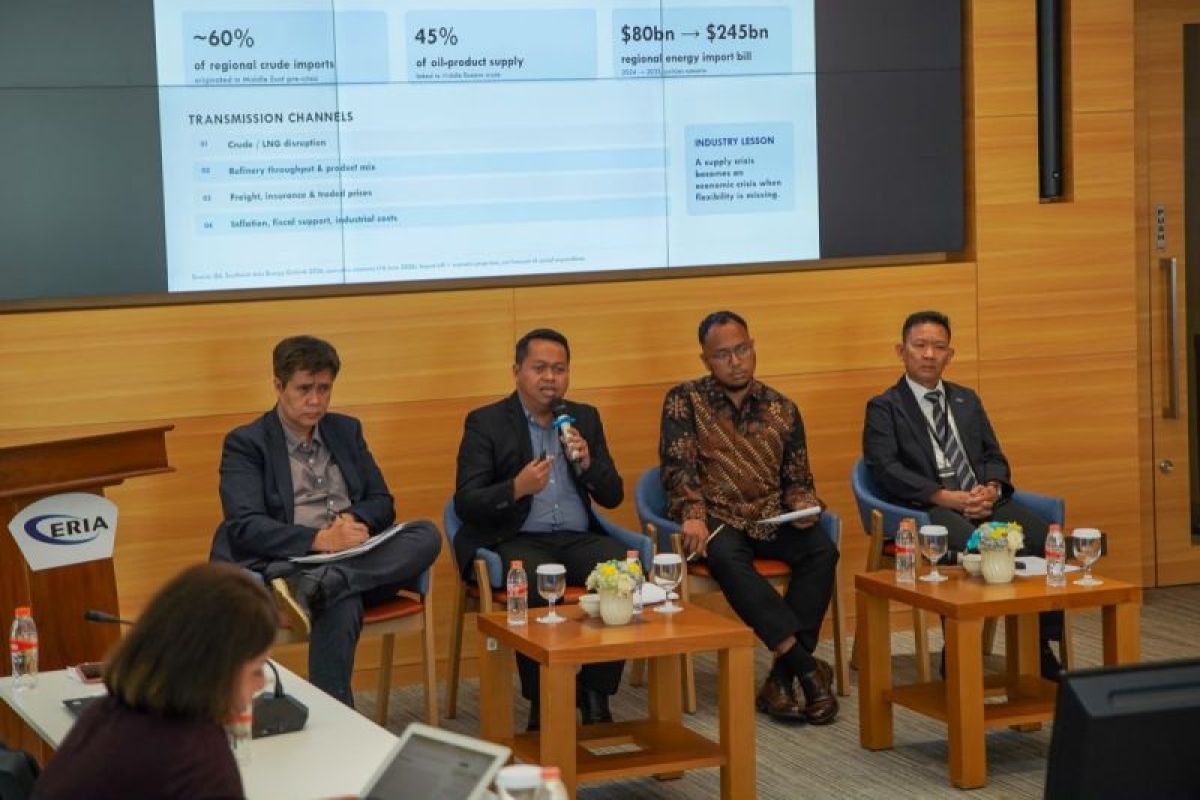
Jakarta (ANTARA) – The Economic Research Institute for ASEAN and East Asia (ERIA) is promoting regional cooperation to strengthen energy resilience and the competitiveness of ASEAN industries, through the 2nd East Asia Media Caucus in Jakarta.
“The forum, which brings together researchers and journalists from several ASEAN countries, is examining opportunities to reduce the cost of providing emergency oil reserves while encouraging businesses to shift to cleaner and more sustainable production processes,” ERIA Chief Operating Officer Takayuki Yamanaka said in Jakarta on Friday.
He said disruptions to global energy supplies underscored the importance of preparedness and cooperation among countries in addressing energy challenges.
Efforts to strengthen energy resilience, he said, should go hand in hand with green growth and digital transformation to boost competitiveness and deepen regional economic integration.
One potential area of cooperation discussed at the forum was the regional provision of emergency oil reserves.
ERIA estimates that cooperation among ASEAN countries could reduce the annual cost of providing and storing additional oil reserves to US$2.19 billion, or more than Rp39 trillion.
By comparison, if each country relied on its own national reserves, the cost would be US$2.80 billion, or more than Rp50 trillion a year.
With the same quantity of additional reserves, the regional cooperation model could save about 22 per cent, equivalent to US$610 million or more than Rp10 trillion annually.
Yamanaka said the calculations assume that the shared reserves would remain owned by producers or partners, while participating countries would have the right to use them under an agreement.
Emergency delivery and replenishment costs are calculated separately. The arrangement is an ERIA recommendation that would still require consideration and approval by the governments concerned.
ERIA Senior Energy Economist Han Phoumin explained that the right to use emergency reserves was only a first step. Each country would need clear procedures for releasing reserves, suitable fuels to meet its needs, and the means to deliver them where required.
“Through voluntary trials, governments and operators can test whether everything works properly before supplies are disrupted,” he said.
ERIA Senior Policy Fellow Intan Murnira Ramli said that, alongside strengthening energy supply preparedness, ASEAN also faced the challenge of maintaining industrial competitiveness amid demands for a transition to a greener economy and the adoption of digital technology.
Both agendas are important to help businesses in the region adapt to global change while taking advantage of new economic growth opportunities.
She said ASEAN’s future competitiveness would increasingly depend on the region’s ability to combine green growth, digital transformation and regional integration.
“Global change gives us opportunities to develop new industries, attract investment, strengthen value chains and create better jobs across the region,” she said.
ERIA survey findings on Japanese companies operating in ASEAN illustrate the progress and remaining challenges in achieving cleaner production.
Some 53.3 per cent of the companies surveyed had taken steps to reduce carbon emissions. However, only 7.1 per cent reported switching to lower-emission suppliers or encouraging their suppliers to reduce emissions.
A separate survey of local ASEAN companies found that smaller businesses were less likely than larger firms to take similar steps, particularly because of limited funding and technical capacity.
A similar gap was evident in the adoption of digital technology. Among the Japanese companies surveyed, 70.8 per cent cited a shortage of digitally skilled workers as an obstacle, while 64.7 per cent pointed to the high cost of adopting technology.
The findings highlight the need to invest in skills and technology development, and to widen access to finance so that more businesses, including small firms, can adapt to these changes.
To address these challenges, forum participants also discussed the importance of aligning standards and strengthening cross-border connectivity to support the region’s industrial competitiveness.
One opportunity discussed was the ASEAN Green Economy Framework Agreement (GEFA), which is expected to encourage investment and create business opportunities in the green economy.
Intan stressed that implementing the shared agenda would be crucial to ASEAN’s ability to develop new industries, strengthen value chains and create better jobs.
Source: jawawa.id (https://jawawa.id/newsitem/eria-says-regional-cooperation-can-strengthen-aseans-energy-resilience-1793962342)
Originally published by Antara (Indonesian) (https://www.antaranews.com/berita/5836703/eria-sebut-kerja-sama-regional-perkuat-ketahanan-energi-asean), translated from Indonesian