
Environmental Experts Reveal the Unexpected Facts Behind Opposition to Data Centres
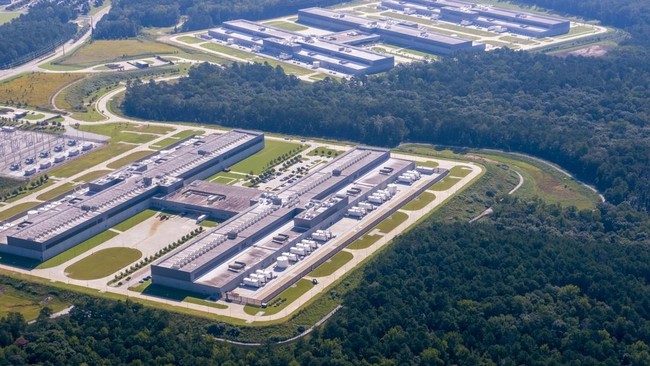
Jakarta, CNBC Indonesia – Artificial intelligence (AI) is increasingly becoming a key tool for environmental organisations around the world to protect nature. But the technology is also raising concerns because it requires large amounts of energy and water, particularly to operate data centres.
This has created a dilemma for environmental organisations: they must weigh AI’s benefits in protecting the planet against the environmental impact of the infrastructure that supports it.
Reuters reported that 15 major organisations working in the fields of the environment, conservation and development said they were using AI in various aspects of their operations. All of them also expressed concern about the environmental impact of data centres, which underpin AI technology.
Researchers at the United Nations University Institute for Water, Environment and Health estimate that the global physical footprint of data centres could more than double by 2030, reaching an area roughly twice the size of Jakarta.
The International Energy Agency (IEA), meanwhile, estimates that global data centre electricity consumption will reach about 945 terawatt-hours (TWh) a year by 2030. That is nearly double current consumption and equivalent to Japan’s annual electricity use.
Water consumption for cooling data centres is also projected to surge, from about 560 billion litres in 2023 to 1.2 trillion litres a year by 2030.
AI’s benefits are still considered greater
Despite this dilemma, some environmental organisations believe AI’s benefits currently far outweigh its harms. The technology enables them to carry out conservation work that was previously difficult, expensive or almost impossible to do manually.
One example is Conservation International, which uses AI to help detect potential forest fires in Cambodia.
The US-based non-profit uses satellite data to identify areas at risk of fire. Its AI system then helps send real-time alerts to forest patrol officers in remote areas that are ecologically sensitive.
“We recognise that AI can have an environmental impact, and that we need to use it wisely. But as the climate and biodiversity crises become more urgent, AI can help us move faster and make better use of the information we gather,” said Ali Swanson, Conservation International’s AI lead.
Save the Elephants, an organisation that works with the Wildlife Conservation Network, has seen similar benefits. It uses machine-learning technology to improve the accuracy of wildlife population surveys and study elephant communication patterns.
Save the Elephants chief executive Frank Pope said an aerial survey of Kenya’s largest protected area in 2017 produced about 200,000 images. At the time, nine people took up to nine months just to examine all the images manually.
Now, an AI model trained using Nvidia’s GeForce graphics platform can complete a similar analysis in a matter of hours.
“The results were really eye-opening. We found that human surveys had missed about a third of the elephant population, around half of the zebra and giraffe populations, and three-quarters of the oryx population,” Pope said.
He said more accurate wildlife population data could help organisations secure funding that is better targeted towards conservation work.
“Ultimately, these tools make nature measurable and, therefore, able to attract investment. This is an important transformation if we are to conserve biodiversity on a large scale,” he said.
More efficient processing of field notes
AI is also helping the Jane Goodall Institute digitise decades of field notes on chimpanzee behaviour in Tanzania’s Gombe National Park.
Digitising the handwritten notes was previously expected to take 13 to 15 years because the documents use the local Kiha language and specialised scientific abbreviations.
With the help of a tool developed in partnership with Amazon Web Services (AWS), the notes can now be scanned, translated and organised in minutes. A project once expected to take well over a decade can now be completed in about two years.
Lilian Pintea, vice-president of conservation science at the Jane Goodall Institute, said the late Jane Goodall supported the use of AI to advance conservation science, provided that humans retained full control of the technology.
“AI technology should be viewed as a tool that remains human-centred,” Pintea said.
Source: jawawa.id (https://jawawa.id/newsitem/environmental-experts-reveal-the-unexpected-facts-behind-opposition-to-data-centres-1794214243)
Originally published by CNBC Indonesia (https://www.cnbcindonesia.com/tech/20261109125825-37-783523/tolak-data-center-pakar-lingkungan-ungkap-fakta-tak-terduga), translated from Indonesian