
Environment Ministry: Palm Oil Companies Need to Strengthen Emissions Inventories
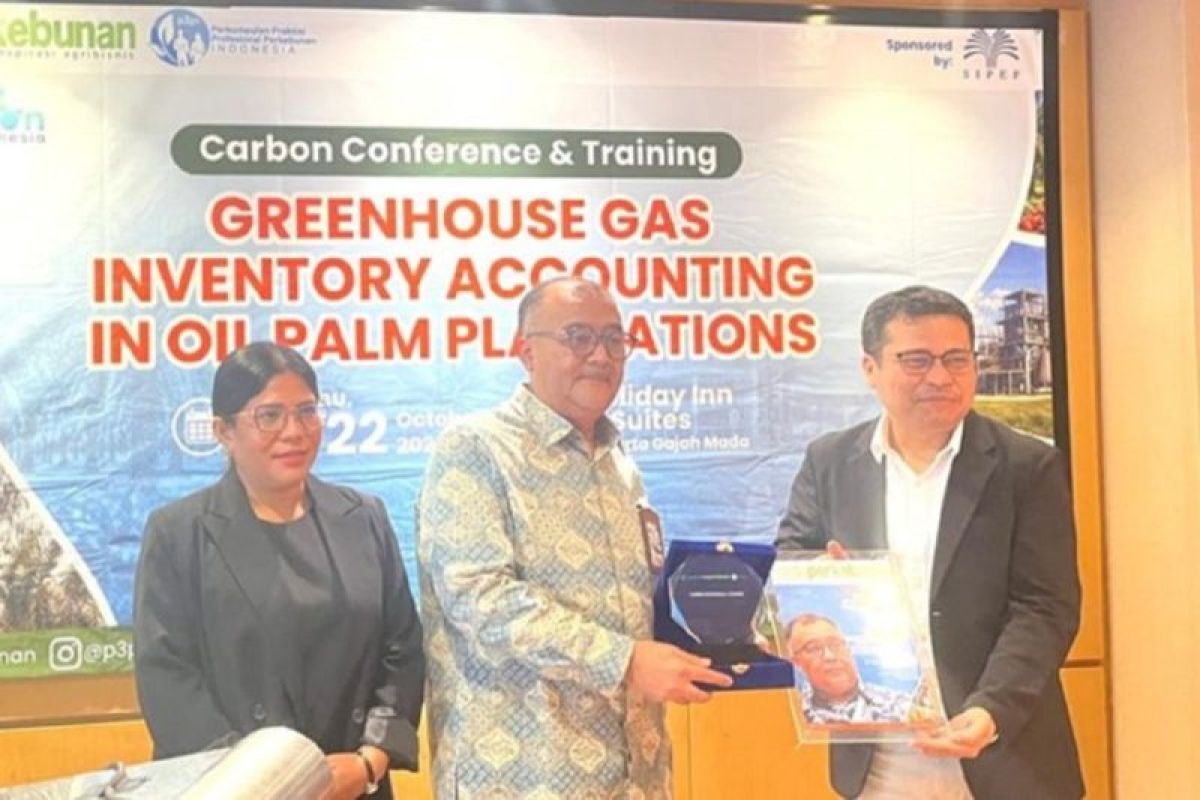
Every emissions figure must have a clear basis, from its data source and calculation method to the party responsible.
JAKARTA (ANTARA) — The Ministry of Environment/Environmental Control Agency (KLH/BPLH) has stressed that emissions inventories should be more than a record-keeping exercise: they should inform decision-making at palm oil companies.
Ary Sudijanto, deputy for climate control and carbon economic value governance at KLH/BPLH, said palm oil companies needed to strengthen data recording, use appropriate calculation methods and prepare documentation that could be traced.
“Every emissions figure must have a clear basis, from its data source and calculation method to the party responsible,” he said in a statement in Jakarta on Thursday.
Speaking at the opening of the Carbon Conference & Training, entitled “Greenhouse Gas Inventory Accounting in Oil Palm Plantations”, he said company leadership support was also essential to ensure emissions inventories were maintained on an ongoing basis.
The transformation of the palm oil industry towards low-carbon practices, he said, required data to be connected with investment decisions and operational activities.
“Therefore, emissions calculation and inventory should be positioned as part of corporate management,” he said, representing Environment Minister and BPLH head Moh Jumhur Hidayat.
Involvement from plantation, mill, energy, procurement, finance and sustainability teams is needed to help companies establish a baseline, set priorities for improvement, take mitigation measures and evaluate results.
Alongside improving inventories, emissions calculations need to be translated into tangible reductions. One opportunity highlighted was the management of palm oil mill effluent (POME), particularly by capturing and using methane gas to reduce emissions while generating energy.
“I encourage businesses to view POME management as part of a strategy to improve corporate performance, bringing together environmental management needs, mitigation potential and investment viability,” Ary said.
He said facility-level emissions data were crucial to identifying mitigation measures, assessing technology performance and demonstrating the results of emissions reductions.
That foundation could also support the development of carbon market instruments, including the possible gradual introduction of emissions trading for industrial wastewater management such as POME.
Developing carbon economic value in the palm oil sector also requires integrated management from upstream to downstream. Cultivation, processing, waste management, and the use of products and by-products should be treated as interconnected parts of a single chain.
Policy alignment, clear accounting boundaries, connected data and traceable records of mitigation results are therefore important.
KLH also stressed the need for partnerships that link investment needs and operational improvements with ecosystem protection, respect for community rights and stronger capacity among smallholders.
Transparency and a fair distribution of benefits are expected to ensure that the low-carbon transition benefits all participants across the palm oil value chain.
“Let us strengthen collaboration to build a more efficient, responsible and competitive palm oil industry through measurable emissions management,” he said at the event, organised by the Indonesian Association of Plantation Professionals (P3PI) and Media Perkebunan.
The Carbon Conference & Training is expected to provide a forum for collaboration among the government, plantation companies, academics, practitioners and other stakeholders to promote more measurable greenhouse-gas management and open up opportunities to develop carbon economic value for Indonesia’s palm oil industry.
Source: jawawa.id (https://jawawa.id/newsitem/environment-ministry-palm-oil-companies-need-to-strengthen-emissions-inventories-1792662822)
Originally published by Antara (Indonesian) (https://www.antaranews.com/berita/5804541/klh-perusahaan-sawit-perlu-perkuat-inventarisasi-emisi), translated from Indonesian