
Environment Ministry and MUI Launch Ecological Repentance Campaign
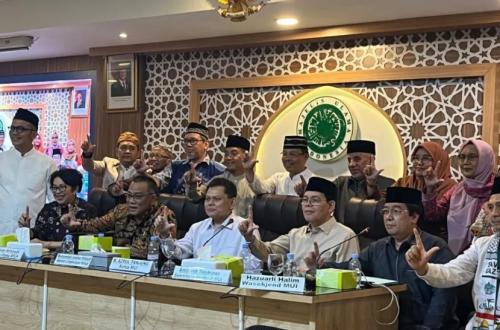
JAKARTA – Restoring environmental damage requires concrete action from the government, businesses and the public, rather than simply changes in individual behaviour. The Ministry of Environment (KLH) has stressed the importance of improving regulations and oversight, and enforcing the law against companies that fail to meet their environmental restoration obligations.
Environment Minister Jumhur Hidayat said companies that profit from their business activities must take responsibility for the resulting environmental impacts. The government will take a phased approach, from issuing warnings to pursuing legal action if companies disregard their obligations.
“If a warning has no effect, we will compel them. If that still does not work, we will pursue tougher measures. That could lead to criminal proceedings and disputes that are extremely damaging to the company itself,” Jumhur said during a visit to the Indonesian Ulema Council (MUI) office in Jakarta on Friday (23 October 2026).
Jumhur said responsibility for environmental restoration did not rest solely with businesses. The government also needed to review policies and oversight that had not been working effectively, in order to prevent further environmental damage.
These reforms are among the principles of the Ecological Repentance campaign developed by KLH and MUI. The campaign emphasises three steps: acknowledging harm to the environment, committing not to repeat it, and taking concrete action to repair damage that has already occurred.
“If regulations should have been drawn up to ensure the public behaves responsibly towards the environment, but have not been, then they must be introduced now. The same applies to oversight: if it should be rigorous but has not been effective, it must be improved,” Jumhur said.
Jumhur explained that the principles of Ecological Repentance apply to all parties according to their responsibilities and authority. For the government, this means improving rules and making oversight more effective, while companies are obliged to manage and restore the environmental impacts of their activities.
Environmental restoration also has an economic dimension, he said. Large-scale restoration could create green jobs, employ workers and increase demand for the goods and equipment needed to support ecosystem recovery.
This potential shows that environmental restoration is not only about controlling damage to nature. Restoration work can also open up economic opportunities through demand for labour and production activities that support environmental recovery.
To broaden public involvement, KLH has partnered with MUI on the Ecological Repentance campaign. The collaboration aims to connect environmental protection with religious values as a foundation for changing behaviour.
“Honouring the environment is a collective movement. The government is only one part of it. That is why the government needs to work together with MUI, because environmental issues also concern awareness and religious commitment,” Jumhur said.
Jumhur said the public also had a responsibility to reduce activities that harm the environment. Behavioural change could start with saving energy, including switching off air conditioning and lights when they are not in use, and reducing wasteful consumption of energy derived from fossil fuels.
The public is also being urged not to litter and to change everyday habits that could damage the environment. However, individual changes must be accompanied by better policies and compliance from businesses.
MUI Secretary-General Amirsyah Tambunan welcomed the partnership with KLH to develop the campaign. He said religious values could provide a foundation for building shared awareness of the need to protect and restore the environment.
Amirsyah said behavioural change could begin with individuals and their families, and extend to the wider community. He also noted that MUI had issued a fatwa declaring acts that damage the environment haram, or forbidden under Islamic law.
“May this be part of our efforts to improve the environment and regulations, and to engage all sections of society. Let us save the environment and honour it, because MUI has issued a fatwa that damaging the environment is forbidden,” Amirsyah said.
The KLH–MUI partnership is expected to broaden public involvement in environmental restoration. Meanwhile, the responsibilities of government and companies will require improvements to regulations and oversight, as well as law enforcement, to ensure environmental damage is addressed in practical terms.