
Environment Minister: National Bamboo Planting Movement to Rehabilitate Land
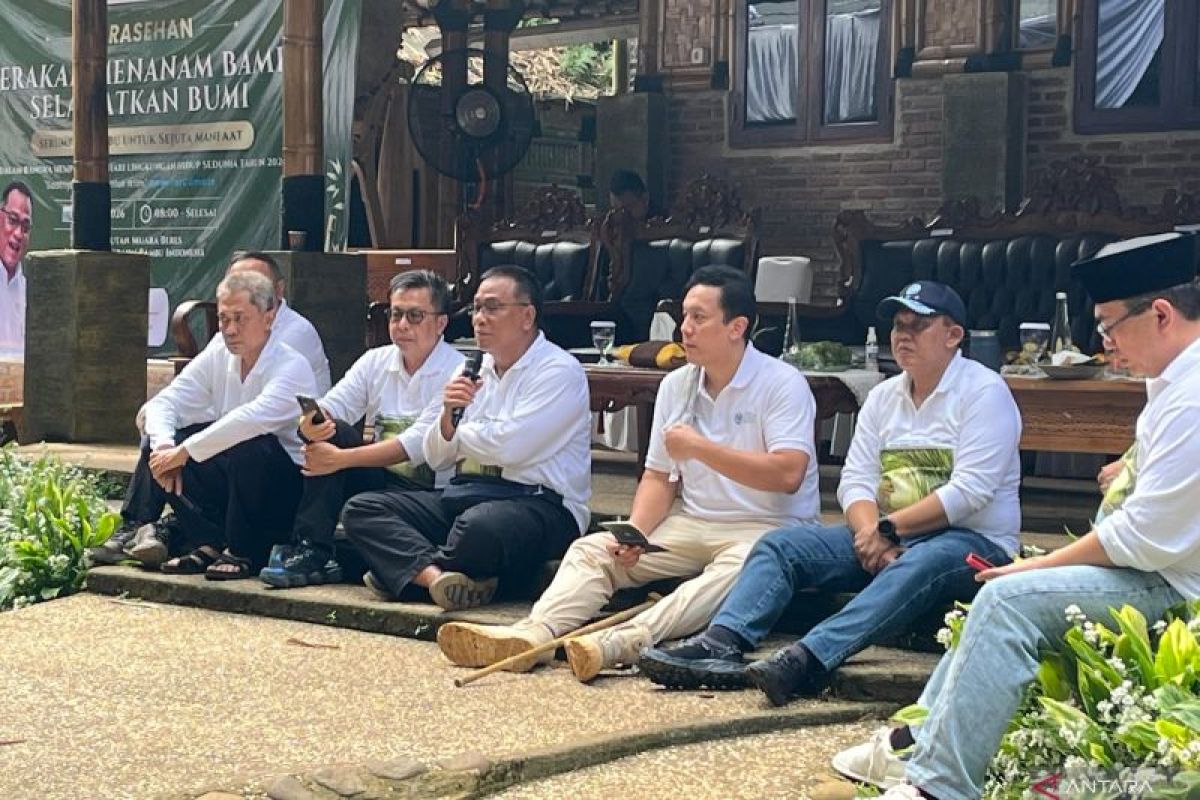
The bamboo planting activities carried out by communities and the public serve as evidence of effective collaboration between the government and environmental groups in preserving nature.
Bogor Regency (ANTARA) - The Minister of Environment/Head of the Environmental Management Agency (BPLH), Moh. Jumhur Hidayat, has launched a national bamboo planting movement to support the rehabilitation of critical lands as part of the ‘national ecological repentance’ programme currently being devised by the government.
Speaking while attending a bamboo planting event with the Indonesia Bamboo Foundation in Cibinando, Bogor Regency, on Sunday, Jumhur stated that environmental preservation movements cannot rely solely on the government but must become a collective movement involving the public.
“The environmental movement does not belong to the government alone; rather, its primary ownership lies with the community,” said Jumhur.
According to Jumhur, the bamboo planting activities conducted by communities and the public demonstrate good collaboration between the government and environmental groups in maintaining nature’s sustainability.
He noted that the government will continue to encourage similar movements in various regions because they offer significant benefits for both environmental rehabilitation and community empowerment.
Jumhur revealed that the government requires a large supply of bamboo seedlings to support the national environmental recovery programme.
“Currently, perhaps only about 5,000 bamboos are being planted here, but eventually, millions, even tens of millions of bamboos could be planted from Sabang to Merauke,” he said.
Jumhur stated that the bamboo planting movement is one of the efforts to recover critical lands, which cover approximately 12.4 million hectares in Indonesia. Therefore, the Ministry of Environment will build collaborations with various parties, including communities and bamboo activists, to ensure the availability of seedlings to support the movement.
“We need many bamboo seedlings and many people who understand the issues surrounding bamboo. This is a massive undertaking,” he said.
In addition to bamboo, Jumhur also emphasised that the government continues to encourage the rehabilitation of damaged mangrove areas. Out of the total approximately 3.4 million hectares of mangroves in Indonesia, about 700,000 hectares are currently damaged.
According to him, mangroves have the capacity to absorb carbon dioxide up to four times more than ordinary vegetation and provide economic benefits to coastal communities.
“Mangroves can be a source of livelihood for the community. If the mangroves are healthy, many economic activities can be undertaken, ranging from crabs and fish to other processed products,” he said.
On that occasion, Jumhur also expressed his appreciation for the Bogor Regency Government’s programme, which targets the development of at least one hectare of urban forest in every sub-district.
He stated that the central government is ready to support the provision of seedlings through various collaborative schemes.
“I respect the Regent’s spirit. If it could be two or five hectares, that would certainly be better, but we still value a minimum of one hectare,” he said.
According to Jumhur, the government has a long-term target to plant approximately two billion trees as part of the efforts to restore the environment and improve the quality of the national ecosystem.
Source: jawawa.id (https://jawawa.id/newsitem/environment-minister-national-bamboo-planting-movement-to-rehabilitate-land-1781423536)
Originally published by Antara (Indonesian) (https://www.antaranews.com/berita/5607587/menteri-lh-gerakan-nasional-tanam-bambu-untuk-rehabilitasi-lahan), translated from Indonesian