
Environment Minister: Concession Holders Obliged to Protect Land from Forest Fires
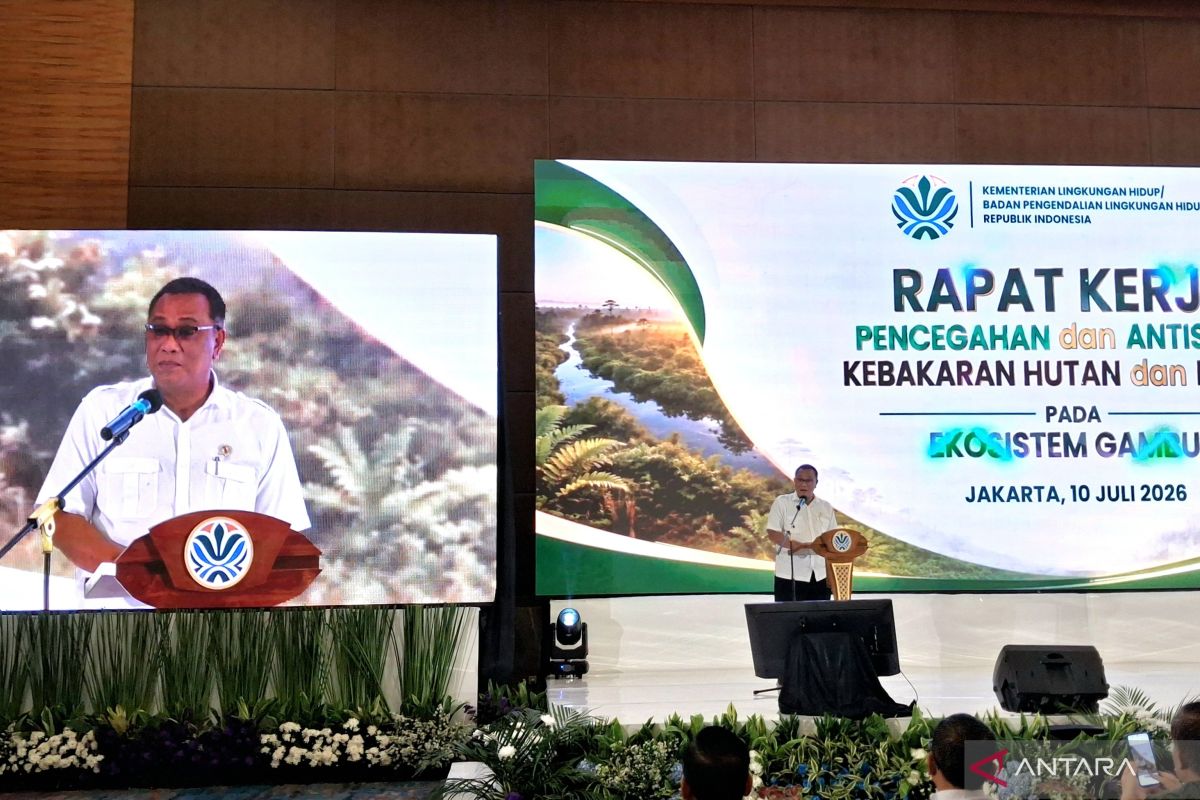
Jakarta (ANTARA) – The Minister of Environment (LH)/Head of the Environmental Control Agency (BPLH), Moh. Jumhur Hidayat, has affirmed that companies holding concessions across Indonesia are obliged to help protect the peatland ecosystems surrounding their areas from forest and land fires (karhutla).
“Regarding forest and land fires, every country has its own measures, including us. Today we held a large meeting with nearly 400 companies holding concessions ranging from 100,000 to millions of hectares, including palm oil and other industrial forest plantations. We want to make sure first that no fires occur in their concession areas,” he said in Jakarta on Friday.
He stressed that companies are also obliged to safeguard their land to prevent hotspots that could potentially trigger fires, through mitigation measures that can be carried out in various ways. One such method is raising the groundwater table by blocking canals filled with water, so that the water flow remains within the land area and does not drain into rivers or elsewhere.
“So it is dammed so that the water irrigates the concession area, ensuring the peat does not dry out, even several metres down. Peat does not burn if it is waterlogged, meaning it stays wet at all times. Therefore, one method used is to block the water flow so that it collects around the area. This is called peat re-wetting,” he said.
Jumhur also emphasised that beyond concession boundaries, companies bear a social responsibility to protect areas several kilometres from their concessions so that fires do not occur. This needs to be done through collaboration with local communities, regional governments, and community groups to build canal barriers.
“They (the companies) are also tasked with taking responsibility up to five kilometres from their concession areas to help with the re-wetting of those canals. We still need to carry out a great deal of canal blocking, especially under El Niño conditions, where we may need tens of thousands of barriers in the coming months, because this El Niño is expected to last a long time,” he said.
According to data from the Ministry of Environment, the area of revegetation — the replanting and restoration of peatland — has continued to increase throughout 2021–2026. In 2021, some 114,000 hectares of peatland were revegetated, and the figure has continued to rise, reaching more than 168,000 hectares in 2026.