
Environment Minister at COP31: Net-Zero Transition Must Create New Economic Opportunities
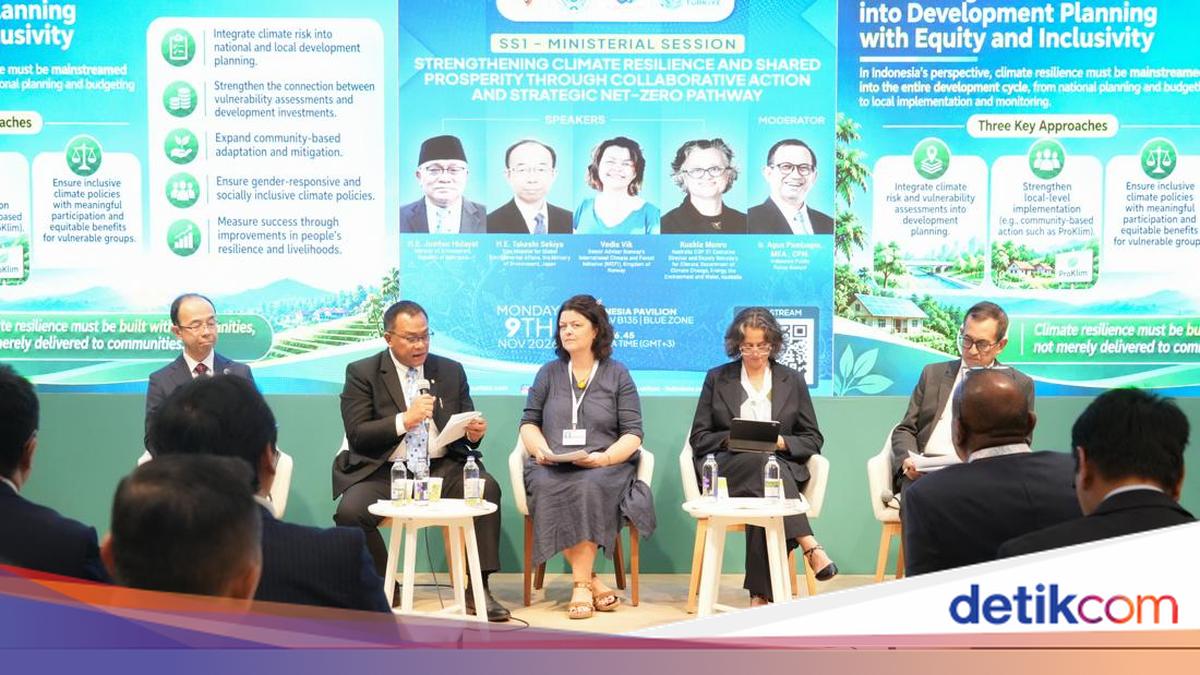
Environment Minister Jumhur Hidayat stressed that efforts to achieve net-zero emissions must go hand in hand with strengthening climate resilience and improving public welfare. The transition to a low-carbon economy, he said, should not focus solely on reducing emissions but should also open up economic opportunities.
Jumhur made the remarks at an Indonesian pavilion event at the 31st UN Climate Change Conference (COP31) in Antalya, Türkiye, on Monday (9 November 2026). The session was themed “Strengthening Climate Resilience and Shared Prosperity through Collaborative Action and Strategic Net-Zero Pathway”. He said the transition should expand access to energy, create jobs and ensure that no groups in society are left behind.
Jumhur said climate resilience needed to be integrated into every stage of development, from national planning and budgeting to implementation in the regions, monitoring and evaluation. Climate risks and vulnerabilities, he said, must be taken into account in decision-making across sectors.
“The fundamental principle we must uphold is that climate resilience is built together with communities, not merely presented to them,” Jumhur said at the forum.
Adaptation policies, he said, could not operate as environmental programmes separate from the development agenda. National policies needed to be translated into practical action at local level, including through the Climate Village Programme (ProKlim), which gives communities a direct role in climate change adaptation and mitigation.
Jumhur said cross-sector collaboration was needed to address climate change, involving central and regional governments, the private sector, academics and civil society.
Such collaboration should be underpinned by a clear division of responsibilities, measurable targets, and integrated monitoring and evaluation systems. Indonesia also regards fairness and inclusivity as essential elements of the low-carbon transition, he said.
Women, young people, Indigenous communities, coastal communities and other vulnerable groups must have opportunities to participate and equal access to the benefits of climate policies.
“Net zero must not mean zero economic opportunities. It must be a transformation towards a more competitive, inclusive and sustainable economy,” he said.
Jumhur said the clean energy transition needed to go hand in hand with the creation of decent jobs and improved access to energy. Meanwhile, nature-based solutions—including forest protection, peatland and mangrove restoration, and sustainable land management—were being strengthened to reduce emissions while safeguarding public welfare.
On carbon markets, international partnerships and financing, Indonesia regards high-integrity carbon markets, climate finance and technological innovation as important instruments. Under Article 6 of the Paris Agreement, international carbon-trading cooperation must deliver credible and transparent emissions reductions and prevent double counting.
Jumhur added that Indonesia was pushing to widen developing countries’ access to concessional finance, blended finance and technology transfer.
“The main measure of our climate ambition is not only how much carbon emissions we manage to reduce, but also how many lives we can protect and how much shared prosperity we can create,” he concluded.
Source: jawawa.id (https://jawawa.id/newsitem/environment-minister-at-cop31-net-zero-transition-must-create-new-economic-opportunities-1794297080)
Originally published by detikcom (https://news.detik.com/berita/d-8746517/menteri-lh-di-cop31-transisi-zero-emisi-harus-ciptakan-peluang-ekonomi-baru), translated from Indonesian